
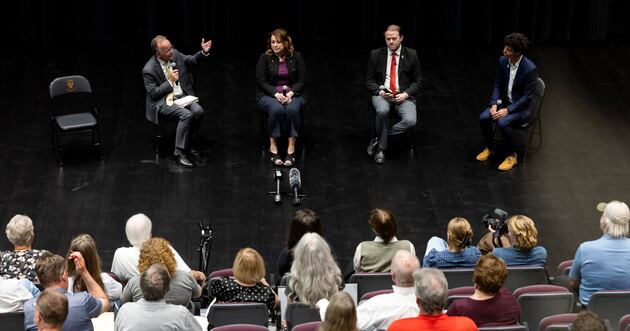
- Utah Senate President Stuart Adams faced criticism from Republican challengers Stephanie Hollist and Braden Hess over his role in approving the Stratos data center project.
- The candidates clashed over how Utah should balance economic growth and data center development with environmental concerns, with Adams defending the project as an investment in energy resilience and critics calling for more transparency.
- The debate also centered on the role of the Military Installation Development Authority, with Hollist and Hess arguing MIDA has grown too powerful while Adams defended it as a tool that supports projects tied to Hill Air Force Base.
As Utah Senate President Stuart Adams, R-Layton, navigates a complicated primary for re-election, he met a difficult crowd on Tuesday night.
Read more Defamation claims and AI ads — inside the messy GOP race for Utah’s 2nd District
He joined the two other Republican candidates for District 7 Senate seat at Sunset Junior High for an informal debate, hosted by a Great Salt Lake advocacy group, Grow The Flow.
Just one week out from Utah’s primary elections, the large-scale data center in Box Elder County was the focus of the candidates’ discussion.
Republican candidates Stephanie Hollist and Braden Hess took shots at Adams for his involvement in approving a special zoning agreement through his role as chair of Utah’s Military Installation Development Authority, or MIDA.
Development of the data center, formally known as the Stratos Project, was originally approved to stretch across 40,000 acres in Hansel Vally, just north of the Great Salt Lake. However, O’Leary has promised to reduce the project size to 20,000 acres, at Adams’ request.
The project has become widely unpopular in the state, with just over half of Utahns saying they do not support it.
Candidates debate how to balance industry and the environment
When asked for their vision for water management in Utah, Hollist began her answer by saying, “I might start by not proposing the largest data center in the country.” The audience of about fifty cheered.
“What is this (data center) really going to do to our aquifers? What is this really going to do to our environment? We’ve heard lots of vagaries. We’ve heard lots of of promises,” Hollist said, then said Utahns deserve more transparency about the project.
Grow the Flow Executive Director Ben Abbott moderated the conversation. He asked the candidates how they would manage the pressure to build data centers and balance environmental concerns.
Adams began, “I’d love to start because it’s not my position. It’s a legislative position.”
The state Legislature has encouraged data centers to come to the state for the past five or six years, he said.
Adams said the Legislature and entities within the state pursued data center development to help Utah’s struggling energy infrastructure. He said the center will likely generate more energy than it will consume, then sell excess energy to residents.
Once built, the Stratos Project is said to provide computing, AI capability and energy resilience for national defense operations.
Read more This Utah city was ranked atop nation’s largest cities — why one city leader says that is
Should MIDA exist?
Hess and Hollist said they didn’t believe MIDA should exist, while Adams defended its usefulness in keeping Hill Air Force Base in Utah.
Hill generates about $12.7 billion in annual economic revenue.
Hess said he believes MIDA should be dissolved so decision making will happen solely by local governments. “I don’t believe MIDA should exist,” he said. “I believe that MIDA has really lost its original intent. It’s bloated to the point where it’s not quite recognizable.”
Hollist claimed MIDA breached the separation of powers described in the state’s Constitution. “What we’re seeing is an entity that has grown so big and has so many tentacles to unravel it will be challenging,” she said.
“We’re also seeing that MIDA is able to override land-use decisions and give developers benefits that a normal entity isn’t given,” Hollist continued. “There’s an energy tax benefit that is usually 6%. That was reduced to 0.5% for this project. Who is it that gets to make that call?”
She then accused Adams of having a conflict of interest. “Am I speaking with President Adams, the state Senate president, or Stuart Adams, the chair of the board of MIDA? Because there are two hats being served right here,” she said.
Adams responded in defense of the state agency. MIDA “has no authority to go to Box Elder County. It’s only if the local authority in the county acts — that’s why we act,” he said.
“Every city has input on everything it (MIDA) does. So they’re really an extension of that local government, but they’re able to do more,” he explained.
Would the candidates support a referendum against the project?
A group of voters from Box Elder County applied to add a referendum to the November ballot to overturn the county commission’s approval of the data center after the commissioners approved it unanimously.
After Box Elder County Attorney Stephen Hadfield denied the legality of the referendum, the group announced that it filed an appeal in Utah’s 1st District Court.
Abbott asked the senate candidates if they would support a referendum.
Hollist said she would support both initiatives and referendums, Hess said he supported both, and Adams said he supported referendums and opposed initiatives.
Hess seemed to at least partially agree with Adams. “It should not be mob rule. So having to wait until the next election is absolutely vital in keeping a continuous flow of a peaceful, really cohesive society. If every time there was a passionate movement where society as a whole just was very enraged over something, we would not have a society at all,” Hess said.
Read more Is federalism the key to restoring faith in elections?