
Western energy has a wiring problem.
Not in the sense that the lights are going out — though in some parts of the region that’s becoming a real risk. The wiring problem is about transmission lines: the high-voltage infrastructure that moves power from where it’s generated to where it’s consumed.
Read more Opinion: In Utah, public lands are where politics should tread carefully
These transmission lines are like roads for electricity — and the ones that already exist are increasingly congested. Building new ones is maddeningly slow, in part because a transmission line that crosses state lines has to run a permitting gauntlet in every state it passes through.
Thankfully though, Utah Gov. Spencer Cox and 10 fellow Western governors are taking a serious shot at fixing that problem.
How leaders are tackling permitting complications for transmission lines
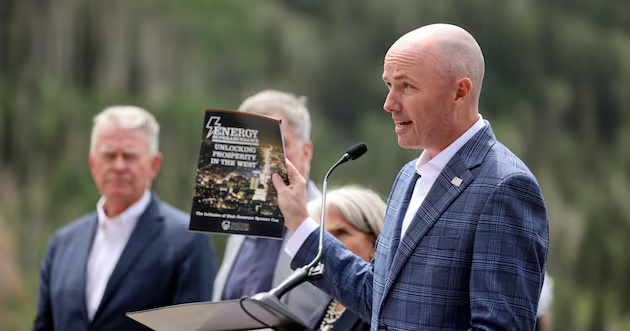
At the recent Western Governors’ Association annual meeting in Park City, Cox announced the the Transmission Permitting Alignment and Coordination Task Force — or PACT.
The bipartisan PACT was by the governors of Utah, Colorado, Wyoming, Nevada, Idaho, Oregon, Montana, North Dakota, Arizona, New Mexico and Washington.
PACT aims to solve the lack of coordination across different levels of government for major power grid infrastructure projects — a problem that adds years to construction times and can sometimes kill these projects outright.
When a developer wants to build a new high-voltage transmission line across the West, they don’t face one permitting process. They face a separate process for every state they cross, plus the federal process for federal land, plus tribal consultations, plus local approvals.
Each permitting process runs on its own timeline with its own rules. A project that clears one state’s process can sit stuck in another for years, with no mechanism to identify problems early or keep all parties moving together.
PACT creates that mechanism. By bringing Western governors and tribal nations into a formal coordination structure, it gives people a common table to sit around and work out conflicts before they become multiyear delays.
The 11 states in the PACT have also endorsed an ongoing study of energy transmission needs across the region, known as WestTEC. This study has already concluded that over the next 10 years, the Western U.S. will need 12,600 miles of new transmission lines and another 3,330 miles of upgrades to keep up with demand.
Read more Opinion: AI anxiety is real — so are Utah’s solutions
“We’re going to cut through the red tape,” Cox said at the PACT launch. “Modernizing our grid will show that we can continue to increase economic competition, ensure energy security and mitigate environmental hazards — all doing it together as Western governors.”
Gov. Cox’s emphasis on energy
Cox was right to highlight the importance of economic competition because transmission congestion is the enemy of energy affordability.
When electricity can’t move freely within states or across state lines, consumers pay for power from the nearest generator rather than the cheapest one. On the other hand, reducing bottlenecks expands choice and puts downward pressure on prices.
In a region where electricity demand is growing fast — about 30% over the next decade, according to the WestTEC study — that’s not an academic exercise. Reducing bottlenecks is what determines your monthly utility bills.
This may explain why eleven governors — from deep-red Wyoming to deep-blue Washington — all signed on as members of the PACT. A group of leading Republicans and Democrats agreed that building the Western grid is not a partisan issue. It’s a prerequisite for our economic future and a challenge too big for any state to solve on its own.
Cox has made energy his signature issue during his chairmanship of the Western Governors’ Association.
Earlier this year, he reached an agreement with the Trump administration to speed up federal permitting times in Utah. Back in 2024, the governor Operation Gigawatt, an initiative to double Utah’s capacity for generating electricity in just 10 years.
Together with PACT, these bold moves on energy are turning Utah and the broader West into a place where energy infrastructure can actually get built, the supply of energy remains robust and energy bills stay affordable.
Read more New study identifies link between air pollution and preterm birth