
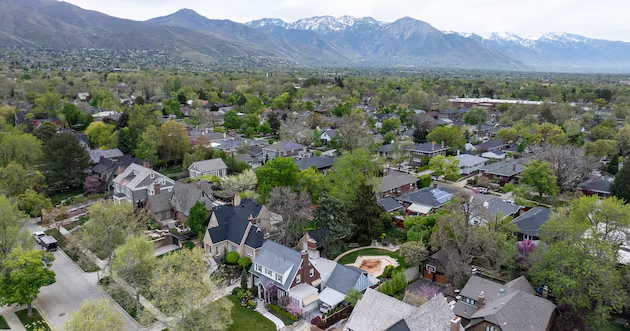
This month taxpayers around the state will receive their annual property tax valuation statement. This statement contains a list of the entities that levy a tax on your property which includes school districts, counties, cities and special service districts. From this notice taxpayers are informed if any of these entities are asking for additional taxpayer dollars or if they are keeping collections the same for the upcoming year.
Read more ‘It’s official’: Darline Graham Nordone announces Senate candidacy
This is a key document as it specifies each year how much the government is asking for, in property taxes, from its people. It is one of the few times taxpayers get a transparent statement from the government on how much government services cost but it is not the whole story.
It is important to remember that taxes are also paid on income made, often automatically deducted from a paycheck, and taxes are paid on many retail transactions but these are typically paid incrementally, not in one lump sum.
The Utah Taxpayers Association supports the lump-sum approach to informing taxpayers about the cost of their government. The sticker shock that comes from seeing how much government actually costs is something that keeps spending in check.
For many Utahns, property taxes range from $2,000 to $3,000 per year. When more is asked than that, taxpayers often turn out in large numbers to city councils and school district board hearings demanding accountability and justification for the additional dollars. In our opinion, that is a good thing.
How some cities are quietly adding more taxes
However, for some elected officials, the pain of having to increase that lump sum has caused them to look at other avenues to collect additional revenue. One area to be on the lookout for is your city’s utility bill. If you pay for water, garbage, power or other services to your city you may want to look at what else you are paying for.
In my city, Bluffdale, there is a line on our water bill titled “Public Safety Fee.” For us that fee is around $9 per month and funds some of the city’s police and fire services. That fee was implemented in 2024. Recently South Jordan instituted a fee on its utility bill to pay for maintenance and improvements of the city’s parks, trails, open spaces and the city cemetery. The fee is $5 a month or $60 a year per residence. Provo follows the original idea of putting a road fee on its utility bill which has a single-family home paying $4.20 a month and certain commercial properties paying as much as $269.93 a month.
This is an example of trying to lessen the blow of how much government services cost taxpayers. Instead of asking for a large lump sum, the cost is instead divided out over 12 months on a utility bill. You should check your city’s bill the next time you receive it to see if your city is collecting more than just money for its utility.
Transparency is needed for these fees and taxes
To help make you more aware of these fees we have worked with Rep. Karen Peterson, R-Clinton, the Utah League of Cities and Towns and other various stakeholders to ensure taxpayers are aware of these utility bill fees that pay for something other than the utility costs.
Under Peterson’s bill, HB425, transparency of these fees is enhanced and justification for these fees is increased. Cities also have to reauthorize the fees every 10 years under the legislation giving taxpayers the opportunity to let their elected officials know if they approve of this type of fee or not.
It isn’t the lump-sum approach that we prefer but HB425 is an improvement from what was being done in the past.
So while you are analyzing the property tax valuation notice you’ll receive soon in the mail to see which government might be asking for more of your hard-earned money, be sure to also check your city’s utility bill. You might find you are already paying for some services that you didn’t know about.
Read more Catholic nuns file lawsuit arguing medical aid in dying law threatens religious freedom