
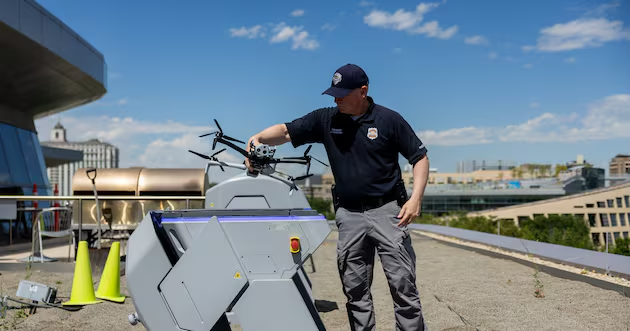
- Drone usage by law enforcement has nearly tripled since 2020.
- Acquisition of police drones raises concerns about public safety versus individual privacy.
- Drones may contribute to a “chilling effect” on public behavior, especially concerning public protests.
- Various states have differing laws regulating drone surveillance activities.
- The FAA prioritizes the safe integration of drones into national airspace for public safety.
A new face (or screen?) is entering the world of law enforcement technology: drones.
Read more Lightning strike sparks new wildfire east of Cedar City
Sacramento saw a nationwide first in June when a drone was used to successfully disarm an armed suspect, lowering the situational threat before law enforcement personnel moved in.
In a nationwide first, a drone was successfully used to disarm an armed suspect, helping bring the incident to a safe resolution.
Sacramento Sheriff’s Special Enforcement Detail (SWAT) had the residence surrounded. The known felon and Parolee-At-Large was seen earlier with a… pic.twitter.com/ZLiU5tEZxw
— Sacramento Sheriff (@sacsheriff) June 22, 2026
This event is one of many that demonstrates the growing use of drones in surveillance and enforcement agencies across the country, including in Utah.
As this technology spreads, however, many express concerns about how to balance public safety with individual privacy.
Drones are used by law enforcement agencies nationwide …
The pace at which the use of unmanned aerial vehicles (UAVs) is spreading is revolutionary. The number of law enforcement agencies operating drone programs has almost tripled since 2020.
From coast to coast, drone technology is being implemented to decrease response time and provide real-time information on critical situations.
UAVs have assisted in answering more than 20,000 calls and conducted more than 3,000 arrests in Chula Vista, California, a city in San Diego County. San Francisco police officers launched police drones almost 1,400 times in the first four months after they acquired them in May 2024.
On the other side of the country, in , police dispatched drones on more than 4,000 missions in 2024 to search collapsed buildings, communicate with individuals trapped behind a barricade, track suspects fleeing a crime scene and help with storm-related rescue efforts.
In Dallas, UAVs were used to assist in security for the FIFA Fan Festival. Millions of fans traveled to the Dallas-Fort Worth area to attend games at AT&T Stadium.
Officer Greg Lovell of the Salt Lake City Police Department said drones are an effective tool to assess lower-priority calls and determine if officer personnel are needed on the scene. Drones are also used to map fires, follow suspects and find missing people.
“It’s an excellent tool, and it’s really cost-effective,” Lovell told the Deseret News.
… but privacy concerns follow drones everywhere they go
“Drones are a very powerful surveillance technology,” Jay Stanley, privacy activist with the American Civil Liberties Union, told the Deseret News. “There’s a lot of potential for them to be used in ways that would not be great for privacy and freedom.”
Privacy concerns surrounding the use of police drones address the fact that UAVs can be hard to detect and may unnecessarily monitor public activity.
Before drones, most aerial surveillance was conducted through police helicopters, which have natural limits to widespread use, such as high costs and required labor from ground and maintenance crews.
Read more Forest Service determines what sparked Utah’s largest fire so far this year
Drones, however, are “fairly inexpensive, self-guided, self-docking (and) self-recharging,” Stanley said. They also can track people in “places where people are not accustomed to being in the public eye,” he added.
A 2023 study published in the Journal of Human Rights Practice found that public concern over surveillance may result in a “chilling effect” where individuals or groups change their behavior for fear of consequences if their behavior is observed by surveillance technology.
Stanley said this is particularly true as more agencies begin using police drones to monitor public protests.
“Having the police deploy a robotic flying video camera over your protest is an act of intimidation, and we’ve seen this become one of the primary use cases for law enforcement deployments of drones,” Stanley said.
“People should have a right to exercise their First Amendment rights in this country without feeling intimidated by law enforcement, without feeling like their identity is being recorded.”
Stanley acknowledged some circumstances where police drones are beneficial.
“If one of my children were lost in the woods, I would certainly love for police to use a drone to try and help find them,” he said. But he does not believe the benefits outweigh the cost in every situation.
“The question is whether there’s a slippery slope and people end up feeling like there’s police flying a robotic camera looking down on them from the minute they walk out of their house in the morning until they get home at night.”
Officer Lovell said his department uses drones exclusively to respond to calls and not for general patrol.
Is legislation the answer to balancing public security and personal privacy?
Laws outlining the permitted activity of police drones differ by state.
In Utah, law enforcement officers and agencies are only allowed to use UAVs if they are investigating a crime or searching for a missing person with a proper search warrant, and they cannot violate a reasonable expectation of privacy.
Utah otherwise prohibits drone surveillance of people and buildings. It is also the only state to do so while also prohibiting drone weaponization and drone interference with first responders, according to a 2026 report published by World Population Review. Other states prohibit an incomplete combination of those three regulations, and some states prohibit none.
The FAA will play a key role in establishing national guidelines on the use of drones, particularly concerning Drone as First Responder, or DFR, programs.
“DFR is a critical component of enabling real-time aerial situational awareness in advance of and to support ground units to enhance community and first-responder safety,” an FAA spokesperson told the Deseret News.
“Safely integrating drones into the National Airspace System is a key priority for the FAA. As drones become more prevalent in the law enforcement community, it is the FAA’s responsibility to make sure that they operate safely.”
Read more Letter to the Editor: How water usage is a necessary civic lesson for our kids