
- The Department of Energy selected Utah as one of five potential host states for a nuclear fuel life cycle innovation campus aimed at rebuilding the domestic nuclear fuel supply chain.
- Utah’s proposed Tooele County facility would focus on nuclear fuel recycling and processing, with state leaders emphasizing safety, community engagement and the potential for thousands of jobs.
- State officials say the project will move gradually under new Utah nuclear regulations, with federal approvals and additional DOE selections still required before plans can proceed.
The Department of Energy selected Utah, Idaho, Tennessee, Oklahoma and Louisiana to serve as potential host states for nuclear life cycle innovation campuses on Tuesday.
Read more Historic ‘fire clouds’ escalate wildfire epidemic in Spain and France
If the states continue with their plans, the campuses will support the full nuclear fuel life cycle, from fuel fabrication to enrichment, reprocessing and disposition.
American nuclear fuel production has sputtered to a near halt in the past several decades. In 2026, about 95% of the uranium used to generate nuclear energy was imported. Annually, average domestic uranium production is about 1 million pounds, while the U.S. consumes about 50 million pounds.
Across the country’s 57 active nuclear power plants, around 91,000 tons of spent nuclear fuel sit in cooling pools or dry casks. The DOE predicts that more than 90% of spent nuclear fuel’s potential energy can be reused, even after five years of operation in a reactor.
A Utah-DOE partnership in this space aims to “make the market and the supply chain domestic,” Emy Lesofski, the director of Utah’s energy development office, told the Deseret News.
The DOE has asked that a host agreement be finalized by Sept. 30.
The DOE will select the states down further. “I don’t know that every single state will make it through the whole process,” she said.
What might this site look like?
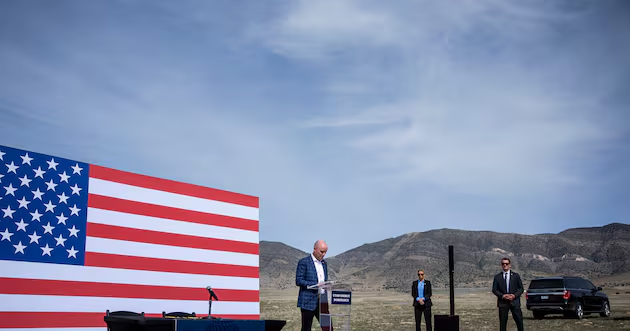
Utah Gov. Spencer Cox first announced his state’s intention to pursue a nuclear fuel recycling facility at the end of March. The proposed site is in Tooele County, on the southwestern side of the Great Salt Lake.
Standing in front of a massive American flag, Cox said such a facility could bring 10,000 jobs with it.
The area’s geology, arid climate, existing infrastructure and work force “make it one of the most practical locations for this kind of work,” Cox said.
He added that a host of private companies, both from in-state and out-of-state, had already expressed interest in building the facility.
Utah has signed a memorandum of understanding with the DOE laying out what they think the facility might look like, and “now we have to figure out in technical terms how to do it,” Lesofski told the Deseret News.
Read more SpaceX stock plunges. Is Elon Musk still the richest person in the world?
The fundamental goal of the facility, Lesofski said, is to “reassure the fuel cycle.” Eventually the facility may produce enough energy to power steel manufacturing, internet infrastructure or a variety of other things.
“If there’s enough power not just for the campus itself, you could power other things with it. But that is not at all the aim. The aim is to reassure the fuel cycle and do it safely and responsibly,” she said.
As the process has moved forward, the state is “not looking to do anything super rapidly,” Lesofski continued. “We want to make sure we understand everything as it goes through the process.”
She said the state will soon put out a Request for Information to companies interested in participating.
“When you think about something with the magnitude of impact of Hill Air Force Base, planning ahead is going to be really, really important,” Lesofski said. “Safety is our No. 1 priority, and second is making sure we’re good partners with the community.”
A slow and steady process
Utah’s state Legislature anticipated the development of this kind of facility during the state’s most recent session.
One law, HB78, established a state nuclear energy regulatory office, which oversees licensing, inspecting, enforcement and providing technical guidance for nuclear energy in Utah.
Given the federal Nuclear Regulatory Commission grants approval for specific projects, HB78 also gave Utah the ability to license aspects of nuclear fuel cycling, including uranium enrichment, fuel fabrication, fuel reprocessing and nuclear waste management.
“We believe in the permitting process,” Lesofski said. “We believe in protecting our air, land, water and people. We don’t want to do anything that isn’t suited for a specific place. So we’ll do the work and do what science tells us.”
The state sees nuclear energy as “safe, abundant, clean and reliable,” Lesofski continued. “In Utah, we like to contribute to our national security and our national defense. And having domestic energy that is reliable and clean is pretty fantastic. We have the ability to play a strong role in that, and we’re excited about it.”
Read more Rep. Burgess Owens says progressives are getting involved with GOP primaries to shift Utah leftward