
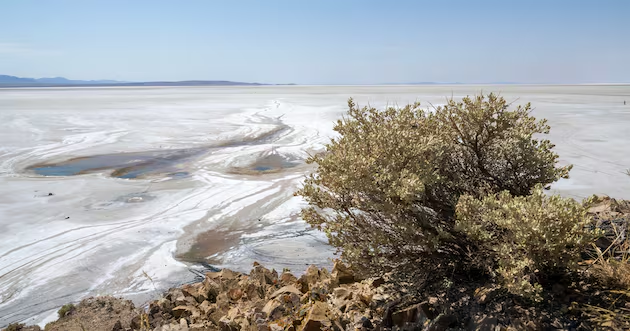
Utah has spent several years building an impressive policy machine around the Great Salt Lake. After the lake hit a historic low in 2022 that signaled environmental collapse, the legislature has passed bills, created programs, appropriated hundreds of millions of dollars, and established the Office of the Great Salt Lake Commissioner. The state has funded agricultural optimization, turf removal, secondary-water metering and water infrastructure improvements.
Read more ‘She was so loved’: Community holds vigil for former Miss American Fork who died Sunday
But the lake doesn’t need money. It needs water.
With fundamental policies in place (and more to come), Utah should now measure every Great Salt Lake action by how much additional water it puts in the lake. That requires a basin-wide water budget based on depletion, not diversion.
What is depletion?
A diversion is water withdrawn from a river, reservoir or aquifer. Some diverted water is consumed, but some returns through streams, groundwater, wastewater discharge or irrigation return flows. Depletion, on the other hand, is the water that doesn’t return because it evaporates or is transpired by plants and is no longer liquid.
Great Salt Lake, the terminus of the regional hydrologic system, responds to depletion. It has been declining because we have depleted too much from its water balance.
Indoor water use has a limited effect on the lake; most of the water returns there anyway. It’s just being borrowed. However, outdoor water use in the basin, for farms and lawns, is far more impactful. Studies from 2025 estimate that agriculture depletes about of water per year, and landscape irrigation depletes about of water per year.
To recover in a reasonable time, Great Salt Lake needs about 1,000,000 acre-feet — extra — each year. It’s a hard number to grasp. Imagine one Olympic-size swimming pool rolling by your home every minute, all day, every day, year over year. Where can we find that much water? And get it to the lake easily and promptly? The problem is not going away.
Read more ‘This isn’t a close case,’ state tells judge in Tyler Robinson case
Water conservation focused on reducing depletion
Some alternatives, like pumping water from the Pacific Ocean or waiting for Mother Nature to bless us with a decade of above-normal snowpack, cost too much, take too long or shove the responsibility outside the state lines. That’s not the Utah way. Others are concerned about the state’s growing population, but that has little impact on water demand: Utah’s municipal water use peaked around 2000 and we’ve added over 1 million people since then while using less water, following a beneficial pattern throughout the West. Population growth and economic growth don’t require more water.
Water conservation focused on reducing depletion is the and the fastest option — and it’s in our control. Reducing outdoor water use, on farms and in cities and by invasive plant species, is how we save Great Salt Lake. That’s where the water must come from. There is nowhere else. In the long term, Great Salt Lake will improve only if we reduce upstream depletion. Nothing else matters.
As recommended in a , state officials should determine how much depletion the basin can sustain while maintaining an acceptable lake elevation. They should then allocate the budget among subbasins and water users. The saved water — that is, water not depleted as it was before — could accumulate in existing reservoirs and be measured and released late in the fall when no downstream users need it, and when it therefore has the greatest chance of reaching Great Salt Lake.
Hannah Freeze, Utah’s new Great Salt Lake commissioner, has an unusual opportunity to make depletion accounting the lake’s new strategy. Her office could work with federal, state and local partners — in their many existing programs — to publish an annual water budget, identify needed reductions and pursue tangible benefits for our home lake.
We have built the policy machine; now we must make every policy answer to one measurable outcome: less depletion upstream and more water in Great Salt Lake.
Read more High school football: Defending 3A champion Cedar squeaks past competition in 3A South projections