
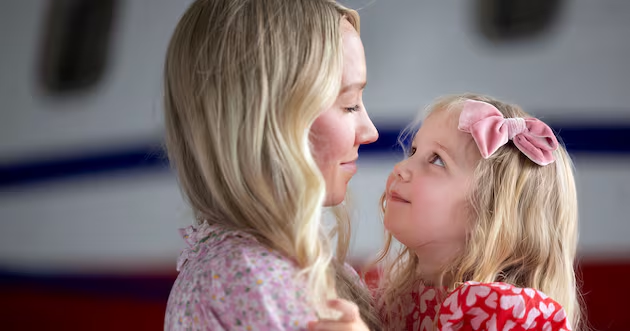
- Estelle Santiago, then 3, was gravely ill in a hospital in Uruguay and in danger of not surviving.
- Intermountain Health dispatched jet to bring her to Utah, providing advanced medical care on the 18-hour flight.
- The girl spent several weeks at Intermountain Primary Children’s Hospital and is expected to make a full recovery.
Estelle Santiago will never remember her flight home from Montevideo, Uruguay. The then-3-year-old was in a coma. She had heart failure and kidney failure that had placed her on continuous dialysis while she was in the hospital there. Her body was shutting down. A machine was breathing for her and she had multiple infusions going for her heart and her brain. She’d also had a brain bleed.
Read more 4 Olympic policies the NHL should adopt
Her life was visibly leaving her body, said her dad, Michael Santiago. And they were thousands of miles from their Midway, Utah, home.
The journey she will never remember is one that her family — and the medical team that rescued her — will never forget.
A desperate plea for help
Michael Santiago, his wife Ellie and their little girls Estelle, then 3, and baby Bianca flew to South America Dec. 13 to see his parents, who were serving a mission for The Church of Jesus Christ of Latter-day Saints, and to enjoy a few weeks’ vacation. They were all having a great time until Estelle got what they thought was a bug that included diarrhea and fatigue. Then whatever illness she had — they later learned it was hemolytic uremic syndrome — morphed into intense vomiting. Her eyes crossed and she was saying things that didn’t make sense.
Hemolytic uremic syndrome can be deadly. It’s typically triggered by an E. coli infection that does terrible damage to small blood vessels, destroys red blood cells and causes kidney failure, according to the Centers for Disease Control and Prevention.
Michael Santiago and his dad rushed Estelle to the hospital in the very early morning hours. By then, she was only somewhat coherent and she had a seizure as her dad cradled her in his arms.
As Michael told the story, he paused periodically, overcome with the enormity and emotion of the experience and the memory of how fragile she was.
That day, in a foreign hospital, little Estelle would undergo lots of tests, including a spinal tap and scans. She would be placed on oxygen. And still she would continue to get worse, day after day. At one very long point, her body cramped and she contorted and screamed in pain, though she wasn’t really conscious, he said.
Estelle’s grandfather, Todd Santiago, the Latter-day Saint mission president, got the ball rolling to solve his family’s dire situation. With the crisis enveloping his granddaughter, he started working the phones to see if he could get his family some desperately needed help.
Working through the challenges
On Jan. 7, those pleas were escalated by phone to the Intermountain Health Transfer Center. Heather Sullivan took the call about the gravely ill 3-year-old patient in a hospital in Uruguay.
This week, various members of the team that worked hard to successfully bring the child to Intermountain Primary Children’s Hospital in Salt Lake City had a chance to tell the story and to meet Estelle, who is now 4.
The scramble included getting health insurance authorization for a medical flight to Uruguay by the Intermountain Health Flight & Ambulance team. There were permits needed to land, a process that in Uruguay could take seven business days the little girl didn’t have. There were nudges and prayers and lots of activity to arrange for the 6,300-mile, 18-hour one-way journey.
“Such a complex flight takes an enormous amount of teamwork, from planning to execution. It never goes perfectly. There are always things to solve,” said Adam Hornung, vice president of Intermountain Health’s medical transport.
It would be Intermountain Health’s first international pediatric transport flight — if they could pull it off. Brooke Hicks, supervisor of the air ambulance team, told the media that every international transport “feels like a victory,” noting some are straightforward and others are very complex. Estelle’s story, she said, “is a victory worth sharing.”
By a miracle, the permit was approved a day later. And so was the insurance needed to cover the cost of the transport. Within three days that included lots of conversations and negotiations both in the U.S. and Uruguay, the plane was in the air.
Critical care
Meanwhile, the hospital care team in Montevideo was diligent and working hard to save the little girl, who they deemed too fragile to survive the flight. They practically begged the Americans to abandon the plan, even as the family urged them to get them back to Utah.
Read more 5 bold predictions for the 2026 BYU football season
Camille Ward, a registered nurse on the teams’ medical staff, said she knew the highly trained crew could handle it. But she will never “forget how scary it was for all of us.” The team included two registered nurses, a respiratory therapist and four pilots who would have to change out to meet guidelines for a safe flight.
It was an adrenaline-inducing inaugural international flight. The plane, a Bombardier Challenger 604 medical jet, had been added to Intermountain Health’s air ambulance fleet in 2022. It’s especially designed for complex medical procedures in flight and Estelle’s care required that. The jet has made a lot of different flights to provide care and transport, including picking up organ donations where time is critical. The day of the press event, it would be dispatched to Hawaii to transport someone needing medical care. In a couple of days, it will bring someone who’s medically fragile back from Mexico, she said.
The doctors in Uruguay were doing a phenomenal job, according to Dr. Jon Woods, University of Utah Health/Intermountain Primary Children’s Hospital pediatric critical care physician.
“We could see how emotionally invested they were in Estelle’s care,” he said. But the family and the Utah doctors agreed that she needed the care Primary Children’s could offer. They kept assuring and reassuring the South American care team that the trip would be the girl’s best option. Medicine is somewhat different in the two countries. For instance, Michael Santiago said on the girl’s third day in the hospital, the doctors cut a slit in her abdomen to do dialysis by hand (peritoneal dialysis).
Part of Woods’ job was predicting what would change in the toddler’s condition before they could get to Uruguay and figuring out what medications she might need in flight. One snag they had to figure out was how to provide five days of a certain drug when the pharmacist said once it was mixed it was only good for 24 hours. There were lots of bumps to overcome in planning, including some language barriers.
The call came Wednesday night. By Friday morning, the jet was on its way.
They usually make room for a family member to travel with them on what’s really a rescue flight. In this case, they brought Estelle’s sister and parents home with them.
Witnessing the outcome
The jet landed and refueled in Peru, changing pilots, before heading to Uruguay. But a massive, tear-trees-up storm was raging as they neared Montevideo. It looked like landing would be impossible, so the family did the only thing they could. “We prayed,” Michael Santiago said.
The clouds lifted and wind abated and the plane landed.
Ellie Santiago described the pain she’d felt watching her daughter’s health crumble. She was both helpless and terrified. When the Utah crew got there, though, she said she felt a profound sense of relief and peace. “I felt the cavalry had arrived to save us,” she said.
Facing the dozens who were involved in some way in her daughter’s rescue, she added: “You are truly angels. Instruments in God’s hands.”
“It’s fun to get to celebrate miracles, isn’t it,” Hornung said, addressing the flight team. “Thank you for being prepared and being who you are.”
Rose Linsler, an Intermountain Health air ambulance flight nurse, said some patients tug at you and that describes Estelle and her family. Some of the flight team did keep in touch and the Santiagos not only welcomed them at the toddler’s bedside, but also sent pictures and videos, including one where Estelle was sitting up and taking tiny sips from a spoon.
Estelle was still in danger and would spend several weeks at Primary Children’s, moving from intensive care to rehabilitation before she finally made it home.
“Often we don’t see the ending,” Linsler said. “We move on and most of the time we don’t know.”
She summarized the journey — all 18 hours and 6,300 miles — as a “weekend well spent.”
But Estelle got the last word. She whispered something to her parents, which they relayed as “She asked dad to say ‘Thank you for saving my life.’”
Read more Taysom Hill confirms he won’t return to Saints in thank you message to New Orleans
Then the girl grabbed her mom’s hand and smiled at her little sister.