
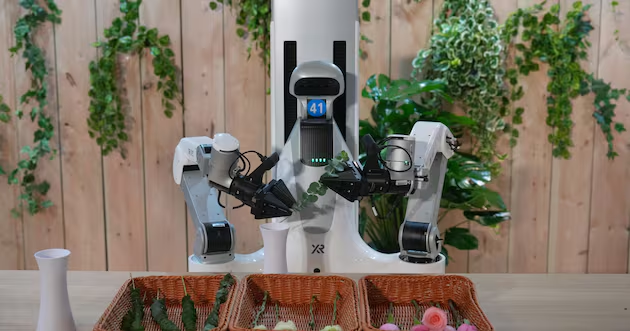
The robotic vacuum roaming your kitchen floor right now may soon be banned in the name of national security.
Read more Why is the Navy walking back Pentagon’s ‘flu shots not required’ policy?
The confirmed that their Covered List, a list that outlines equipment and services deemed to pose “an unacceptable risk” to the safety of the country and its people, now includes new models of household robots, such as those used to vacuum floors, mow lawns and clean pools.
NEW
The FCC has now added two new categories of devices to our Covered List, which bans new versions from import or sale in America.
1. Advanced robotic devices, such as humanoids and quadrupeds produced in foreign countries.
2. Power inverters produced in foreign countries.… pic.twitter.com/q8YCIOHBzZ
— Brendan Carr (@BrendanCarrFCC) July 28, 2026
Use of these devices, the FCC said, could create a national security threat by allowing foreign entities to “collect and maintain sensitive data” using the devices’ “high-fidelity sensors” that are “vulnerable to exfiltration.”
Relying on foreign suppliers also poses a risk to the U.S. economy by subjecting the economy to “the whims of foreign entities that could disrupt or degrade the supply chains at a time of their choosing,” the FCC said.
So, to protect both the data and the dollars of American consumers, new models of foreign-produced devices are prohibited nationwide.
What devices are included in the ban?
Initially, the updates to the Covered List, released on July 27, were not clear on whether household robotic devices were included. The ban “advanced robotic devices, including four-legged quadrupeds, bipeds, and wheels and tracked vehicles.”
FACT SHEET —Today, the FCC updated its Covered List to include two new categories of devices—“advanced robotic devices” (defined as mobile robots, such as humanoids and quadrupeds) and, separately, connected power inverters produced in foreign countries.
Read more 🧵⬇️ https://t.co/sfvEi2Z0zs pic.twitter.com/IdVwHjywwr
— FCC (@FCC) July 28, 2026
A later clarification in an online FAQ defined “advanced robotic devices” as any mechanical mobile device that is capable of autonomous navigation and obstacle avoidance, can move at a distance from a human operator and weighs more than 4.4 pounds combined with the weight of its docking station.
Under the ban, companies that produce robotic devices in a foreign country can apply to receive an exemption from the Department of Defense or the Department of Homeland Security that allows them conditional approval while they work to bring manufacturing onshore, but new models of devices on the Covered List are prohibited from receiving FCC authorization.
The ruling does not impact devices already authorized by the FCC and acquired by consumers, which can continue to receive software updates “at least” until Jan. 1, 2029, .
Read more Utah mill breaks ground on rare earth mineral processing plant
The bans come amid growing threats to safety and innovation
In a regarding the ruling, the FCC noted a security vulnerability that took place in early 2026 when foreign-produced robotic devices were remotely accessed in “homes around the world” to collect data from “live camera feeds, microphone audio, and detailed maps of consumers’ homes.”
That information “could be leveraged by malign actors to surveil Americans (and) enhance the capabilities of foreign intelligence services,” the FCC said, and “must be protected and maintained in the United States.”
In addition to safeguarding sensitive information, limiting the use of robotic devices made in foreign countries is meant to promote robotic innovation within the U.S.
“Advanced robotic devices will be critical to creating efficiencies in our economy, dominating on the battlefield, and securing our homeland,” the FCC said. “To ensure the United States is able to take advantage of this generational technology, the United States must have an independent and resilient robotics supply chain and industrial base.”
Protect the Homeland—Build in America 🇺🇸
Safe. Secure. Supply Chains. 🏗️
— for our nation’s critical technologies and infrastructure. 🦾 https://t.co/sfvEi2Z0zs pic.twitter.com/F6b7fdIIcG
— FCC (@FCC) July 30, 2026
Currently, the top five companies producing cleaning robots are all Chinese companies, according to 2025 data released by IDC.
The FCC said the ban is “country neutral” and not meant to target any country specifically.
This regulation is not the first — and likely not the last — of its kind
The update addressing household robots is similar to other recent bans concerning Uncrewed Aircraft Systems, which were prohibited for similar reasons. All updates to the Covered List are made by “national security agency experts,” the FCC said, and it looks like this is not the last time experts will add a new product to the list.
“Following President Trump’s leadership, the FCC will continue to do our part to secure America’s critical supply chains and, with today’s action, the FCC is acting in lock step with our national security agencies to do just that,” said .
🎥 @BrendanCarrFCC joins @NBCNews to talk about following @POTUS’ lead in securing U.S. critical supply chains—including advanced robotic devices:
“We’re acting relatively early, so that we don’t discover, 5-10 years from now, that we’re too dependent on foreign-produced tech.” pic.twitter.com/JnlzJtGSMS
Read more Kouri Richins’ request for new trial denied
— FCC (@FCC) July 29, 2026