
Monsoonal storms have left their mark this month, drastically improving Utah’s mountain soil moisture levels.
Read more High school girls soccer: 2026 2A team-by-team region capsules, predictions
However, state water officials say they’ve yet to leave much of a mark on the state’s overall drought situation.
All parts of Utah remain in drought, including almost 95% in at least severe, although the percentage in extreme or exceptional drought diminished somewhat over the past week, according to the U.S. Drought Monitor. It now lists 37% of the state in the worst two categories, down about 2.4 percentage points from last week’s report.
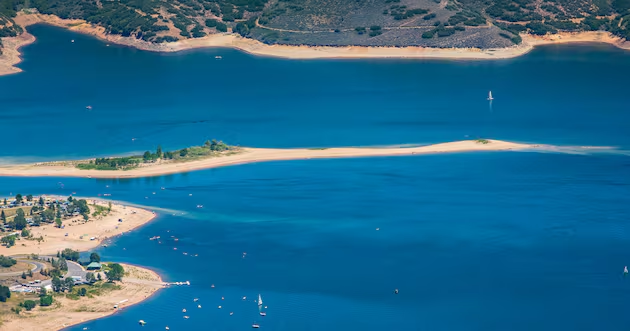
At the same time, Utah’s reservoir system is poised to close out the month at 57% capacity, down 22 percentage points from last July and 17 percentage points from the July average. It dropped 11 percentage points since June amid consumption, evaporation and also some projects that require reservoir drainage in some cases.
“While the rains have arrived, our reservoirs have seen a significant decline. The median drop between May and July is typically 1%, but this year it reached 13%,” said Laura Haskell, drought coordinator for the Utah Division of Water Resources, in a statement on Thursday, adding some of this is also tied to last year’s record-low snowpack.
A few reservoirs are in better shape than others. Porcupine Reservoir in Cache County remains listed at 100% capacity, the most among the state’s largest reservoirs, while Current Creek and Smith and Morehouse reservoirs are still above 90%. Many other large reservoirs across Utah’s northern half, including popular draws like Jordanelle Reservoir, are still over 60% full.
But there’s a growing number of reservoirs nearing empty status, mostly in central and southern Utah. Gunnison, Otter Creek, Panguitch Lake, Piute, Upper Enterprise and Yuba reservoirs are all listed at 10% capacity or less.
Utah wildlife officials have even increased fishing limits at reservoirs that have gotten so low that it has harmed their ecosystem. Some boating ramps are also closed because of the challenges.
Read more High school girls soccer: 2026 4A team-by-team region capsules, predictions
The Great Salt Lake remains over 7 feet below its minimum healthy level, too.
That’s not to say this month’s monsoons haven’t been beneficial to the state’s water systems. Utah’s average soil moisture at Natural Resources Conservation Service sites scattered across the state’s mountains had been close to record-low status throughout June, but that started to change in early July.
It then spiked by mid-July, as a strong wave of monsoonal moisture entered the state after a record-setting heatwave. Many storms lacked upper-level steering winds to push storms into the valleys, which led to larger totals in the mountains, KSL meteorologist Matt Johnson explained last week.
Some mountain sites have received multiple inches of rain this month.
Utah’s average soil moisture is now 40%, nearly 7 percentage points above normal for the end of July, per Conservation Service data. It sets Utah up for a more efficient snowpack runoff next spring, should levels remain above normal and Utah not have another abysmally low snowpack.
Storms also started reaching more valleys, including along the Wasatch Front, more recently. After another storm early Thursday, Salt Lake City has collected 0.61 inches of rain since July 21, about the same it collected between May 18 and July 20. It’s also more than its July normal.
The only other downside has been the flooding. Gov. Spencer Cox issued a state of emergency for Beaver, Piute and Sevier counties over severe flood damage in those areas, largely caused by rain falling on recent wildfire burn scars.
Long-range forecasts favor Utah again in August, meaning the risk for more flooding may continue, but it also could continue to boost soil moisture levels and chip away at the drought.
Utah has a 33% to 50% chance for above-normal precipitation next month, which is among the highest in the nation, according to the National Weather Service Climate Prediction Center. The agency’s three-month outlook also notes the wetter trend could linger into the fall.
Read more Newly discovered St. Augustine sermons shed light on this mysterious Bible story