
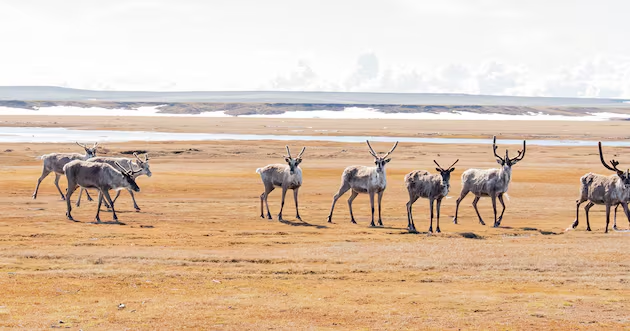
- The Arctic National Wildlife Refuge covers 19 million acres in the north of Alaska.
- It’s considered the last great American wilderness, the crown jewel of public lands.
- Enough oil to fuel America for a year is thought to be underneath one parcel of it.
Some 3,800 feet above sea-level, hundreds of miles from the nearest strip mall, hospital or road this past June, we found the massive, spiraling horn of an approximately 12-year-old dall ram.
Read more Opinion: Empowering local officials to fight and prevent wildfires their way
The horn of the great, white arctic sheep was nestled in the spongy, tundra-covered saddle between two nameless mountains. A Utah-raised hunter within the group of journalists I traveled with explained that it was a once-in-a-lifetime find.
Rams keep their horns for life, which is why they’re called “dead heads” when they’re found in the wild. Stumbling across a helix in any range is rare, but to come across one of that size and shape from such prize game — and in a place where it’s unlikely another human soul would ever see it — was rarer still.
Aside from some caribou and moose antlers, the horn was the first sign of mega-fauna since arriving in the massive glacier-carved river valley a few days earlier. Our guide, Jeffery “Country” Gillespie, explained that the lack of wildlife wasn’t too surprising considering the scale of that arctic wilderness and how far away the caribou migration was at that point, but it was proof of the giants living in the landscape.
Aside from being a cool find, the horn indicated a whole other revelation at play in one of the harshest, most unforgiving habitats on the planet. That animal had access to an environment large enough and wild enough for it to live as long as it took to grow such horns.
Getting there
The flight from Fairbanks to Arctic Village was delayed due to a large, lingering storm that settled over the top of Alaska. Once the eight-seat Cessna Caravan did take off, the hour-and-twenty minute flight took us north over a lesser mountain range and then the sprawling marsh of the Yukon River before touching down in one of the most remote towns in the country.
Arctic Village sits on the banks of the East Fork of the Chandalar River, which braids its way south out of the adjacent Brooks Range. Those rugged mountains are the northernmost in the United States, extending from Canada across to the Chukchi Sea.
The 200-person village is within the 1.8 million acres owned by the Gwich’in Tribe — how it became titled land and not a reservation is its own inspirational story — and is entirely isolated from the rest of the country’s road system. The nearest one is the Dalton Highway, otherwise known as the “haul road,” as it’s used to facilitate Prudhoe Bay’s arctic oil fields. That one is some 90 miles to the east though, with mountains in between.
Yet, the gravel landing strip and one-room outpost making up the airport was just the staging ground for another flight that required a de Havilland Beaver prop plane flown by seasoned bush pilot Dirk Nickisch.
That’s because where we were going was farther north, into an even more remote and much wilder part of the country — one without paved landing strips, roads or human infrastructure. It’s a place too large to fathom, too far away from most to feel relevant, but far too important to overlook.
A place that found itself back in the political spotlight last year, too, when a longstanding debate over whether to extract natural resources resurfaced. Then, when actual oil and gas leases were sold in June, the debate ceased to be simply one of sentiment.
We were headed to the Arctic National Wildlife Refuge.
Into the largest wildlife refuge in the country
Called either “Anne-Wahr,” which is the phonetic pronunciation of its acronym, ANWR, or plainly as “the refuge,” it’s the largest wildlife refuge in the country, spanning more than 19 million acres. That’s roughly the size of South Carolina and, if you’re looking at a map, it covers the entire northeast corner of Alaska.
Situated above the Arctic Circle, the refuge is an unblemished wilderness made up of thousands of unnamed, jagged mountain peaks, vast river systems and expansive tundra plains. Whatever “wilderness” experiences I’ve had in the backcountry environments of the West paled in comparison to what exists up on the northern border of the United States. Its immensity cannot be overstated.
Even President Jimmy Carter, whose administration prioritized preserving a lot of Alaskan territory, wrote that, “the arctic refuge stands alone as America’s last truly great wilderness.”
Hundreds of species of migratory birds — from peregrine falcons and regular old robins to a variety of eiders — travel from around the globe to hatch there. One of the largest herds of caribou in North America migrate thousands of miles through the refuge and back every year. Their trip and lifecycle provides for wolves, grizzlies and foxes as well as a cascade of other species down into the biome. In winter, its coast is among the most critical polar bear denning locations on the planet.
The U.S. Fish and Wildlife Service manages most of it, spare the 100,000 or so acres owned by the coastal Iñupiaq village of Kaktovik and the underground mineral rights for a specific parcel that is, not-so-confusingly, held by the Bureau of Land Management.
But, of course, you’d be forgiven for not knowing much about it. Alaska’s national parks are hard to keep track of, let alone all the other state-sized tracts of federal land sprinkled across its landscapes.
In the refuge’s case, however, the stakes are quite high and have been for decades. That’s because some consider it the absolute crown jewel of America’s public lands and among the greatest successes of its conservation efforts. For others though, it represents a ripe opportunity for the kind of energy production and subsequent economic benefits the country needs.
Carveouts
Energy development in the refuge has been a point of contention and debate for at least 46 years, but goes back well further still.
The region was first protected in 1960 under Dwight D. Eisenhower as a result of decades of lobbying by a wide swath of American conservationists, spearheaded by Olaus and Margaret Murie. The current iteration, however, didn’t come into existence until 20 years later.
In December 1980, on the eve of the Reagan administration, the Arctic National Wildlife Refuge was established and expanded by 9 million acres with the passage of the Alaska National Interest Lands Conservation Act. ANILCA was the single largest conservation effort in history, preserving some 157 million acres of Alaska.
The 1002 section of the law stipulates that one specific 1.5 million-acre parcel be excluded from the wilderness designation granted to the rest of the refuge. It also deferred any decisions about oil and gas exploration there.
Energy development in the ‘ten-oh-two’
A few years after ANILCA passed, seismic and surface testing was conducted on the parcel of land now known as the “ten-oh-two” after the section of the law. Since arctic ecosystems are so slow to recover due to short growing seasons, there’s still evidence of that work visible 40 years later. Regardless, the results of that testing suggested there are healthy deposits of recoverable oil under the permafrost.
The BLM estimates that there’s anywhere from 4 – 11 billion barrels of oil in the 1002. The U.S. Geological Survey published a report stating there are potentially 7.7 billion barrels of oil underneath the land. That’s about equivalent to the amount of oil America consumes in one year. As an estimate, that is a lot, but it’s less than the 25 billion barrels found in Prudhoe Bay or the tens of billions found in the Permian Basin.
Such a deposit was why in 2017, as part of the Trump administration’s signature legislation, the Tax Cuts and Jobs Act, provisions were included that opened the area to responsible energy development.
“For decades, Alaskans have fought for the right and opportunity — against an unwilling federal government — to allow Alaska to develop the 1002 Area of the Arctic National Wildlife Refuge so that we can strengthen our communities and build a better life for our children,” Sen. Dan Sullivan, R-Alaska, said in a statement at the time.
“But for decades, we’ve been denied that right. Today that has changed. I want to thank all of the hundreds — if not thousands of Alaskans — who have spent countless hours over the years to get this done.”
In the political back and forth between the Trump and Biden administrations over the past nine years, efforts to pursue those oil deposits were stymied.
That is until last October when Interior Secretary Doug Burgum announced plans to open the region for oil and gas drilling.
“From day one, President Trump directed us to unlock Alaska’s energy and resource potential while honoring commitments to the state and local communities,” Burgum said in a statement. “By reopening the Coastal Plain and advancing key infrastructure, we are strengthening energy independence, creating jobs and supporting Alaska’s communities while driving economic growth across the state.”
For many of the people who live in the only actual village within the refuge, Kaktovik, the news was welcome. They own mineral rights in the region and have long supported natural resource development on their land.
“It is encouraging to see decision makers in Washington advancing policies that respect our voice and support Kaktovik’s long term success,” Charles “CC” Lampe, the president of Kaktovik Iñupiat Corp., said in a statement.
A sacred place where life begins
Sloping down from the mountains toward the ice flows of the Beaufort Sea is a 15- to 20-mile wide expanse of undulating tundra which constitutes most of the 1002.
As part of his arguments for drilling in the refuge in 2001, Alaska Sen. Frank Murkowski described for Congress what the region’s like in winter by holding up a blank sheet of paper.
But as we flew over it this past July, the soft verdant expanse was soaked through with snowmelt, dotted with streams and small ponds sparkling in the 24-hour sun. Thousands of crisscrossing caribou trails veined out in all directions.
Setting down on an old sea-side gravel landing strip built by the U.S. Navy for researchers, hundreds of birds took off in different directions, flying out along the coast. But they were not alone. Not until we reached the part of refuge closest to Prudhoe Bay’s oil fields did we encounter some of the mega-fauna we’d missed in the mountains.
Even before the Beaver’s engine died, a small herd of caribou came galloping toward us. There were some 15 cows, bulls and calves that approached. Curious about the plane, they stopped to stare within yards of its wings.
That confluence of abundant life and the presence of oil is the unsurprising and cruel twist of fate regarding the 1002.
The Gwich’in people, whose existence has been tied to the migrations of the caribou for thousands of years, call the coastal plain “Iizhik Gwats’an Gwandaii Goodlit,” which means “the sacred place where life began.”
That name is relevant because the caribou migration’s ultimate destination is exactly there. Pregnant cows travel thousands of miles from the Canadian Yukon to birth their calves on the refuge’s coastal plain due to the dense, protein rich vegetation that grows in the summer.
Read more Are foreign actors actually influencing the data center debate?
Just as I saw that July afternoon, it’s not just the ungulates though. Hundreds of species of migratory birds and raptors also nest there. Come winter, polar bear mothers den in the same place.
Mabeleen Christian, the second chief of Arctic Village and Gwich’in tribal member, told me that her people do not even set foot on the 1002 out of reverence for what it provides their people.
Oil and gas leases sold
After Burgum’s announcement last fall, the Bureau of Land Management held an oil and gas lease sale for parcels inside the area this past June 5.
The sales did not show a tremendous amount of industry interest in natural resource development in the region. In particular, none of the large, multinational oil corporations that have existing footprints in the Arctic such as ConocoPhillips and Hilcorp placed bids.
But five lease tracts were still sold. Of the total 688,829 acres offered, 72,049 were scooped up, resulting in $3.7 million in revenue, according to a report by Taxpayers for Common Sense, a nonprofit economic institute that tracks the impact of government spending.
The companies that did place bids, however, are different than what one might expect from an oil and gas lease sale. The Northern Journal, a local newspaper, summed up the situation with the headline, “With industry wary of Arctic Refuge, Alaska’s own government plans a lonely quest for oil.”
Three of the five leases were purchased by the Alaska Industrial Development and Export Authority (AIDEA), which is a state-run corporation that provides loans to private companies to facilitate economic growth. The other two were won by a private company called HEX Energy LLC., which received nearly $60 million from AIDEA across one loan in 2021 and a line of credit last year.
In addition to those sales, the Alaska State Legislature authorized AIDEA to spend $175 million on seismic testing. While it is not an oil and gas company and does not have the necessary expertise to do that kind of work on its own, it is a lot of money.
Max Graham, a reporter with the Northern Journal, found that AIDEA has already contracted with two other companies to begin the process of executing seismic testing. Though, neither AIDEA or HEX would comment on any specific plans.
“I’m here as an Alaskan trying to be a responsible developer for Alaska, so we have opportunities in the future for our kids and my grandkids,” John Hendrix, HEX’s chief executive, told Graham.
“We’re not going to do anything radical. But we will do what we have to do to bring production forward.”
The Interior’s 2025 decision to open the 1002 for leases is currently in litigation. The Gwich’in Steering Committee, Earthjustice and the NRDC sued this past January, which means there’s some potential for AIDEA to hold back on testing for the time being. But several sources close to the refuge said they believe that with the leases, financing and permission in hand, it’s a waiting game for when heavy equipment enters the refuge.
A false dichotomy
Nathan Gordon Jr., said he was probably built to be the mayor of Kaktovik. That’s because his father was the chairman of the Kaktovik Iñupiat Corporation, which manages the underground mineral rights owned by the community His grandfather was a founding council member for the city.
When he stepped into the role, he was focused on the health and safety of his people — his other full-time job is helping to manage the local polar bear population — but in his five years as mayor, he has championed self-determination. Of those efforts, oil and gas development in the Arctic National Wildlife Refuge is the most important. He’s thrilled with the current direction things are headed.
“I feel eager right now, but I’ve been patient for long enough,” he said about the potential for testing and development to begin. “Being ready for this and staying ready for this has been my priority.”
Gordon said if it weren’t from taxes on oil and gas projects in the state, his community wouldn’t have flush toilets in their homes that came only 20 years ago.
The cash flow funds the police and fire departments, sanitation, road and airstrip maintenance and water treatments.
“We want to do larger infrastructure over here: build homes, repair homes, and it’s going to be key to fund a bunch of that, which makes it like a light at the end of the tunnel,” Gordon said.
In a July 29 op-ed in The Alaska Story, Gordon said the recent lease sales “represented a meaningful step forward,” and were “an important moment in our historical arc.” He aimed to dispel the myth that development on the coastal plane would threaten his town’s way of life.
“This false dichotomy, pushed by those who have no connection to our lands or communities, pits economic growth against our Indigenous traditions,” Gordon wrote.
“But we know that our traditions and responsible resource development can, and do, coexist, as they have for over 50 years.”
A side angle
Nickisch flies from his home base in Coldfoot throughout the Brooks Range, including into the Gates of the Arctic National Park, Kobuk Valley National Park and the refuge.
He’s intimately familiar with the range’s topography and knows the natural landing strips, the distance between them and how much fuel he needs to reach each one. He’s proof that, while the scale of such a large place is unimaginable, it’s as Barry Lopez, the author of “Arctic Dreams,” wrote, somehow still knowable.
And though he did not start out as a conservationist, he said that he came to adopt the perspective from a side angle.
As proof, Nickisch told me that he was a crop duster in North Dakota before he moved to Alaska in the late 1990s. He’s even held onto some of his Monsanto swag, including his RoundUp jacket.
After a visit, he realized that he could make some money up in Alaska with his skill flying small planes. So, he moved and then set up a business with his wife Danielle called Coyote Air.
Flying with mentors in the early days, they would point out various conservation points to him from time to time, but it really wasn’t until he first flew his wife and 3-month-old son into the refuge in June 1998 that the reason for protecting such places clicked for him. They were similar to those that the HEX’s CEO mentioned to The Northern Journal.
After dropping his family off, Nickisch had to shuttle some folks out of Arctic Village so he left them in the refuge for a few hours. On his return, however, the landing strip was overrun.
“There were just thousands of caribou rolling through there and, at that moment, literally the biggest thought in my mind was, ‘I wonder where my kids will have the opportunity to take their kids to experience something like this,’” he said.
“That was a real epiphany moment and ideologically changed my perspective on the land up here completely.”
Just like the clarity he has about flying in certain weather or where to land in what part of the country, Nickisch is black and white about the natural resource extraction in the refuge.
“Well, I mean, ideologically, I see the fight for the refuge as this choice between what we pass on to the future, versus what our current greed makes us want to have right now,” he said.
”You have to decide who are you, right? Is it that we make the absolute most money we can right freaking now the most important thing, or is it that we have something that we pass off and hand down?”
Dead head
After taking pictures with the ram horn, it crossed the minds of several folks to keep it. The notion was quickly dispelled, because it’s illegal to take items out of wildlife refuges without special permits. Of course, that didn’t stop the usual hemming and hawing over ethical choices in the backcountry.
We wondered if anyone would ever know. In the face of such a rare object, would it really matter? Was the trophy worth the risk? Who was being harmed if someone left with it? It was right there, after all.
We turned to Country, our guide, to get his thoughts on the matter. Loath to tell his charges what to do, he didn’t say the group should leave it outright, but he did — ever so gently — remind us to think of the refuge’s future.
I think it would be nice, Country said, if someone else had the opportunity to find it.
Note: The American Lands Project, a nonpartisan, nonprofit charity building connections between policymakers and public lands, sponsored the trip for journalists to Alaska.