
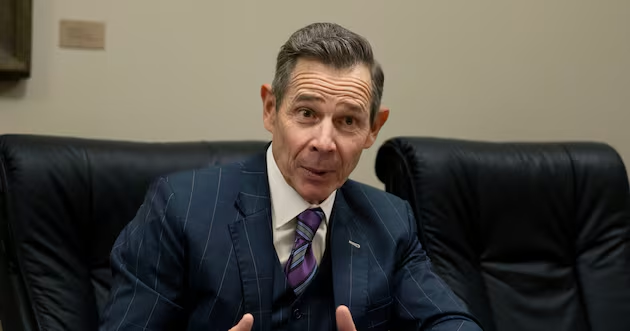
- Sen. John Curtis wants states to run their own migrant guest-worker programs.
- Bill would allow participating states to bring in more than 5,000 migrant workers.
- Visas include pathway to legal status for those living in U.S. for more than 10 years.
Utah Sen. John Curtis announced the introduction of a on Monday that would create a voluntary state-sponsored visa program, allowing state legislatures to expand their temporary migrant workforce.
Read more Blanche formally dismantles anti-weaponization fund in deal to advance attorney general nomination
The legislation, introduced with Arizona Democratic Sen. Mark Kelly, appears to mirror a 15-year-old proposal passed in Utah as part of the 2011 Compact on Immigration, but which never received federal approval.
Curtis’ bill would mark a major reform to federal immigration law, if it can make its way through congressional gridlock, by letting states manage their own state-level guest-worker initiatives based on local labor demands.
“I’ve heard time and again from small business owners, farmers, and ranchers across Utah how difficult it has become to hire enough workers to meet growing market demands,” Curtis said in a statement.
The bipartisan plan would “help fill the gap” by launching a pilot program for uniquely tailored visas accompanied by “rigorous federal vetting” that would include a process to investigate complaints of U.S. workers being displaced.
The United States saw the highest levels of net immigration in American history under President Joe Biden, totaling more than 8 million entries between the start of 2021 and the end of 2024, according to Census Bureau data.
Surges of immigrants lacking legal status strained services, public safety and housing, making it one of the top issues of the 2024 presidential election that saw President Donald Trump return on a promise of mass deportation.
But Utah’s Republican junior senator hopes to continue his independent streak with a bill that hearkens back to a time before border crises and enforcement crackdowns by focusing on narrow economic needs of American cities.
Utah worker shortage
Utah is experiencing a “severe” worker shortage, according to a U.S. Chamber of Commerce report from December, with 96 available workers for every 100 open jobs. This is an improvement from August 2025, when the state had 72 available workers for every 100 jobs.
To address this problem, Curtis’ bill would amend the Immigration and Nationality Act to form a new nonimmigrant classification for state-sponsored individuals coming to work or invest — as well as their spouses and minor children — for up to three years.
States would set their own criteria for employment, duration and place of residence, subject to approval by the Department of Homeland Security. States could also establish interstate compacts so visa holders could move freely within the member states.
“States understand their own economic needs best, but federal rules currently determine who can live and work here,” Kelly said in a statement. “Our bipartisan bill would let Arizona and other states choose the visas they need to fill labor gaps and strengthen their local economies.”
Curtis’ and Kelly’s framework requires background checks of visa applicants prior to entry. Once visa holders are approved, states must allow them to apply for occupational licenses and credentials. However, visa holders may not receive federal means-tested benefits.
To incentivize compliance, states can make visa holders post a bond refunded upon proof of departure. If federal agencies find more than 3% of visa holders in a state are overstaying, the state will be required to implement a bond of $4,000, and their visa quota will be reduced by 50%.
The total number of state-sponsored visas under the new program would be limited to 5,000 per fiscal year, plus a proportional share of a 245,000-visa pool based on a state’s population, a state’s compliance with the 3-year limit and growth in the U.S. gross domestic product.
The bill includes a provision that could be described as a pathway to legal residency for some visa holders who are illegal immigrants, physically present in the U.S. since Dec. 31, 2016. These illegal immigrants would need to undergo a background check and pay a $1,000 “penalty.”
Curtis’ bill could bring a resolution to a 15-year-old Utah law that has been sitting in federalist limbo. In 2011, the Utah Legislature requested a federal waiver for permission to operate a state-run migrant worker visa program. Utah never received the waiver.
During the 2026 legislative session, Utah House Republicans took a dramatic departure from the state’s immigration compromise, voting to repeal the defunct program. The bill never received a Senate vote after no member of the upper chamber opted to sponsor it.