
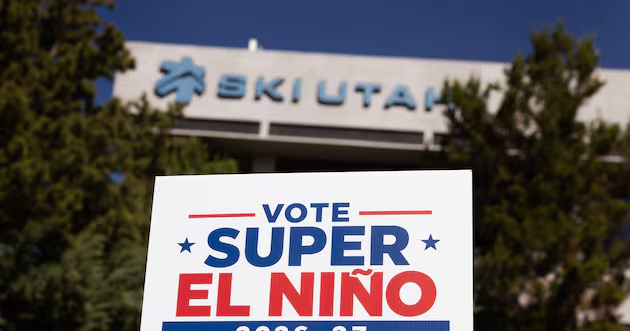
- Ski Utah made lawn signs that read “Vote Super El Niño” to lighten the heavy election season.
- The organization will make the signs available for free on Oct. 2.
- How much snow a Super El Niño could bring to Utah ski areas is unpredictable.
Ski Utah is getting into politics — sort of.
As signs touting political candidates pop up ahead of the November election, the association that promotes the state’s 15 ski and snowboard resorts has mounted a campaign of its own. It made yard signs reading:
Read more Himalayan mountain abruptly closes for the season, sending 1,000 climbers home
“Vote Super El Niño 2026-27. The Greatest Snow on Earth.”
“We’re going all in on Super El Niño,” said Nathan Rafferty, Ski Utah president and CEO.
The organization burned through a hundred signs this past weekend, and plans to order several hundred more. It wants to get them into the hands of people who will display them with pride, he said.
“I think people are so over politics,” Rafferty said. “We’re just trying to provide a little levity and hope.”
Ski Utah will make “Vote Super El Niño” lawn signs available for free on Oct. 2 from 10 a.m to 2 p.m. in its Salt Lake City office parking lot at 2749 E. Parleys Way. It also plans to put up billboards.
“Every fall, Utahns start watching the forecast and talking snow with their neighbors. This year that conversation has a name: Super El Niño. Election season can feel divisive, but spend five minutes in a lift line and you’ll find plenty of common ground,” Rafferty said.
“This is the one race where all of Utah is on the same ticket. Whatever divides us the rest of the year, we can all agree on hoping for a big winter. Grab a sign, put it in your yard and let your neighbors know where you stand on powder.”
Will El Niño bring snow to Utah ski resorts?
There wasn’t much powder to stand on or, uh, ski on last year. The 2025-26 season went down as the least snowy winter on record.
Alta measured just 319 inches of snow against a 10-year average of 547 inches. Utah recorded 4.8 million skier days, a 26.5% drop from last year. Skier spending fell 17.8% from last year, to $2.1 billion, according to a Kem C. Gardner Policy Institute report in August.
But the prospect of what a Super El Niño could bring this year has skiers and snowboarders filled with anticipation.
Read more The cost of compromise
Meteorologists, though, say El Niño is unpredictable when it comes to snowfall in the West. Two of the four strongest events on record produced above average snowfall, while two produced below average snowfall.
“The effects of El Niño appear to show a mixed bag for much of the western United States, with the strongest signal being average to above-average snowfall for the Southwest. Again, though, the pattern doesn’t hold 100% of the time,” OpenSnow meteorologist Sam Collentine wrote.
Collentine, “to have a little fun,” then looked specifically at how the snowpack finished during the 1997-1998 winter season at ski regions across the western United States. Utah’s snowpack was 128% of normal that year.
While he said that season is interesting to look at as a potential comparison for an El Niño episode, keep in mind that no matter how deep or light a winter is overall, when it comes to skiing, it’s all about timing.
Collentine said booking a trip seven to 10 days in advance and for a general area that looks stormy will increase the chances of scoring the best conditions.
What is a Super El Niño?
El Niño is a naturally occurring climate pattern in the tropical Pacific Ocean in which sea surface temperatures in the central and eastern equatorial Pacific become warmer than average. When the sea surface temperature there runs at least 0.5 degrees Celsius above average for a sustained period, meteorologists call it El Niño. When it runs cold, it’s called La Niña.
Meteorologists typically use the term Super El Niño when temperatures climb 2 degrees Celsius above normal. Meteorologists will compare specific Pacific temperatures to the average temperatures in the area and compared to the rest of the tropical oceans to determine that 2-degree threshold.
“It sounds small. A patch of the Pacific being a degree or two warmer than usual doesn’t seem like it should matter to anyone who isn’t a fish. But that warm water reshapes the jet stream, which reshapes where storms go, which is the only part of this article that actually matters to skiers,” forecaster Evan Thayer wrote for Ski Utah.
The National Oceanic and Atmospheric Administration puts the probability of El Niño at 100% through at least February through April 2027, and gives a 75% chance during October through December 2026 of a historic event exceeding the strength of all previous El Niños on record.