
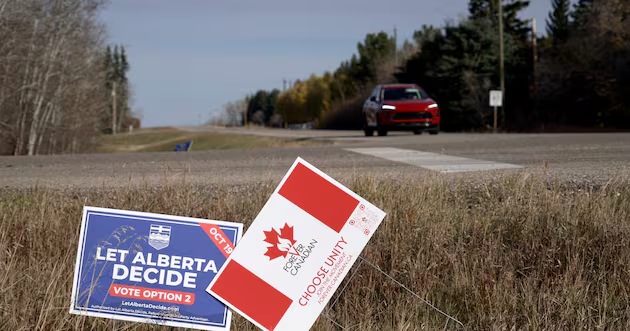
- About 75% of voters chose for Alberta to remain in Canada, while roughly 25% backed starting the process for a future separation referendum. The vote was not a direct decision on independence, and results remain unofficial.
- The result is a win for Prime Minister Mark Carney’s push for Canadian unity, but it also shows that frustration with Ottawa remains a significant force in Alberta politics.
- Premier Danielle Smith welcomed the result, while separatist leaders said they would continue organizing, leaving Alberta’s debate over its relationship with Canada unresolved.
Alberta voters rejected the first step toward a possible separation from Canada on Monday, with early results showing roughly three-quarters choosing to keep the oil-rich province in the country.
Read more Britain takes aim at Apple’s grip on tap-to-pay
The nonbinding referendum did not ask Albertans to leave Canada; it asked whether the province should begin the legal process for a future binding vote on separation. The result is a win for Prime Minister Mark Carney’s push for national unity, but it does not erase the western province’s longstanding disputes with Ottawa over energy policy, federal power and Alberta’s place in Canada.
“While votes on all questions continued to be tallied, tonight’s results on the defining question of separation mean that Albertans and all Canadians will move forward together with renewed purpose and high ambition,” Carney said in a statement posted online. “We are building that future, bigger and faster than ever before.”
My statement on Albertans choosing to build a stronger Canada, together: pic.twitter.com/pNXb427wXI
— Mark Carney (@MarkJCarney) October 20, 2026
A referendum before a referendum
At first glance, Alberta’s ballot looked like a choice between staying in Canada and leaving it. However, voters weren’t deciding on independence itself. They were choosing whether Alberta should remain a province or start the legal process for a future binding referendum on separation. The vote was nonbinding, and Elections Alberta says official results are scheduled for Oct. 29.
As of Tuesday afternoon, Monday’s referendum is a clear win for keeping Alberta in Canada. Unofficial results show about 75% of Albertans voted to remain in Canada and 25% voted to start the separation process.
Questions 1-9 on the ballot were mostly on immigration and required a simple “yes” or “no.” Question 10 was the only one with two options and focused on the Alberta separation issue, and was placed on the ballot after separatists gathered about 300,000 petition signatures between January and May 2026.
The question asked, “Should Alberta remain a province of Canada, or should the Government of Alberta commence the legal process required under the Canadian Constitution to hold a binding provincial referendum on whether or not Alberta should separate from Canada?”
In practice, remaining a province of Canada means that nothing changes. If Option 2 had the majority vote, it would have started the legal process through the courts to separate Alberta from Canada and would have eventually ended in a second, binding vote.
Premier Danielle Smith, the head of Alberta’s province, promised her constituents she would not hold another separation referendum as long as she is premier. But separatists in her own party are trying to replace her, and a court case over the original separatist petition could still force another vote.
Why separation gained traction
Alberta’s separatist movement has grown out of long-running frustration with the federal government, especially over energy policy and the balance of power between Ottawa and the provinces. Alberta is Canada’s oil province, and many residents feel federal climate and energy rules have held back their economy.
Read more Trump awards Utahn Nick Shirley $10,000 check under new anti-fraud reward program
For example, Bill C-69 made it harder to approve big projects like pipelines, and a cap on oil and gas emissions was seen as a cap on the industry itself. Pipeline fights left Alberta with few ways to sell its oil overseas.
In 2019, then Premier Jason Kenney said in a keynote address that “Albertans have been working for Ottawa for too long” and claimed that Ottawa was “killing the golden goose.” In 2025, Premier Smith said Ottawa was fixated on “punishing our energy sector and layering on policies to keep it on the ground.”
Protest voters share these feelings and voted for Option 2 on the ballot as a way to tell Ottawa they’re fed up but don’t actually want to leave, while committed separatists are a smaller group who actually want an independent Alberta.
Since Prime Minister Carney has rolled back some of the highly disputed policies and backed a new pipeline, Smith has campaigned for Alberta to remain a part of Canada. Smith posted online Tuesday, saying that she is “very pleased” that the initial results “show widespread support for remaining in Canada.”
Thank you, Alberta!
I’m very pleased to see the initial results from Elections Alberta show widespread support for remaining in Canada. Albertans have voted for a stronger Alberta in a united Canada.
Thank you to all Albertans who took time to vote on these critically important… pic.twitter.com/a3Tk7T7k8H
— Danielle Smith (@ABDanielleSmith) October 20, 2026
What happens next for the separatist movement
The result gives Carney and supporters of Canadian unity a clear political win, but it may not settle the argument over Alberta’s place in Canada. Separatist leaders have said they plan to keep organizing, and are now trying to oust Smith as leader of the United Conservative Party.
“As far as I’m concerned, we’ve already won,” separatist leader Jeffrey Rath told reporters in Edmonton. “We’ve created a massive movement in this province.”
The original separatist petition is still in court, so a judge could eventually decide whether another vote happens. Regardless of what happens in court, the vote answers the question “leave or stay,” but not “is Alberta happy in Canada?”
Few Albertans expect the question to stay closed. Before the vote, an Abacus Data Poll found just 14% believed a “remain” win would settle the debate for a generation or longer.
Read more Pro dancer suspended ahead of ‘Dancing with the Stars’ Dedication Night