
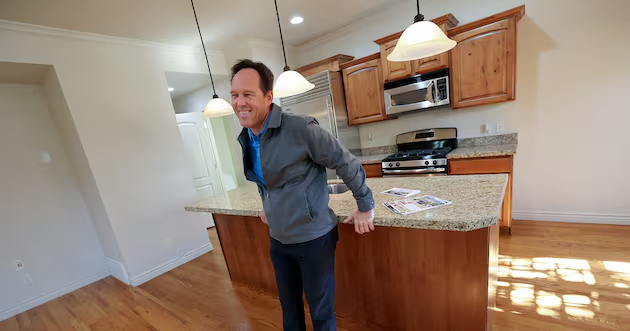
- More than half of Utah heads of households aged 25-34 are homeowners, but that’s declining.
- Salt Lake Board of Realtors wants more young Utahns to look at buying despite high costs.
- State official says new initiatives to build more starter homes may be coming soon.
Michael Peterson, a 37-year-old paralegal at a Draper law firm, had never really thought much about buying a home on her own.
Read more BYU-Utah rivalry matchup will have a morning kickoff
But faced with paying more than $2,000 a month to rent a one-bedroom apartment near her family in southern Salt Lake County, Peterson said she decided almost a year ago to get serious about becoming a homeowner.
In late August, Peterson closed on a three-bedroom, two-bath condominium in Herriman. Already, she’s completely repainted her condo, replacing the original gray walls and ceilings with lighter colors to make the space look bigger.
“It’s just a different feeling, to come home and know it’s mine and be able to do any changes or improvements that I want to it. It’s exciting,” Peterson said, describing her purchase as the first step toward someday owning a single-family home with a yard, her preferred type of home.
“I kind of always thought I would be doing it with someone and then that just wasn’t happening,” she said of becoming a first-time homeowner. “My family was really pushing, like, you’ve just got to find a way to make it work.”
Her father recommended a real estate agent who steered Peterson toward properties that would keep her monthly payments close to what she was paying for rent and helped her negotiate the price down from the $342,000 listed to around $320,000.
Her down payment was borrowed from her retirement account at work, money she said is being repaid through payroll deductions. There’s a $220 monthly HOA fee that Peterson isn’t too happy about, but it’s less than what other places she looked at are charging.
“I do believe housing prices in Utah are astronomical and significantly limit the options available to people, especially those relying on a single income,” Peterson said. “Fortunately, I had access to resources that made purchasing my condo possible.”
While not everyone may have that opportunity, she said “it’s worth exploring the possibilities. I believe investing in yourself and your future is important, and for me, purchasing my condo was a step in that direction.”
‘Sky is not falling’ for would-be Utah homeowners
Despite the state’s high housing prices and rising mortgage rates nationwide, the Salt Lake Board of Realtors is trying to make it clear that first-time homeownership isn’t out of reach for many younger Utahns.
“I acknowledge there are challenges,” the board’s president, Scott Colemere, said, adding that’s nothing new when it comes to buying a first home. “Every market brings unique challenges. For sure, the sky is not falling. There are opportunities.”
A new study commissioned by the Wasatch Front organization that’s been promoting homeownership since 1917 found that just over half of Utah households headed by 25- to 34-year-olds are homeowners.
Considered the “prime years” for first-time homebuyers, sales among those 25-34 “has declined only modestly” in recent years and, at 50.1% in 2024, remains above the rest of the country, according to the study by longtime Utah economist James Wood.
In 2024, the national rate of homeownership for the same age group was 40.4%, while the number of Utah households that owned their homes dropped from 54.3% in 2010 to 51.5% in 2019, before hitting 50.1% in 2024.
To Colemere, the higher rate of young homeowners in Utah is a sign that the state’s young people are better at “adulting” than their peers across the country, “very responsible at younger ages when you compare them.”
The Sandy-based real estate agent credits Utah’s culture, including the influence of The Church of Jesus Christ of Latter-day Saints, with what he sees as a greater interest in settling down among Utah’s 20- and 30-somethings.
“That influence of responsibility and commitment and obligation to oneself and family, et cetera, I think that all plays a factor in young people wanting to be responsible,” Colemere said, adding “hard work is definitely a value of Utah culture.”
The study cited a higher median income for the heads of young Utah households, $102,400 compared to $93,200 nationally, as well as their lower rate of unemployment as reasons for the state’s showing.
Read more Judge blocks fed effort to obtain Utah voter rolls
Also credited by the study is the increasing availability of more affordable multifamily options, like condominiums and townhomes, along with the financial help offered by first-time homebuyer assistance programs.
Here’s what makes it hard to buy a home
But the historically low mortgage rates from 2019-2022 that the study noted “allowed many young households to attain homeownership” are long gone. Mortgage rates have more than doubled since falling below 3% during the COVID-19 pandemic and are now above 7%.
The rise in mortgage rates “changed the affordability equation,” according to the University of Utah Kem C. Gardner Policy Institute’s recently released “State of the State’s Housing Market: 2025-2026″ report.
Before mortgage rates shot up, the record low rates during the pandemic helped offset rising home costs. But between 2021 and 2022, the report said the estimated average monthly mortgage payment on a median-priced home in Utah jumped 40%, to more than $3,328.
While this year’s estimated payment is down slightly from 2025, to $3,669, the report said it still puts homeownership out of reach for approximately 91% of Utah renters, with only 4.9% of homes sold last year considered affordable to a renter with a median income of $64,000.
Colemere said he was frustrated that statistic got so much attention on social media, since first-time homebuyers typically spend less than the median home sales price, up to $520,000 for the first quarter of 2026, according to the institute’s report.
“I don’t want to be cold and unfeeling to the challenges. But I’m just seeing so many situations where they are doing it,” he said, describing driven young buyers able to afford a home thanks to a good job, savings and seller concessions like rate buy downs.
“It takes effort,” Colemere said, suggesting that Utahns who want to buy their first home work with a real estate professional, save at least $15,000, shore up their credit and make sure they have a job that pays a “reasonable” income.
Then, he said, they should be able to find a home they can afford.
“Is it the four-bedroom, two-bath sprawling rambler on a quarter acre that we used to have 30 years ago in Salt Lake as a starter home? Maybe and maybe not,” Colemere said, suggesting more “densely populated housing options” are a more likely fit financially.
“I think there’s a lot of fear and there’s a misinformation in the market,” he said, that’s keeping many Utahns from buying a first home. The number of young homeowners in the state, he said, should serve to counter any uncertainty about the market.
‘Headwinds are getting tougher’ for homebuyers
State Housing Coordinator Steve Waldrip agreed it’s encouraging to see so many young homebuyers.
“I think the hopeful part of that is that it just shows how resilient our young people are. They’re figuring it out. They’re making it work. They recognize the value of homeownership,” Waldrip said. “That’s obviously such a critical piece to the American dream.”
But it’s getting harder for them to share in the benefits of homeownership, he said, pointing out that homeownership among young Utahns is declining as more and more of them are priced out of the market.
“We know that the headwinds are getting tougher. Interest rates are rising now,” Waldrip said, adding as much as $400 to $500 to monthly house payments. “So we’re still incredibly focused on delivering attainable housing opportunities, starter homes, for our young people.”
Nearly three years ago, Gov. Spencer Cox set a goal of building 35,000 new starter homes in Utah by the end of 2028 but is only about a quarter of the way there. Waldrip, who serves as the governor’s housing adviser, said building has slowed due to rising interest rates.
New initiatives intended to boost starter home production are being developed for the upcoming session of the Utah Legislature, he said, while existing programs to help builders with infrastructure costs and to utilize state-owned land for homes are already underway.
“We can’t sit and just hope,” Waldrip said. “We have to be actively engaged in creating solutions.”
Read more ‘The Lord’s hand was in preserving that property’: The story of the Cody Wyoming Temple site