
- Utah House District 62 swung 54 points toward Democrats in the U.S. House vote.
- Democratic victor David Chappell is member of the Democratic Socialists of America.
- Chappell condemned political violence despite association with radical leftist groups.
Voters in the heart of conservative Utah County swapped Republican crimson for a very different shade of red in the Nov. 3 midterm elections that upended the state legislative landscape.
Read more Chuck Schumer gets a challenger in race to be top Senate leader
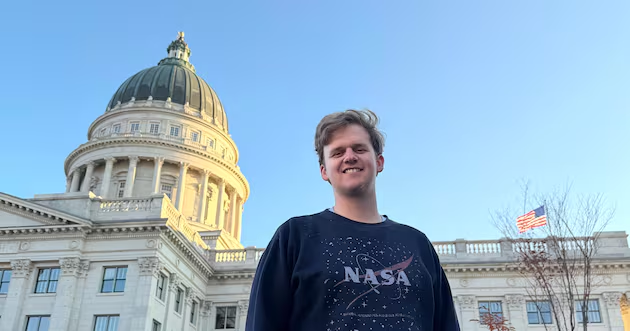
A national wave swept through the southern, student-heavy half of Provo and northern Springville, carrying with it a 27-year-old member of the Democratic Socialists of America into office.
Self-described “progressive independent” David Chappell succeeded in doing what no one — not even himself — thought was possible: ousting 12-year incumbent Rep. Norm Thurston, R-Provo.
As of Friday, Chappell led by more than five percentage points. When the race was called on Monday, he became the 16th candidate to capture a Republican district, shattering the House GOP supermajority.
This was enabled by a truly enormous swing. In 2022, Thurston won by 22 percentage points. In 2026, his constituents shifted 27 points in the opposite direction with similar voter turnout for each year.
It may have been downstream from an even more significant transformation at the federal level. House District 62 shifted more than any other legislative seat in the state in terms of U.S. House vote.
In 2022, voters in House District 62 favored the Republican nominee for Congress by 39 percentage points. In 2026, the same district opted for the Democrat by 15 points.
A swing of 54 percentage points.
After supporting President Donald Trump by an 18-point margin for three consecutive election cycles, voters found an alternative who will now be one of the most left-leaning lawmakers in Utah.
Democrats championed the victory as proof of an underlying cultural shift in the deeply religious city. Republicans hope the result simply reflects temporary dissatisfaction with the GOP brand.
Both sides will have to wait till 2028 to find out.
Communism or common sense?
Until then, the neighborhoods south of Brigham Young University will be represented by an idealistic civil engineer who believes demographics are destiny and that Provo’s demographics are changing.
“I don’t think it’s just the blue wave,” Chappell told the Deseret News. “Provo is not what they think it is. Provo is getting more diverse, diversity of thought, diversity of race, of background, of income.”
Chappell ran a grassroots campaign via door-knocking and social media focused relentlessly on the cost of living. His top priorities include strengthening renters’ rights and making all school meals free.
Alleviating poverty is a place where members of The Church of Jesus Christ of Latter-day Saints might align with the Democratic Party, according to Chappell, who no longer considers himself a member.
Chappell draws on an anti-capitalist interpretation of Christianity to inform his aggressively anti-corporate posture that might alienate other adherents of New Testament teachings.
“It teaches me to hate wealthy people; I mean, Jesus was the biggest hater of billionaires,” Chappell said — a stance sure to raise eyebrows among those who consider Jesus a God of love and healing to all.
He had kinder things to say about the father of communism than the business elite. Karl Marx, he said, advocated for “more economic democracy” instead of economic control by “three rich guys.”
Chappell does not consider himself a “socialist.” He is “anti-revolution,” he said. But he confirmed he is a dues-paying member of the Democratic Socialists of America, run by openly communist caucuses.
Chappell distanced himself from DSA’s “crazy ideas,” like abolishing the police, borders and U.S. Senate.
During his campaign, Chappell accepted the endorsement of Mormons with Hope, an activist group that fights for collective ownership of the means of production — the end goal of socialism.
Chappell downplayed his other ties, first reported by The Cougar Chronicle, to radical leftist group People of Provo Against ICE. He attended POPAI meetings, but was not part of its leadership, he said.
Read more Deseret News archives: Before the NBA draft lottery, there was a much more sobering draft lottery
The group came under scrutiny when The Cougar Chronicle reported that POPAI member Hector Mujica had made stickers saying “Shoot Trump be a hero,” which other members cheered on.
Mujica, a Venezuelan national, was arrested by U.S. Immigration and Customs Enforcement in October. Chappell donated $200 to help with Mujica’s legal defense and posted on his behalf.
Chappell said he wants due process for Mujica who he thinks was arrested without cause. But he condemned the stickers and other remarks from POPAI, including those suggesting billionaires and their children should be killed.
POPAI is not Chappell’s only questionable association.
Provo artist Sav Kubensis, who frequently helped on his campaign, attracted national attention for her artwork that depicted Trump’s severed head on a platter with gouged-out eyes and a piñata of Sen. Mike Lee.
“I don’t like violent artwork. It’s not my style. But this is a free country,” Chappell said. “I don’t consider myself extreme. I think that I just want to help people. And that means fighting against corporations.”
Chappell’s approach, unusual in the Beehive State, has won him fans and skeptics among his new constituents.
Blue wave brings red scare
Thurston chalks up Chappell’s upset win to a seething anti-Republican sentiment, stemming both from actions taken by the Trump White House on the state Legislature on things like AI data centers.
He points to losses suffered by his colleagues who spanned the spectrum from the most moderate to the most uncompromising lawmakers as evidence that climate mattered more than candidate.
“Our district has gone from somebody who has really strong policy analysis skills that looks at every issue very carefully … to somebody who’s just incredibly idealistic,” Thurston told the Deseret News.
Thurston says his district has trended more liberal. But hopes it is competitive enough to retake in two years.
Local GOP precinct chair Steven Baxter is still stunned Thurston lost. It could be that younger, less affluent voters in Provo were especially impacted by tariffs and gas prices, Baxter told the Deseret News.
However, Baxter is less worried about Chappell’s budget-breaking progressive proposals, which he believes will be tempered by the constraints of working in a legislature with 104 other lawmakers.
Meanwhile, Provo City council member Rachel Whipple, who represents downtown, is “delighted” that voters who normally feel ignored have a voice like Chappell’s representing concerns of tenants.
The blocks below BYU are the most densely populated streets in Utah County, according to Whipple. The district is also one of the youngest in the state and has a higher than average rental rate.
“This part of Provo is a little bit of a progressive enclave,” Whipple told the Deseret News. “There are ways in which Provo itself is changing, and this district is the forefront of that change.”
Whipple does not affiliate with a party, but was a proud supporter of Chappell’s campaign, giving him $500.
Like just about everyone else, BYU student Emma Adams was “shocked” Chappell won. She told the Deseret News that increased ideological diversity could improve community representation in state government.
Carter Leonard, another BYU student who lives next door to Chappell, said he appreciated Chappell’s candidacy, but cannot get past his pro-choice views on abortion, or his message of “free this, free that.”
Read more High school football: 1A/8-Player Quarterfinal previews
“It just kind of seems like wishful thinking,” Leonard said.
Contributing: Reagan Campbell