
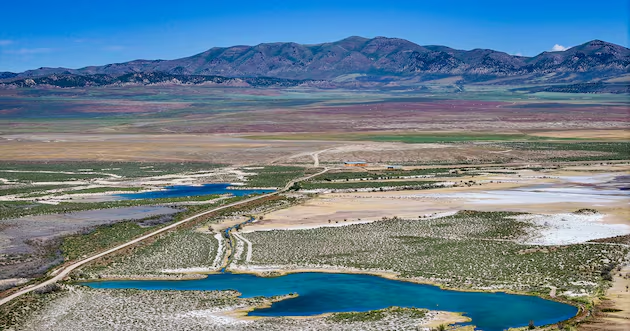
- Utah Senate President Stuart Adams has publicly asked Kevin O’Leary to shrink the proposed Stratos Project from 40,000 acres to 10,000 acres and adopt stricter environmental and transparency measures.
- Adams’ requests include returning excess water to the Great Salt Lake, using water-efficient technology, protecting wildlife and agriculture and publicly disclosing permits and project approvals.
- The project has faced significant public scrutiny over environmental and transparency concerns, prompting additional state reviews and a new executive order from Gov. Spencer Cox establishing statewide guidelines for large data centers.
Utah Senate President Stuart Adams is asking for a 75% land reduction in the proposed Box Elder County data center project before it can move forward.
Read more Is Taylor Swift involved in ‘Toy Story 5′? Here’s what we know
Adams, R-Layton, who chairs the Military Installation Development Authority, which oversees the project’s development area, said he sent a letter directly to the project’s main developer Kevin O’Leary, asking him to scale down the land used from 40,000 acres to 10,000 acres.
The letter doesn’t hold any legal weight, but Adams told the Deseret News he hopes it reaches O’Leary with “some credibility.”
“I would think a responsible person would respond to the letter and do the right thing,” he said.
O’Leary told “Fox and Friends” in late April that he had met with Adams and Utah Gov. Spencer Cox in January about the project.
The letter asks for greater transparency, stronger conservation commitments and that any excess water be treated and sent to the Great Salt Lake. Currently, no water from that area flows to the lake.
“If we can use this opportunity to take the water that doesn’t flow to the Great Salt Lake and actually move it to the Great Salt Lake, that’s a big win,” Adams told the Deseret News.
The Box Elder County data center, officially named the Stratos Project, generated intense public scrutiny after being unanimously approved by county commissioners in early May. After public comment had closed, many Utahns expressed concerns about the project’s potential environmental impact and alleged lack of transparency.
Following the blowup, a group of voters applied to add a referendum to the county’s November ballot to overturn the commission’s approval. However, last Thursday, county officials rejected the applications, saying they don’t believe the issue is “legally referable to voters.”
“I think there’s a natural anxiety that comes with anything new. You don’t know, the future causes anxiety and I think that is a natural process. But that’s why there are so many critical issues and regulatory processes that have been put in place,” Adams said.
Read more Utah Democrat renews push for rivals to drop out of congressional race as he releases new poll
Adams is currently seeking reelection for his Utah Senate seat in a Republican primary with multiple challengers.
He told the Deseret News he would “stay in the issue” regardless of the race.
“This is what we do every day, regardless of elections or regardless of anything else,” he said.
President Stuart Adams lists specific demands of O’Leary
Adams posed six new demands for Stratos Project developers to meet before beginning construction.
- Reduce the proposed project area from 40,000 acres to 10,000 acres to “limit impacts on the region and broader environment.”
- Commit to using the most water-efficient technology available and only the water “reasonably necessary” for operations. All excess water will return to the Great Salt Lake “at the developer’s expense.”
- Enter a Memorandum of Understanding with Utah’s Department of Natural Resources to disclose how the land within the reduced project area will preserve and protect wildlife and agricultural uses.
- Use heat-capture technologies and provide independent scientific and engineering analyses.
- Create a transparent, public-facing website that shows all approvals, including water and air quality permits.
- Work with state and federal agencies. The project should meet or exceed all environmental performance requirements.
Adams’ letter adds to the response from state leadership
Several days after the project was approved, Cox asked five departments within his administration to evaluate the project before it is allowed to move forward.
Analysis of the project will come from the Division of Drinking Water, the Division of Water Quality, the Division of Water Rights, the Division of Air Quality and the Division of Wildlife Resources.
In Cox’s May 8 statement, he reiterated his support for the project and, in addition to addressing public concerns, described potential benefits. He predicted the project would boost military readiness within the state and be an economic driver in Box Elder County.
Then last Friday, Cox issued an executive order establishing statewide guidelines for future large data center projects, which ensure transparency, air quality, responsible water use, energy generation and wildlife protection.
“Utahns have expressed legitimate concerns regarding the potential impacts of large data centers on water resources, air quality, utility rates, local communities and quality of life,” Cox wrote. “And those concerns must be carefully considered.”
The order referenced a state law passed in 2025, which requires any power development for data center projects to not increase electricity costs for Utahns.
Read more Silver linings: All groan up — Grunting, sighing, muttering and groaning