
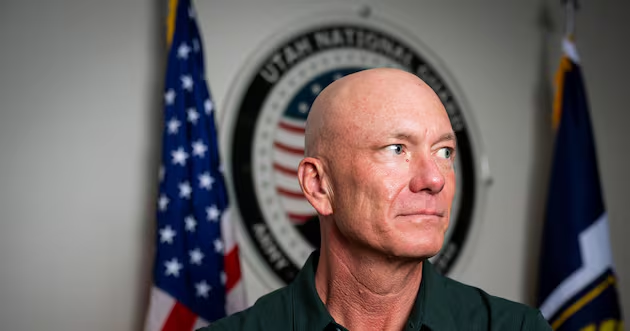
On a remote military base near Ramadi, Iraq, a run-down barracks offered little more than shelter from the elements. The building housed hundreds of U.S. troops serving during Operation Iraqi Freedom, and after years of heavy use, was dim, dank, and nothing more than a single cavernous room where soldiers packed in to sleep.
Read more What Republicans want — and don’t want — to see from Trump’s meeting with Chinese president
Zero comfort. Zero privacy. Zero resemblance to home.
“It was bare concrete walls, and just a big, open bay,” Brig. Gen. Shawn Fuellenbach remembers. “The power didn’t work great, and the lighting and air conditioning were in terrible shape.”
Civilian skills in a combat zone
For Fuellenbach and his men, this run-down barracks would be their only home for the next 12 months. Unlike the active-duty units that had come before, the Utah National Guard brought skills from their civilian lives with them. Some of them had even been electricians and construction workers.
“They came to me and said, ‘Hey, we want to fix this up. We can make this better for everybody,’” Fuellenbach said.
In the weeks that followed, the old barracks underwent a transformation reminiscent of a fixer-upper’s fever dream. The men in Fuellenbach’s unit stripped the barracks completely before installing new wiring and air conditioning, and even tracked down enough lumber to divide the cavernous space into small rooms.
“The bay was divided evenly so every two people had their own little room, which offered some privacy and let people personalize their space however they wanted,” Fuellenbach said. “It made it feel a little more like home.”
More than a unit
The renovation of a dilapidated barracks in the middle of Iraq is just one example of the innovation, resourcefulness and teamwork that Fuellenbach and his men displayed during their deployment. In an area that Fuellenbach described as the “Wild West,” his men found ways to look out for one another and hold on to their humanity even in the worst of circumstances.
“I had about 105 soldiers assigned underneath me, and got to know them on a very personal level,” Fuellenbach said. “We got to really know each other, our families, our situations … you could tell who somebody was just by how they walked across the parking lot at night.”
Fuellenbach went on to hold combat and leadership positions spanning every level of the organization, serving in high-stakes missions under Operation Spartan Shield and Operation Inherent Resolve.
“I think the thing that drove me the most to stay doing what I did was the brotherhood and the bond we developed,” Fuellenbach said of the men he served with throughout his career. “After all, you’re sacrificing together in something you strongly believe in.”
From private to general
Fuellenbach didn’t begin his service thinking he would someday command thousands of men. He started as a 17-year-old boy from Richfield, Utah, looking for a way to pay for college.
“I was 17, so my mom and dad both had to approve,” Fuellenbach said. “They had to sign the form, and my mom was not very excited about that. But she finally did sign the form, and I was able to join.”
Read more ‘Avengers: Endgame’ is headed back to theaters — with some brand-new scenes
Fuellenbach enlisted as a field artillery cannon crew member before rising to the rank of sergeant first class and eventually commissioning as a field artillery second lieutenant in 2001. In the years that followed, Fuellenbach would lead thousands of men in countless training exercises and combat missions.
Fuellenbach credits his years as an enlisted private working a variety of front-line jobs for his ability to lead his men and earn their trust.
“I started out on a howitzer section crew, and did all different things before becoming an officer,” Fuellenbach said. “Having that frame of reference to draw on helped me a lot because I knew what I was asking my soldiers to do.”
Brig. Gen. Michael Kjar, Utah’s adjutant general, called Fuellenbach a “master of his craft” who pursued expertise so he could lead with moral authority. Yet Fuellenbach stressed humility over credentials when leading troops into combat.
“As a leader, you don’t know everything, so you have to trust in those that work with you and get feedback whenever you can,” Fuellenbach said. “Then you get a strong team that wants to help you do the right things and make sure everybody gets home.”
An honor to serve
Fuellenbach’s retirement ceremony was held at the Utah National Guard Joint Force Headquarters auditorium in Draper on Sept. 11 after 36 years of service.
Fuellenbach was surrounded by friends and family, including his children and wife Yvonne, whom Fuellenbach thanked for his ability to serve for so long.
“I had awesome family support,” Fuellenbach said. “My family was always behind me; I couldn’t have done it without them.”
Over three decades, Fuellenbach carried Utah’s National Guard legacy into combat zones, coalition headquarters and some of the military’s most consequential operations.
“As you move along, you realize the importance of what we do and that not everybody in America recognizes that,” Fuellenbach said. “We have a great country with so many freedoms, and it takes people willing to protect those and be prepared to fight and win our nation’s wars if called upon.”
Read more Utahns speak their minds on AI policy: ‘Learn from experts, not from lobbyists’