
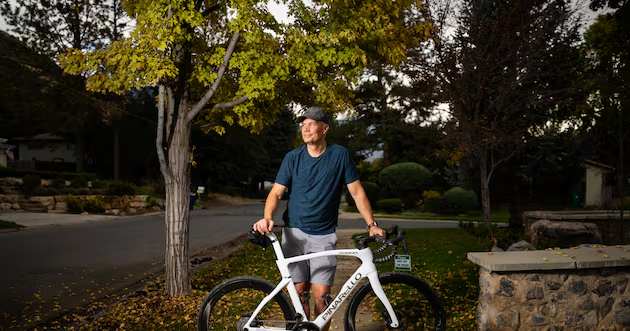
In the spring of 1945, when the world was at war and the Nazis occupied the Netherlands, 14-year-old Hank Hoole rode a bicycle with metal rims 175 kilometers through the Dutch countryside after delivering food to his father so he wouldn’t starve.
Read more High school football: Friday’s 3A/2A/1A first round recap
Last month, 56-year-old Greg Hoole did the same ride, albeit with rubber tires.
There was no media, no pomp or ceremony; just Greg, alone, on his bike, paying tribute to a father he revered, reflecting as he passed the flowers, dikes and windmills about what it must have been like during the Second World War, about the gumption and resourcefulness of his father, about what was going through his mind riding on those metal rims … and about why on Earth he didn’t ask his dad more questions about it when he was alive.
Hank Hoole (full name Hendricus J. M. Hoole Jr; he switched to Hank after emigrating to America after the war) passed away in 2013 surrounded by his loving family.
Three years earlier, he’d handed out copies of his life story to his posterity, detailing an amazing, eventful life that overcame the Great Depression, World War II, and integrating into a new land and language.
Earlier this year, Greg, Hank’s youngest son, was rereading the autobiography — a book he helped write and edit — when he came upon the bike trip story:
It was in the spring of 1945. The Netherlands had survived another winter under the Nazi boot. There was a serious food shortage in the cities, on account of strict border controls, particularly in Amsterdam, the biggest city. A year earlier, the Nazis, because of the famine, had ordered women and children out of Amsterdam, but told the men to stay behind. Johanna Hoole left with her seven children, Hank being the oldest. The family lived on a farm outside the town of Assen in exchange for their labor. In the country there was more food, not in great abundance, but enough to go around. All winter Johanna worried about her husband Hendricus, sure he was wasting away to nothing.
When passage looked safe, she filled a sack full of food, put it on Hank’s back, and sent him to Amsterdam to find his father. Hank walked for a while, then an army truck full of Nazi soldiers passed by. He waved them down. They made a deal. If he’d look out for enemy planes, they’d take him into the city. On one occasion, he spotted a British Spitfire and they all dove in a ditch till it passed.
In Amsterdam, Hank found his father, plied him with the food, and after what must have been a joyful and solemn reunion, Hank prepared to leave. That’s when his father pulled out the bicycle. It was in decent shape, but all the rubber was gone. Because of rationing, there wasn’t a rubber tire to be found in all of Amsterdam.
But it was all Hank had, so he climbed on board and somehow rode that bike all the way back to the farm.
Maybe it was because he loves bikes, maybe it was because enough time had passed to make each memory that much more valuable, but whatever it was, the story resonated with Greg to the point that when he closed the book, he had one thought: I’ve got to do this!
In early September, he flew to Amsterdam, found a bike shop and rented a heavy town bike with upright handlebars (to the objections of the sales clerk, who, when he heard how far Greg was going, recommended a high-end road bike).
Read more Opinion: It’s not money or duty that sparks more childbearing
Despite the no-frills bicycle, in a lot of ways — well, almost all ways — the two trips differed.
Besides riding in peacetime, the list of things Greg had going for him that his Papa didn’t included: rubber tires, a bike path the entire way, multiple gears, all sorts of places to eat — and, not least, Apple Maps.
To get started, Greg simply plugged “Assen” into his iPhone and put in his earbuds so he could listen to Siri telling him where to go (and to his playlist when she wasn’t).
But it was still Holland and it was still 175 kilometers (110 miles) from A to B.
Besides, the point wasn’t to exactly replicate the ride. The point was to pay homage to the boy who rode it.
It took Greg two days to cover the distance. He rode 120 kilometers the first day, meeting up with his wife that night at a nice hotel in Vollenhove (“Wow!” he remembers thinking. “My dad wouldn’t have stayed here”). Then 55K the next. In Assen, he loaded his bike on the train and headed back to Amsterdam. “One-way trip,” he says, “just like my dad.”
All the way, he thought constantly of Hank Hoole, wishing he was there.
“I’d have asked him, ‘Dad, how long did it take you? What did you eat? How did you know where to go?’ So many questions I regret I didn’t ask. He wasn’t one to regale you with stories of his childhood, but he would talk about it if it got brought up. The war didn’t traumatize him, probably because he was young, but he wasn’t into bragging either.”
Still, “it was a really neat time just to reflect on his life. It was just fun, it was uplifting, it couldn’t have been more enjoyable.”
“When I finished,” says the second Hoole in history to ride a bicycle from Amsterdam to Assen, “I felt like I was on top of the world.”
Read more Utah business, government leaders deepen connections in Ireland