
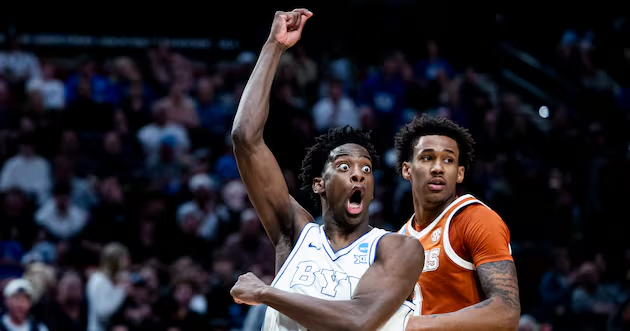
- An NCAA study found more than half of male college athletes believe they will become pros.
- Three-fourths of men’s basketball and football players see themselves at the next level.
- Only about 1% of male college basketball players are drafted by an NBA team.
Very few college athletes become pros. In fact, of the more than 500,000 NCAA athletes, fewer than 2% will go pro in their sport.
An old commercial showing college athletes working out and playing various sports, including swimming, basketball, football and softball, ends with this famous line: “Almost all of us will be going pro in something other than sports.”
But that doesn’t stop them from dreaming of The Show, especially men’s basketball and football players.
How many college athletes think they’ll go pros?
A newly released survey of thousands of athletes in Division I — schools that generally have the largest athletics budgets and offer the highest number of athletics scholarships — found a majority see themselves as future professionals or Olympians.
Among male athletes, 57% believe they are somewhat likely to become a professional or Olympic athlete, according to the NCAA’s Growth, Opportunities, Aspirations and Learning of Students in College or study.
The percentage fell dramatically among female athletes. Only 24% see themselves going to the pros or the Olympics.
Perceptions varied widely by sport, gender and division. Athletes competing in sports with more established professional or Olympic pathways were generally more likely to think they could continue their athletic careers at the next level.
The number of those who believe they can play professionally drops significantly among Division II and Division III college athletes.
Sports in which at least half of student-athletes reported being somewhat likely or more likely to become a professional or Olympic athlete were:
- Division I men’s basketball (78%) and Division II men’s basketball (63%).
- Division I men’s ice hockey (75%) and women’s ice hockey (54%).
- Football Bowl Subdivision players (74%) and Football Championship Subdivision players (61%).
- Division I men’s golf (67%) and women’s golf (50%).
- Division I baseball (59%).
- Division I men’s soccer (56%).
A total of 20,877 current athletes at 493 schools participated in the study, according to the NCAA.
Athletes in the study were also asked whether they expected that their job after college would involve sports. The survey found 54% of Division I male athletes and 49% of Division II male athletes somewhat or very likely. Both rates were higher than those for Division III men’s and women’s athletes in each division.
Making the NBA
An analysis of draft-eligible NCAA men’s basketball conducted by Saint Xavier University exercise scientist Joe Eisenmann found the percentage of players transitioning from NCAA basketball to the NBA in 2023 was 1.1%.
Read more A new look and new names to fill in as Utah’s largest farmers market returns
That year there were 19,213 NCAA men’s basketball players, of which 4,270 were eligible for the NBA Draft.
There were 58 total draft slots but six international players not attending U.S. colleges and another six players from the U.S. club teams G League Ignite and Overtime Elite allowed 46 picks of NCAA athletes, Eisenmann found.
Even among the power conferences, only 13.7% of draft-eligible players were selected in the NBA draft in 2023.
Parents’ expectations of their child athletes
A study published in Journal of Sport and Social Issues last November found most parents have realistic expectations of their children’s future athletic achievement. But a substantial minority believe their kids will beat the odds and become collegiate, pro or Olympic athletes.
In a survey of 785 American parents, 34% thought it was somewhat or very likely that their child would become a small-college athlete, 27% thought it was likely they would become a college scholarship athlete, and 17% thought it was somewhat or very likely they would become a professional or Olympic athlete, per Ohio State News.
“Most parents seem to have realistically pessimistic expectations about how much their children might achieve in sports,” said Chris Knoester, co-author of the study and professor of sociology at Ohio State University.
“But there were sometimes wide differences in expectations depending on a variety of factors, including parents’ race and ethnicity, socioeconomic status, neighborhood they lived in, sports fandom and whether they thought their child had a strong identity as an athlete.”
Study lead author Christopher McLeod, associate professor of health and human performance at the University of Florida, said one factor in particular had a strong impact on parental expectations.
“When parents believe their child thinks of themselves as an athlete, and has a strong athletic identity, that seems to be an on switch for parents to have these very high expectations,” he said.
The study was based on adults who participated in the National Sports and Society Survey, sponsored by Ohio State’s Sports and Society Initiative, according to Ohio State News. The researchers used data on the adults in the survey who were parents of a child aged 6-17 and living at home. If they had more than one child, one child was selected for them to focus on in the survey.
Read more Miraculous rescue of Everest Sherpa defies all odds