
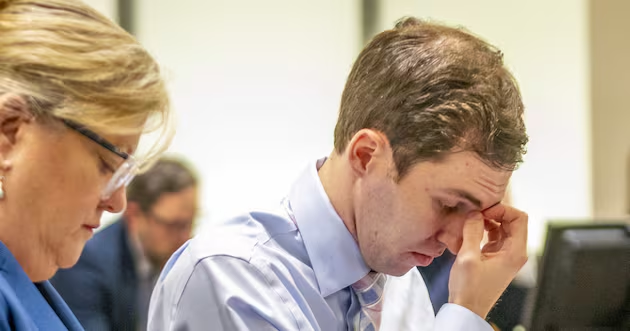
Tyler Robinson’s defense team believes the Utah County Attorney’s Office violated the court’s order to not make prejudicial statements to the media and that the judge should impose sanctions.
Read more Flesh-eating screwworm just got scarier
“I think that the number one remedy in this case is to preclude the state from seeking the death penalty against Mr. Robinson,” attorney Richard Novack told 4th District Judge Tony Graf on Friday in Provo.
The judge in the Robinson capital murder case heard about three hours of arguments from both sides on Friday about whether comments made by prosecutor Chris Ballard, the office’s spokesman, to various media organizations nationwide — including TMZ and USA Today — were in violation of the court’s order and if the Utah County Attorney’s Office should be held in contempt of court because of it.
Robinson, 23, is accused of shooting and killing political activist Charlie Kirk at Utah Valley University on Sept. 10, 2025. He faces a potential death sentence if convicted.
In March, Robinson’s defense team filed a motion to postpone his preliminary hearing. In that motion, they noted that an initial report from the Bureau of Alcohol, Tobacco, Firearms and Explosives “indicates that the ATF was unable to identify the bullet recovered at autopsy to the rifle allegedly tied to Mr. Robinson.”
That tidbit of information, the prosecution contends, was misleading and generated a tidal wave of media reports questioning whether the state’s case had imploded. The state says Robinson left out a key part of the ATF report that said it could not identify “or exclude” that the bullet fragments recovered at autopsy matched the rifle found near the shooting that investigators believe Robinson used.
Because of that, the Utah County Attorney’s Office contends it had an obligation to its client, the state of Utah, to correct the misinformation that was being spread and prevent the potential jury pool in Utah County from being prejudiced with misleading information. Ballard appeared on several national news programs and sent a statement from the Utah County Attorney’s Office to several outlets.
The goal of the interviews was to respond to media inquiries about the misinformation being spread, Ballard testified on the witness stand Friday, and that a simple “no comment” to the numerous media requests the office received would not have been sufficient.
“My concern is that it would feed the idea the state did not have sufficient evidence in the case,” Ballard said. “This was a significant issue, and we needed to figure out how to respond to that.”
Likewise, when Utah County Attorney Jeff Gray was called to the witness stand, he concurred, “What we’re concerned about is prejudice to a prospective jury.”
But Novack took issue with the explanation from prosecutors, particularly when Ballard argued he was speaking in general terms about ballistics testing and not the bullet fragment in question in Robinson’s case.
“Sometimes the coverup is worse than the original conduct,” he said while adding that he found “no credibility” in Ballard’s sworn testimony. “He’s talking about the bullet fragment analysis in this case. And I have trouble accepting Mr. Ballard’s explanation that he really never said anything about the bullet fragment analysis in this case.”
Rather than trying to correct alleged misinformation, Novack argued that “Mr. Ballard is trying to influence public perception” about the case. And while one of the elements to sustain a contempt allegation is intent, Novack contends the conduct of the Utah County Attorney’s Office “at a minimum…was extremely reckless.” He also pointed to all the press the case has generated since Robinson’s arrest and how the state has maintained that, in spite of that, there are still ways to seat an impartial jury.
“The state has been saying all along that media coverage has not prejudiced the case, but when it suits them, they say they’ve already determined that their case is prejudiced, so they need to correct the perception in the jury pool so they can have a right to a fair trial,” Novack said. “What was going on here was an attempt to influence the jury pool.”
The state countered that Ballard never directly said he believed Robinson was guilty and that nothing he said to the media violated the court’s rules since he was addressing evidence already mentioned in publicly filed court documents. Prosecutor Ryan McBride also reminded the court that when attorneys file, they must be honest in their representations.
Read more Faith powers these U.S. stars at the World Cup
In addition, McBride says comments by Ballard that the state believes it has enough evidence to prove its case is something all prosecutors say and what the public expects when filing serious charges.
“I think everybody knows we believe we can prove this case,” he said.
Also, on Friday, Graf heard brief arguments on the admissibility of hearsay evidence during the preliminary hearing.
Hearsay evidence is any statement that an officer might collect from another person and present at the preliminary hearing. That might include, for example, detectives who talked to Robinson’s roommate, Lance Twiggs, although Twiggs is not scheduled to be called to the witness stand himself, or officers who talked to witnesses at Utah Valley University on the day of Kirk’s shooting, but those witnesses aren’t being called themselves to testify.
Defense attorney Michael Burt says hearsay evidence is not proper for a preliminary hearing in this case, yet the state intends to rely almost exclusively on it. Without naming him directly, Burt alluded to the fact that video testimony from Twiggs, who was questioned by law enforcers — and asked a “series of leading questions,” according to Burt — is expected to be used during the preliminary hearing. Burt called the unnamed witness “central” to the state’s case. He argued Friday that the defense has a right to cross-examine witnesses, even at the preliminary hearing stage, “to get to the truth.”
It’s unfair for a case to go forward on hearsay when Robinson’s “life is at stake,” Burt said.
But prosecutors say the burden they need to meet at a preliminary hearing is so low that reliable hearsay is sufficient.
“All we have to show is probable cause,” Ballard said. “A reasonable probability that an offense was committed and the defendant committed it.”
Burt countered that a “low burden does not mean no burden.” During a preliminary hearing, a judge decides whether there is enough evidence for a defendant to proceed to trial on the charges filed.
Graf will announce his rulings on the hearsay and contempt issues on June 22.
Meanwhile, Robinson filed a motion Thursday night under seal that’s titled, “Application for Certificate to Secure Out-of-State Witness” for the preliminary hearing. In court Friday, defense attorneys did not indicate who the witness is, only saying it is not the victim, presumably meaning Erika Kirk. The defense stated that the witness’s attorney has declined to accept service of the subpoena. More court filings are expected soon on how the court should proceed.
Graf started Friday’s hearing by issuing a ruling on Robinson’s request to put all state legal proceedings on hold while the Utah Supreme Court decides whether to hear their appeal regarding electronic media coverage. On Saturday, the Utah Supreme Court requested that the Utah County Attorney’s Office and attorneys for the media each file a response to Robinson’s petition within two weeks. Because of that, Robinson wants his legal proceedings to be stayed while the state’s high court considers the defense’s petition.
On Friday, Graf denied the motion, stating that Robinson “has not established a concrete threat of irreparable harm” if cameras are allowed to continue in the courtroom pending the high court’s decision. While Graf says he is not minimizing Robinson’s concerns regarding the high publicity the case has generated, he says “extensive publicity does not mean an impartial jury cannot be selected.”
“Prominence does not produce prejudice,” Graf stated in his ruling. The judge stated that the case’s continued progression outweighs the need for a stay.
Robinson’s preliminary hearing is currently set for July 6-10. Defense attorneys indicated Friday that they may again oppose and request that the media have cameras and microphones in the courtroom during the hearing.
Read more Latter-day Saint convert and retired U.S. Marine gears up for 2026 Warrior Games