
- Around 6,700 Republican or unaffiliated voters requested ballots for the 1st Congressional District Democratic primary.
- This is a 415% jump compared to the number of Democratic ballots requested across Salt Lake County in the previous midterms.
- These voters are likely to have a higher turnout, potentially having an impact on congressional and municipal Democratic races.
A new court-ordered congressional seat in Salt Lake County put Utah Republican voters in a position they are not accustomed to: asking whether they may have the greatest electoral impact by voting for a Democrat.
Read more Opinion: Why I’m walking 250 miles for America’s semiquincentennial
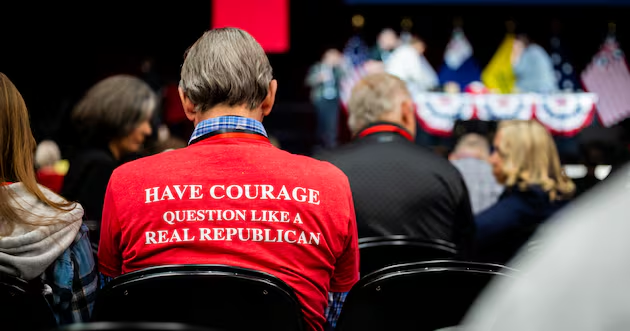
After years of criticizing self-identified Democrats for registering as Republicans to participate in the GOP’s closed primary system, some conservatives are exploring the chance to influence Democratic races in the party’s open primary.
The 1st Congressional District favors Democrats by anywhere from 14-24 percentage points, leading to a competitive Democratic primary, while many Republicans in the district will not be receiving a primary ballot at all.
This has led to a huge surge in voters requesting access to the Democratic primary without changing party affiliation.
Around 6,700 Republican and unaffiliated voters in the 1st District have requested a Democratic ballot, according to Salt Lake County Clerk Lannie Chapman. This accounts for 90% of requests for ballots in Salt Lake County and represents a 415% increase compared to the previous midterm in 2022.
While some Republicans may be trying to spoil the race for progressive underdogs in hopes of giving GOP nominee Riley Owens a shot in the fall, one Democratic candidate, former Rep. Ben McAdams, is encouraging Republicans to weigh in.
McAdams’ campaign confirmed to the Deseret News on Wednesday that they sent out mail pieces and digital ads prompting likely voters, regardless of party affiliation, to take the steps necessary to request a Democratic primary ballot.
The last day to do so was Tuesday. Voters have until June 23 at 8 p.m. to submit their ballot or vote in person.
It is unclear how much non-Democratic voters will affect Utah Democrats’ first hotly contested primary in recent years. But it could change how Republicans view their vote and how Democrats feel about their open primary process.
Republicans voting in a Democratic primary
Kathleen Anderson already has her name on the general election ballot as the Republican nominee for the Salt Lake County Council at-large seat, but she said she believes it is her civic duty to vote in the Democratic primary this year.
Anderson, like thousands of other 1st District Republicans, did not receive a GOP primary ballot this year after she and Owens beat their convention-only opponents with a primary-proof margin at the party convention in April.
However, she said voters should take advantage of Democrats’ open primary system to oust long-time incumbents, naming District Attorney Sim Gill, and to shape the Democratic representation Utah sends to Washington, D.C.
“I just take governance very seriously, and wherever I can have my voice heard is where I’m going to make my voice heard,” Anderson told the Deseret News. “I always encourage people to vote. … Be civically engaged.”
Republican voter Jackie Martin also decided the best way to ensure representation in Congress is to request a Democratic ballot. Martin runs the Kearns community Facebook page where she interviews candidates.
After talking to the candidates, Martin said she appreciates McAdams’ experience working on the West Side as county mayor, but she is leaning toward state Sen. Nate Blouin because he seems more open to solutions on housing.
“For lot of Republicans, there’s sort of a purity to it,” Martin told the Deseret News. “They think if you associate in any way with Democrats that it affects your party affiliation, whether on paper it does or not. And it just doesn’t.”
Despite voting in the Democratic primary, both Martin and Anderson said they plan to support Owen in November.
Will Democrats change the system?
Utah Democratic mainstay Scott Howell remembers how Republicans rallied around closing their primaries to non-party members 20 years ago after learning that he, as state Senate Minority Leader, always voted in GOP primary elections.
He believes Democrats’ open primary remains its strength, enabling candidates who speak across partisan divides.
Read more Here’s how Utah basketball’s schedule for next season is shaping up
Howell is helping with multiple Democratic campaigns this year that have sent mail pieces to Republican voters, actively seeking for them to request a Democratic primary ballot, emphasizing this will not change their party affiliation.
“The more citizens who can engage in the democratic process, the healthier our whole democracy becomes,” he said. “Voters today are much less interested in party labels, and they’re more interested in the quality of the candidate.”
An open primary could help McAdams against his socialist-leaning opponents, Howell told the Deseret News.
Rob Axson, the chair of the Utah Republican Party, told the Deseret News he hopes Democrats see what is happening and follow the GOP’s example. Closed party primaries, he said, create buy-in that leads to more constructive political debates.
But he does not condemn the two camps of 1st District Republicans: those who want to nominate an extreme Democrat to boost their party’s chances in November, and those hoping to cut their losses by electing a more moderate candidate.
“I can understand people wanting to participate and I can understand the strategic benefit,” Axson said.
Rachelle Morris, who narrowly lost a county council race against progressive candidate Natalie Pinkney in 2024, said fellow 1st District Republicans are conflicted about how to use their vote now that the congressional seat is so blue.
But with at least 6,700 requesting mail-in ballots, and more sure to vote on Election Day, Morris said Republicans could potentially decide some close county and legislative Democratic primaries, if not the congressional race.
“There could be impacts in several different competitive Democratic primaries across Salt Lake County,” she said.
What does turnout look like?
Voter turnout is already ahead of schedule: 18% of eligible voters have cast a ballot, compared to 15% at this point in 2024, when there was a presidential and U.S. Senate race, according to Chapman, the Salt Lake County clerk.
In the past midterm election, Salt Lake County had a voter turnout of 44%, with more than 149,000 ballots out of roughly 338,800 voters. But Chapman expects the turnout rate to be higher among those who requested ballots.
“Human nature tells me that if you’re going to take the effort to request something, … that those people are more likely … to turn in those ballots than somebody who may have just automatically been sent a ballot,” she said.
While Democrats’ open primary allows any registered voter to participate, it does not allow voters to participate in multiple primary elections, Chapman said. If a voter tries, their second ballot to arrive will not be counted.
Her office automatically mailed out 200,000 ballots, not including the 7,500 Democratic ballots requested later.
A large majority of Salt Lake County voters are Republican. As of January, there were roughly 120,600 unaffiliated voters in the 1st District, 134,000 Republicans and 98,700 active registered Democrats — 41% of the state’s total.
While much remains uncertain about what Utah’s newly drawn Democratic district is like, Chapman said the upcoming primary will shed light on how redistricting has changed voter behavior — for Democrats and Republicans.
Candidates in the 1st District primary include McAdams, who represented Utah in Congress from 2019 to 2021; Blouin, Liban Mohamed and Michael Farrell, who have framed themselves to the left of McAdams.