
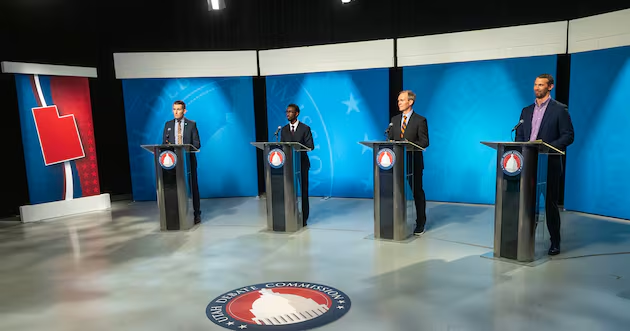
- Ben McAdams has raised $2 million, compared to Nate Blouin’s $644,000, Liban Mohamed’s $288,000 and Michael Farrell’s $43,000.
- A pro-AI innovation super PAC has spent more than $1 million on advertisements in support of McAdams, ranking third-highest in country.
- Blouin, Mohamed and Farrell have put forward a progressive agenda of free healthcare and childcare funded by taxing billionaires.
Utah is about to learn what kind of Democrat the newly created 1st Congressional District will send to Washington, D.C., with the first test for the House seat pairing big money with a bold lurch to the left for the Beehive State.
Read more Opinion: As we celebrate Juneteenth, let’s also celebrate the courageous woman who made it possible
The four Democratic primary contenders have repeated liberal talking points, often veering into economic populism, reflecting confidence that a Utah district where Kamala Harris won by 24 points is ready to leap into progressive politics.
As state Sen. Nate Blouin competes with 27-year-old tech policy advocate Liban Mohamed and self-funded attorney Michael Farrell over the democratic socialist lane, former U.S. Rep. Ben McAdams has secured establishment support.
This has translated into a huge fundraising advantage, with McAdams pulling in nearly $2 million, including $368,500 over the past two months, dwarfing Blouin’s total of $644,000, Mohamed’s $288,000 and Farrell’s $43,000.
Utah’s rare competitive Democratic primary has also become a proving ground for artificial intelligence special interests, as political action committee money floods voters with more ads, texts and mail than they know what do with.
On Tuesday, 1st District Democrats — plus the Republican and unaffiliated voters who requested a ballot in the open primary — will send a message about the representation they want during a tumultuous moment for the country.
What messaging tells us
According to Robert Jensen, a Democratic voter in Sugarhouse who has already cast his ballot, the 1st District nominee should be able to address Democrats’ two biggest concerns: federal dysfunction and executive overreach.
“I think both of those are important — you’ve got to be able to work with the other side, or politics doesn’t work, but you’ve also gotta be willing to take a stand and fight for what we’re trying to get in our agenda,” Jensen said.
This is the balance McAdams has been trying to strike from the beginning of his campaign: touting his vote to impeach President Donald Trump in 2019 — which may have cost him his reelection in 2020 — and his eagerness to reach across the aisle.
While his opponents echo the anti-capitalist rhetoric of New York Rep. Alexandria Ocasio-Cortez, McAdams recognizes “Utah progressives,” not “San Francisco progressives,” will decide his race, Utah political strategist Reed Galen said.
Convention delegates who narrowly nominated Mohamed over McAdams in April, are about as representative of the primary-voting electorate as those who call into radio talk shows are of the audience, Galen told the Deseret News.
A fundraising advantage frees McAdams from relying on the activist base, according to the Lincoln Project co-founder.
“Money doesn’t buy you victory in politics, but it certainly does buy options — and he seems to have the most options right now,” Galen said of McAdams. “And you can see it in his messaging.”
McAdams’ moderate tone combined with a campaign centered around pragmatic coalition-building on LGBTQ non-discrimination, affordable housing and the Great Salt Lake is exactly what appeals to Linda, a resident of Taylorsville.
Linda, who did not want to share her last name, does not appreciate the name-calling or demonization rampant in both parties. She believes McAdams will find productive compromises in Congress like he did during his first term.
But “all indications” are that Utah’s court-ordered 1st District is not so moderate, according to Josh Ryan, a professor of political science at Utah State University who researches Congress, redistricting and Utah politics.
“The truth is, if the district is as Democratic as everyone believes it to be, McAdams would likely be too conservative for the district,” he said. “This isn’t the old 4th in which the legislator had to appeal to both Democrats and Republicans.”
Whether he likes it or not, McAdams is seen as the choice of the party “establishment,” Ryan told the Deseret News.
But that might be a calculation primary voters are willing to make to have a candidate who is more likely to get things done and who has a better chance at surviving the future redistricting battles that are sure to come, Ryan said.
Read more Will this be America’s best birthday celebration, or perhaps, the worst?
McAdams’ opponents have done all they can to speak to the dissatisfaction of the district’s Democratic demographic.
Blouin, Farrell and Mohamed have each backed a similar vision of radical change, calling for tax hikes on wealthy Americans to fund Medicare for all, universal childcare and federal action to counter climate change.
Is big money a big deal?
This approach, reminiscent of New York City’s socialist mayor Zohran Mamdani, is exactly what Murray resident Shaun Paddock was looking for. Her top issues include aggressive resistance to Trump and the elimination of U.S. Immigration and Customs Enforcement.
After consulting candidates’ campaign material, Paddock said she decided to vote for Mohamed. She said her red flag for McAdams came early as her mailbox and Instagram feed filled up day after day with super PAC-funded ads.
“I don’t know who’s bankrolling him but I’m over it,” she said. “I think you can get your point across without spending.”
Out-of-state PACs, which cannot legally coordinate with campaigns, have dropped more than $2.6 million on ad placements in support of McAdams this election cycle, according to Federal Election Commission filings.
This includes more than $1 million from New Democrat Majority, which aims to elect “pragmatic” candidates focused on “economic growth”; and more than $1 million from Think Big, which backs “pro-AI” candidates.
Think Big is part of the Leading the Future network funded with $100 million from OpenAI co-founder Greg Brockman and techno-optimist investor Andreessen Horowitz to limit government regulations that stunt rapid AI innovation.
With the latest Think Big expenditure on Wednesday, McAdams became the third-ranking candidate in the country in terms of pro-AI innovation PAC money spent to support him, according to the Transformer campaign finance tracker.
Special interest dollars pouring into the race is producing a response among Democratic voters skeptical of AI and Silicon Valley giants, said Jamie Carter, the outreach director at the pro-Democratic nonprofit DemCast.
Up against the pressures of a party primary, McAdams has emphasized progressive stances on abortion and minimum wage, according to Carter. But she said voters are more interested in who is funding candidates’ campaigns.
“Wanting big money out of our politics … that’s where I think you’ll see the backlash,” Carter said.
But, ultimately, the political realities of superior name recognition will likely rule the day, according to Matthew Burbank, a professor of political science at the University of Utah, who specializes in urban political participation.
With every candidate emphasizing progressive views, the deciding factor in the 1st District race could be McAdams’ name ID as a former representative, and the funds he has to reinforce that name ID, Burbank told the Deseret News.
One Democratic voter, Sierra, said she is taking all of these factors into account before she votes next week.
The Sugarhouse resident, who preferred not to share her last name, said since her activist youth she has become disenchanted with “100% idealistic leftist candidates,” because they rarely are able to bring about real change.
“I see who aligns better with my politics, and then I try to look at it through a lens of who can actually win, and then who can actually get things done,” Sierra said.
The 1st District Democratic primary will take place on June 23. The district covers most of Salt Lake County — including Salt Lake City, West Valley City and Murray — but excludes the more Republican-leading southern part of the county.
Read more Sarah McLachlan reflects on her ‘Toy Story’ moment: ‘One of the most beautiful songs ever written’