
Environmental groups opposing the proposed Vesper Amphitheater project claim it violates the city’s “Hillsides and Canyons Plan,” but project owners say the proposal actually helps fulfill the plan’s goals.
Read more Supreme Court rules along ideological lines in case involving religious rights in prison
On Wednesday, the Provo Planning Commission will discuss the proposed Vesper Amphitheater project for the first time — approving or denying the project’s concept plan and making recommendations for the city council on the requested general plan amendment and zoning change.
Provo Mayor Marsha Judkins said the project would “transform this area into something that will be not only an economic driver for Provo, but also just an amazing, beautiful, wonderful venue for fantastic musical events.” Utah County Commissioner Skyler Beltran also expressed his approval for the “spectacular project.”
But opposition has grown in community circles, with hundreds of comments against the idea and several local Facebook pages asking how to stop the development. A petition, signed by 4,500 people, argues Provo Canyon is “simply not the right place” for a large-scale commercial endeavor that would “fundamentally alter” the canyon.
Conserve Utah Valley and other environmental groups have taken issue with the Vesper project, saying the situation is an uphill battle.
“There are many venues for the arts in Utah, but there is only one Provo Canyon. Once gone – it’s gone forever,” the group said in a statement.
Hillsides and canyons preservation
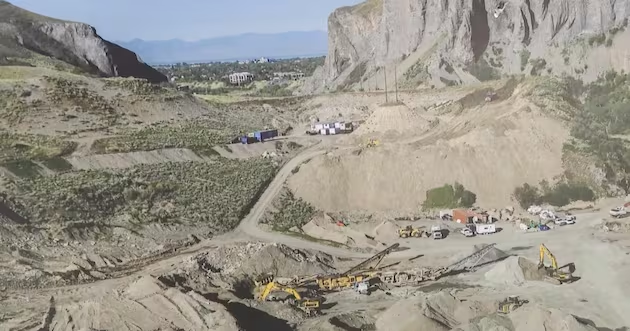
The 100.7-acre proposal would include a more than 20,000-seat amphitheater, 75 hotel rooms, a parking garage and a retail and dining area, located at 6622 N. Highway 189, across the street from Mount Timpanogos and Canyon View parks. Vesper touts the project as restoring the canyon’s natural beauty, as it would be built on the site of a mining facility.
The Provo Hillsides and Canyons Plan was adopted in December 2023 with guidelines for the preservation and development of the canyons.
The plan’s goals are to preserve and restore natural habitats and landforms, conserve and protect water, increase recreation opportunities, encourage trail connectivity, use “best practices” development to minimize environmental impacts, limit development in environmentally sensitive areas and ensure scenic quality and hillside visibility so future developments fit in the natural setting.
“Overall, residents would like to see the hillsides and canyons preserved as they are, with minimal additional development beyond improvements to basic amenities,” the plan says.
Vesper Amphitheater addressed the issue in its planning applications submitted to the city, saying the project is “in line with the vision” of the Hillsides and Canyons Plan. Vesper cited the Hillsides and Canyons Plan’s implementation section: “Consider the creation of a task force to address gravel pit reclamation. This could include ecological restoration, the creation of an outdoor concert venue, or other recreation amenities.”
Conserve Utah Valley executive director Kaye Nelson disagrees. She was part of the group that created the Hillsides and Canyons plan and argues there are many things in Vesper’s project proposal that “don’t jive” with the preservation plan.
“While the Hillsides and Canyons plan now has the words, ‘concert’ and ‘amphitheater’ in it, those who helped craft the plan never would have approved the uses put forth by the developers. The idea was more about potential gathering places for manageable groups, nothing even remotely nearing 20,000 people,” she said.
The hillsides plan says the Vesper project is in a “high level of ecological constraint,” meaning it is “less suitable” for development due to high fire risk, habitat priority access, and geological hazards.
Vesper is requesting that the zoning of the area — which currently covers three zones: open space, preservation and recreation; public facilities; and agricultural — be changed to a regional shopping center zone. The company also wishes to amend the general plan’s designation of the proposed project area from agricultural and parks, recreation and open space to commercial.
Despite being commercially designated, the project leaders say the development t is still focused on being environmentally forward.
“Its location at the mouth of Provo Canyon gives it regional visibility and access characteristics that are materially different from a typical infill or neighborhood property. The project will provide and enhance access to public trails and open space, which is consistent with current general plan goals,” Vesper said.
Read more Opinion: The civic virtue of everyday citizens
The project will be, at most, 30% developed to comply with the regulations of the regional shopping center zone, the application says.
All leftover undeveloped areas will be landscaped or preserved as open space. Vesper said it plans to place more than 50 acres of the project under a conservation easement and increase connectivity between the Provo River and the Bonneville Shoreline trail systems.
“While the current site area is not publicly accessible, the proposed plan will incorporate public trails and connect existing trails to open space and trail hubs,” the application says.
Vesper said it will work with the Utah Department of Transportation to determine roadway infrastructure improvements to handle the increased traffic. One such solution is a pedestrian and vehicle bridge across Highway 189 to increase access to local parks and trails.
But Nelson argues the environmental and traffic studies need to be completed and addressed before the area is rezoned. Even though Vesper claims the venue will only have a few full-capacity events, Nelson says the development’s uses should be limited to minimize its impact on the canyon.
“We have lots of concerns on many topics, but, besides traffic, the biggest concern we have is how this will change the nature of the canyon. It’s a gift for many people from all over to go there to recreate, to relax, to see fall leaves and more. This high-impact venue will cause a shift in who uses the canyon. People will stop going if they have to battle the traffic, even if it is mitigated with a UDOT flyover,” Nelson said.
Finalized plans to come with city approval
“The design for the project, including the structure locations, sizing and massing, is not yet finalized,” the application states.
Vesper submitted a 48-page planning application detailing an “envelope-based concept plan” that provides the city with the authority to shape the final list of uses, design commitments and project obligations, but also allows for flexibility on some aspects, such as site-grading, utility strategies, road access and geotechnical conditions that still need to be studied.
The project plans to use native vegetation and water-wise principles throughout the development and minimize the need for regrading by using existing slopes and landforms when possible, according to the application. The flexible design can be adjusted “around existing natural features without compromising the integrity of a premier venue experience.”
Because the existing condition of the site has “substantial portions” that are previously mined or disturbed gravel pit terrain, Vesper said, the main concern isn’t about whether development is extending into “intact undisturbed hillside conditions,” but rather how previously altered landforms can be safely regraded and reused through engineered pads, circulation, drainage, stabilization and revegetation.
“This does not mean hillside considerations disappear across the site. Rather, hillside sensitivity is not uniform,” Vesper said in its application. Further geotechnical, grading and engineering refinement will follow as the project continues, it added.
David Osmond, who announced the project in a press conference last month, says the goal is not to overwhelm the canyon with a new development but to “transform it from an existing gravel pit into something more beautiful, more useable, more stable, more thoughtfully planned — a gateway to the Provo Canyon.”
Conserve Utah Valley, however, argues that the situation doesn’t have to be an “either/or” of an amphitheater or a gravel pit. She said many people never even knew there was a gravel pit there until talks of Vesper started.
She suggested another option to “truly restore” the area as intended by the Hillsides and Canyons Plan, which she said was created to honor residents’ wishes of what they wanted the area to be
“Provo Canyon is an iconic treasure and many travel from all over the county and even farther to create memories there. There are lovely parks, a blue-ribbon fly fishing stream, many species of wildlife, waterfalls and the views are breathtaking!” Nelson said. “The Vesper development could be a great idea. It’s just proposed in the wrong place.”
Provo will host an open house meeting about the project on July 8. The City Council will make final decisions on the proposed zoning and plan amendments on July 14 at 5:30 p.m.
Read more ‘The show must go on,’ 81-year-old rocker Rod Stewart says after pausing Utah show for oxygen