
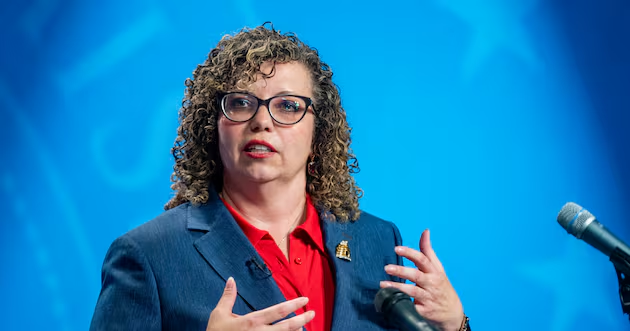
Utah Rep. Celeste Maloy defeated Republican challenger Phil Lyman in Tuesday’s GOP 3rd District primary election, handing Lyman his third loss in two years as he has waged an electoral crusade to discredit the state’s political establishment.
Read more AP: Ben McAdams wins Democratic primary in Utah’s 1st District
The Associated Press called the race 35 minutes after polls closed, as Maloy was leading by 39 percentage points. Maloy led with 69.3% of the vote to Lyman’s 30.7%, a margin of more than 24,600, with a majority of votes having been counted.
Maloy dominated across the district, leading by more than 30 points in the population centers of Utah County and Washington County, where in separate races two years ago Maloy lost by 18 points and Lyman won by 18 points.
During a campaign defined by diligent constituent outreach, the candidates crisscrossed a redrawn 3rd Congressional District, pitching conservative voters on their opposing visions for how to rebuild trust in the American project.
Maloy touted incremental reforms in the right direction as the nation turns 250. Lyman demanded sweeping transparency in response to elite failure, like he did during bids for governor in 2024 and for GOP chair in 2025.
And as he may do yet again during a promised second try for the governor’s office in 2028.
Now Maloy will get another chance to counter voters’ crisis in confidence as domestic issues, like artificial intelligence and affordability — and foreign ones, like trade and war in Iran — roil public opinion in the United States and in Utah.
“I hope that this is a reflection of people responding to positivity,” Maloy told the Deseret News. “We’ve had cynical times before. We’ve gotten through all of them. And I really want us to believe we’re going to get through this one.”
Maloy, who jumped into Utah politics with a special election victory in 2023, was forced to make this case to a majority of voters who had never seen her on the ballot after a district court reshuffled Utah’s House seats in November.
A refreshed endorsement from President Donald Trump and support from a PAC founded by Chris Stewart, her former boss in Washington, D.C., may have given Maloy a needed boost after eking out a primary win two years earlier.
Divided over distrust
On Tuesday night Lyman said he had called Maloy to concede the race.
“The voters have spoken, and I respect their decision,” Lyman said in a statement. “Thank you to Celeste for your willingness to run. Congratulations and know that you have my support.”
Lyman still has not conceded his race against Gov. Spencer Cox in the 2024 Republican primary, when he came within 9 percentage points of the incumbent governor.
At the time, he called for an independent audit, alleging corruption without evidence and asking the Utah and U.S. supreme courts to reverse the election outcome based on a belief Cox did not qualify for the ballot.
After dominating among state delegates at the 2024 nominating convention, where he beat Cox by 35 points, Lyman lost to GOP chair Rob Axson among the same delegates in 2025, and to Maloy in this year’s convention in April.
Lyman served one term in the Utah House, preceded by time as a San Juan County commissioner, where he made headlines for his arrest after protesting an Obama-era closure of an ATV trail on public lands.
Lyman was pardoned by Trump in 2020 after he paid nearly $96,000 in restitution and spent 10 days in jail in 2015.
Read more AP calls race in Utah’s 2nd District: Rep. Blake Moore wins GOP primary
Maloy serves in key congressional committees
Since entering Congress in 2023 with the blessing of Stewart, for whom she served as chief legal counsel, Maloy has quickly worked her way up the U.S. House hierarchy to key committee positions benefitting the state of Utah.
As the only Utahn on the powerful House Appropriations Committee, as vice chair of the Subcommittee on Interior and Environment and as the chair of the congressional Western Caucus, Maloy has focused on Utah-specific wins.
She recently included $10 million in the interior spending bill to create a Great Salt Lake Watershed Recovery Program, and has successfully passed legislation to keep public roads accessible and to bring federal courts to southern Utah.
Throughout her campaign, Maloy has struck a positive tone about America’s most unpopular institution, saying that under GOP leadership, Congress is fixing the budget process, reforming welfare and addressing affordable housing.
Maloy has also promoted her role in resisting the White House’s efforts to preempt state regulation of AI, saying the federal government should let Utah lead out on regulations that pair innovation with child protection.
This stance earned her the support of Stewart’s Public First PAC, funded by the AI firm Anthropic, which has spent just shy of $1 million on ads boosting Maloy, making her one of the top beneficiaries of AI-related PAC money nationally.
What’s next for the 3rd District
Maloy held an enormous fundraising advantage, even without the outside support. She raised a total of $1.1 million, according to her pre-primary FEC filing, compared to Lyman’s $30,800 in donations and $22,500 in personal funds.
Lyman has given mixed signals on whether he plans to keep his name in the Beehive State’s political spotlight.
After his attempts to alter the 2024 outcome hit dead ends, Lyman told his supporters he planned to run for governor again in 2028. Lyman left the door open during the May interview, but said he might call it quits after another loss.
“When I’m defeated, when I’m done I will go away. I’m a very good loser. I’m happy to lose in a fair fight,” Lyman said. “It’s hard to walk away from something midstream, mid-fight when we’re making so much progress.”
One of the challenges that comes with Utah’s new court-ordered 3rd District is the size. It spans 60% of the state, some 51,000 square miles, covering Orem, Provo and Springville, as well as the entire eastern and southern parts of Utah.
The diverse district combines all of Utah’s “Mighty 5″ national parks, with Utah’s biggest college towns.
This change means Maloy is new to most 3rd District voters. An analysis from L2 Analytics found Maloy kept just 38% of Republicans, and an even smaller share of all voters, from her old district. More than 60% are new constituents.
“I think voters can tell when you are being sincere,” Maloy said. “I stuck to talking about issues and policies, and I avoided political mudslinging or talking points. And it’s a risky strategy. It’s one that I’ve employed in every race.”
Maloy will face Kent Udell, a Democrat, in November. Utah’s redistricting saga has produced a district even more favorable to Republicans, giving Maloy a partisan advantage of 47 points, according to Inside Elections.
Read more He’s won 8 ‘Jeopardy!’ games (so far). Can you answer these 15 clues he’s missed?