
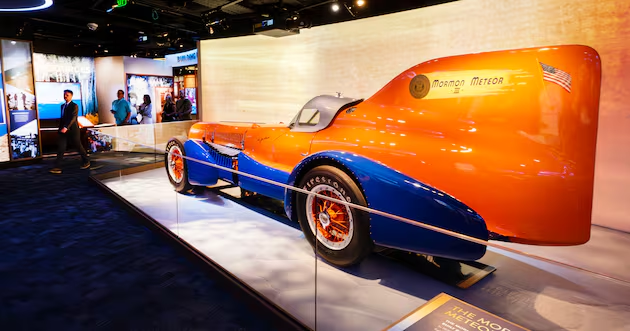
The Mormon Meteor III once raced across the Bonneville Salt Flats with Ab Jenkins at the wheel, setting a 24-hour land-speed record of 161.180 miles per hour in 1940 — a record that stood unbroken for 50 years.
Read more Richie Saunders just got drafted by the Memphis Grizzlies. Here’s how social media reacted
Today, the historic vehicle has a permanent home, sitting stationary on Capitol Hill inside the brand-new Museum of Utah.
Uniquely integrated with the Capitol Hill Complex, Utah’s first state museum focuses on people and their stories rather than an industrial timeline or a strict chronological list of events. While timelines are woven throughout the exhibits, thematic outlines and personal story take center stage to ensure every visitor can see themselves reflected in the state’s history, Utah Historical Society Director Jennifer Ortiz told reporters during a recent gallery walk-through.
Admission to the 17,000-square-foot facility is free, earning its nickname among museum staff as “the Smithsonian of Utah.”
Fostering a sense of belonging for visitors
“The hierarchy of a thematic space is that we start with a giant theme and then we work down to a case level and individual stories,” said Museum Director Tim Glenn regarding the layout.
The facility is divided into four permanent thematic galleries: Building Utah, Inspiring Utah, Becoming Utah and Connecting Utah.
“Our galleries are split into four thematic galleries; that was a decision that was made very intentionally, in part because of the space allocation that we had to work with,” Ortiz said. “Seventeen thousand square feet is a good size of space to work with, but kind of tight for telling a whole state history.”
Ortiz noted the framework allows the museum to stay dynamic.
“The thematic approach also allows us to tell stories from multiple different angles,” Ortiz said. “We can switch out objects, switch out stories, as time progresses. As we want to tell different stories, we’ll be able to do that through the thematic approach instead of chronological.”
Ultimately, staff members hope this layout fosters a sense of belonging for all visitors.
Building Utah
This gallery highlights the labor history of the state and how the concept of labor has evolved. Instead of focusing purely on industry machinery, curators centered the exhibits on the individuals driving the work.
“The reason we organized this space this way is because we wanted workers to sort of identify,” Glenn said. “We all work up somewhere. So, we took that quite literally — outside, inside, in our communities. There’s artifacts on display that relate to all sorts of different types of work within these spaces.”
Featured artifacts in this gallery include:
- A geiger counter from a uranium engineering company
- A World War II military uniform worn by Franklin Riter
- A J.G. McDonald Chocolate Company Utah state fair trophy
- A Scofield mine clock
- A saddle used by Preston Nutter
- Artist tools belonging to Pilar Pobil
Inspiring Utah
The Inspiring Utah Gallery houses a semi-immersive theater running a program titled “Utah Voices.” The film serves as an introduction to the state, narrated by 100 different Utahns from across the state who share what the region means to them.
The Utah Teapot is displayed in this gallery, connected to Martin Newell, a University of Utah student who figured out how to create a 3D model in a digital space based on a teapot in his house, Glenn told reporters. In 1975, Newell created the foundation of digital art and animation we see today. “So when you’re watching ‘Toy Story,’ it’s because of Martin Newell and the Utah Teapot,” Glenn noted.
The gallery also features pop-culture and sports triumphs personal to the state of Utah, like the 2002 Olympic torch and H.L.A. Culmer’s artwork, “Monument Valley.” Another prized artifact on display is Marty McFly’s screen-matched Western shirt from the film “Back to the Future Part II,” worn by Michael J. Fox when his character travels back in time to become a cowboy.
Becoming Utah
The Becoming Utah Gallery focuses on the road to statehood. Curators collaborated closely with all eight of Utah’s federally recognized Native American tribes to ensure their histories were seamlessly integrated from the very beginning.
A central exhibition space titled “Utah as a Place of Movement” highlights how different groups arrived in the region.
“If you grew up in this state or you have kids who grew up in this state, chances are you’ve heard about handcarts,” Glenn said, gesturing to an original handcart on loan from the Church History Museum. “Handcarts are such an iconic symbol for Utah.”
However, Glenn noted that handcarts only represent a small fraction of early migrations, adding there were only 10 handcart companies in total.
Read more New York surged left. Utah chose the center. What does it mean for Democrats?
“Most people did not come here via handcart,” Glenn explained. “The point of dealing with different identities, we want people to feel seen and see themselves in this space … but we also want people to learn. If you don’t know that there were only 10 companies, you’re going to learn that in this space … there were all sorts of different ways to travel to this area in the 19th century.”
Other foundational artifacts in this gallery include a telescope used by Orson Pratt, the historic Deseret Coin and Utah’s first state flag.
Glenn called the first state flag one of the museum’s most treasured pieces. Misplaced within the state’s collection at the Rio Grande Depot for years, it was rediscovered in the 1990s. It has since been kept in protective dark storage. “Now,” Glenn said, “we get to show it off.”
Connecting Utah
Connecting Utah explores the relationships and traditions that bind communities together. Ortiz noted that the gallery colorfully looks at shared values, offering familiar sights alongside a few surprises.
Items on display include:
- The Trinity AME Church record and roll book (1937-1941)
- A mochi spatula and hammer
- The charter for the Utah Association for the Blind
- A Utah Shamrocks women’s softball uniform
- A Disability Rights Act flag used by activist Barbara Toomer
- A hand-painted ceramic by Katherine Poleviyaoma
Across the permanent galleries, visitors can see the 940 objects on display, according to Glenn.
However, officials emphasize that this is only a fraction of the museum’s holdings.
“That of course is only a small percentage of our collection’s objects that will be housed here in the future at our garden level,” Ortiz added, noting many display pieces are on loan from community partners.
Unlike many institutions, the Museum of Utah houses roughly 90% of its historical collection on site.
“We’re excited to have like 90% of our collection stored on site,” said Kimberly Kronwall, director of collections and exhibitions. “Like the Louvre doesn’t even have that. The Smithsonian doesn’t even have that. It’s amazing.”
The temporary gallery: ‘The Past is Personal’
Alongside the permanent galleries sits a 1,500-square-foot temporary gallery space. Its deliberate, intimate size was designed to promote collaboration with existing local museums rather than create competition.
The space will rotate through different exhibits about four times a year, Ortiz said. For its inaugural season, however, it will feature a yearlong exhibition tied to the America 250 semiquincentennial project, titled “The Past is Personal.” The display draws heavily on the community preservation work done by the Utah Historical Society, widening the lens of Utah’s history to spotlight previously underrepresented communities.
Why the long wait for a state museum?
Utah is the 48th state to establish its own official state museum. When asked why the process took over a century, Glenn cited a host of factors.
“I think there are a hundred reasons,” Glenn said. “It’s not for lack of trying. … Many state history museums are close to or over a hundred years old because there was this era around a centennial when a lot of people were forming organizations.”
Glenn went on to note factors like a fiscally responsible state and already established locations, like the Daughters of Utah Pioneers, that provided Utahns with places to learn about the state’s history.
While several efforts have come and gone over the decades, the blueprint for the current museum officially began in 2019. Ortiz noted that being among the last states to build a museum allowed Utah to pull the best, most innovative concepts from facilities nationwide under one roof.
Museum of Utah grand opening
The Museum of Utah will host its official grand opening celebration on Saturday.
In addition to the museum doors opening, the state will host a public festival on the Capitol’s North Plaza near the Michael O. Leavitt North Capitol Building. The event will feature more than 30 community partner booths, live music, food trucks and family-friendly activities, according to a press release sent to the Deseret News.
Whether your ancestors walked these lands millennia ago, crossed the plains with the pioneer handcart companies, arrived as a refugee or you recently moved to the state yourself, the museum’s overarching goal is to connect every visitor to the diverse people who shaped Utah’s history.
Read more Data center fallout upends Utah politics, ousting Senate president