
- The first confirmed Ebola case outside Africa from the Bundibugyo outbreak was reported on Wednesday.
- The number of cases is growing, and CDC said it doesn’t expect the virus to slow down soon.
- The U.S. is prepared for any potential domestic cases, according to CDC.
The Centers for Disease Control and Prevention held a media briefing on Friday to share updates on the Bundibugyo Ebola outbreak.
Read more Utah fires: By the numbers
Officials said in the briefing the risk to the U.S. remains low, but they are preparing for any potential cases that enter the county.
In France
On Wednesday, the France ministries of health reported one confirmed Ebola case in the country, the first outside of the Democratic Republic of Congo or Uganda since the Bundibugyo outbreak began in May.
The patient in France is a physician who was providing medical care in Congo, according to French authorities.
When he returned home from Africa, the man notified French authorities of his symptoms and was put in isolation. “Public health investigations and contact tracing began immediately, and this individual is now receiving care,” per the CDC briefing.
“While imported cases can occur during large outbreaks, there’s currently no indication of community transmission associated with this case, and there have been no reported exposures involving U.S. citizens associated with this case,” said Dr. Satish K. Pillai, incident manager for CDC’s Ebola response.
In Africa
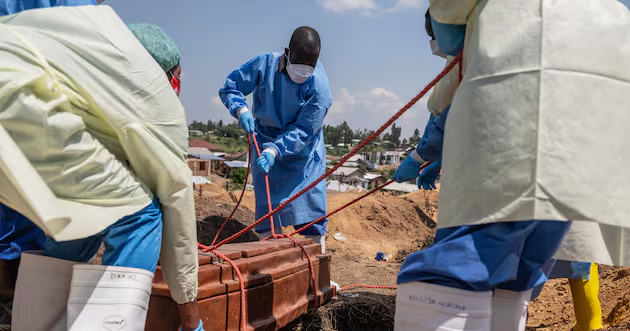
Pillai also said that “there are more than 1,100 cases confirmed between the Democratic Republic of Congo and Uganda,” and the CDC expects that number to grow.
According to Pillai, “Rapid and sustained public health interventions are urgently needed to keep this outbreak from surpassing the other two large outbreaks of Ebola that we’ve seen both in West Africa in 2014 to 2016 as well as the 2018 to 2020 North Kivu DRC outbreak.”
He said CDC has 24 staff permanently stationed in DRC and close to 100 in Uganda and, based on need, the agency continues to deploy individuals to the country to provide support.
In America
Pillai said CDC is working with federal, state, territorial, local and tribal health departments to prepare for any domestic Ebola cases.
The risk in the U.S. has remained low because of the “robust domestic and public health capacity to contain and control an Ebola outbreak” the U.S. has, according to Dr. Kevin Chatham-Stephens, deputy incident manager for CDC’s Ebola response. He said, “The U.S. has the tools to rapidly identify cases, appropriately triage and enact patient isolation and management measures, confirm Ebola through laboratory testing and conduct contact tracing.”
“We remain committed to working with our partners to help contain this outbreak and prevent further spread,” Pillai said. “The more quickly and effectively we can support containment of Bundibugyo virus in the DRC, the more we can reduce the risk to other countries.”
Read more Why Rep. Burgess Owens touts apprenticeships as wise career-path educational options