
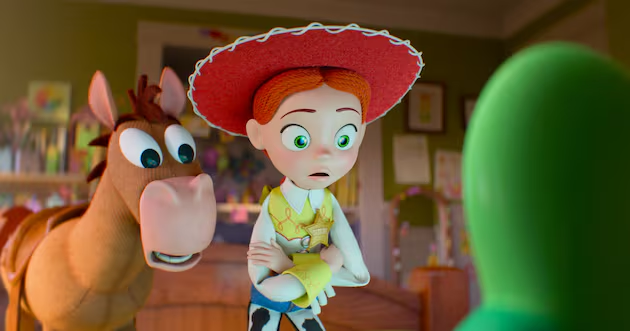
“Toy Story 5,” the latest release from Disney and Pixar, encapsulates the challenges of raising children in this digital age while refraining from employing anti-tech dogma. Which I appreciated as a mom in 2026.
Read more Most Utahns disapprove of how Trump is handling Iran war: Poll
The first “Toy Story” was released in 1995 when I was 9 years old. So it felt a bit surreal to take my three children — two of whom are now older than I was when the first movie premiered — to the fifth installment of the series.
It was equally surreal to view this latest chapter through the lens of a parent, and watch the moms and dads in the film wrestle with the modern-day parenting challenges we all share. Namely, what kind of access we should allow our children to have to technology.
Screen time is a frequent topic of discussion in every group chat I’m in. How much time, if any, should children spend interacting with devices? Which YouTube creators need to be avoided? How accurate are the claims made in “The Anxious Generation”? All are questions bounced back and forth endlessly between parents, and almost always, no one has a definitive answer.
And I think that’s because, like with most big questions, it’s complicated.
In 1995, Mr. Spell — an electronic spelling device akin to a calculator — was the most high-tech of Andy’s play things in “Toy Story.” But in 2026, advanced technology is at the center of most of our lives, including our children’s. The central conflict of the story is Bonnie’s parents agreeing to buy her a tablet after observing Bonnie’s isolation and inability to make friends with her peers, all of whom have devices. The solution, her parents assume, must be getting her a tablet to connect with her “friends.”
At first, the tablet, known to the toys as Lily and voiced by Greta Lee, is helpful to Bonnie. It connects her with a group of girls from her dance class and gets her invited to her first sleepover. But because Bonnie is different from this particular group of girls, she quickly becomes the subject of their mockery in their online chat, forcing Bonnie to pretend to be more grown up than she is, and to pretend that she no longer has an interest in playing with toys.
Read more Deborah Sampson’s two wars
Meanwhile, the anthropomorphized toys have an entire hero’s journey trying to save Bonnie, which includes befriending an electronic potty trainer voiced brilliantly by Conan O’Brien, a digital camera, an electronic navigator, and a swarm of high-tech Buzz Lightyears. The journey also includes a turn from Lily the tablet, who at first is seen as the enemy but later is revealed to only want to help Bonnie, to such an extent that at one point she tries to throw herself away. The toys, too, are learning how to incorporate tech into their world with boundaries that enable connection without creating isolation. Just like all of us.
One of the things I appreciate about “Toy Story 5” is how often the parents are shown using tech. They’re sometimes scrolling their phones, sometimes sitting on the couch with their laptop, sometimes in a home office on a Zoom call. Which is exactly what my children see with my work-from-home life. And is exactly why I feel hypocritical enacting a tech ban when I use devices all the time throughout my day, as do most adults in 2026.
I’ve also come to believe that barring children from access to technology does them no favors in helping them adapt to the world and their future careers. And I believe that millennial parents’ nostalgia for our 1995 childhoods sometimes forgets the summer days we spent watching Nickelodeon and playing Sonic on the Sega — much, I’m sure, to the consternation of our parents. Technology use has always been a balance between too much and too little. This era just feels accelerated.
“Toy Story 5” ultimately lands where I have, in the belief that technology is both a boon and a burden. A tool for connection when used in moderation, and a source of anxiety and isolation when used too much. Ultimately (and this is a spoiler, so be warned), Bonnie makes a new connection through her tablet with Blaze, a friend who still enjoys the kind of play Bonnie does. It’s a connection that would not have been possible without technology, but a friendship that centers creative play that is not device-dependent.
The final scene of the movie features Blaze and Bonnie throwing an imaginary wedding between Buzz Lightyear and Jessie the cowgirl, while Lily the tablet plays the bridal march. It represents what I believe tech should be in our children’s lives, and if I’m being honest, my own — a tool to be used to our benefit, not our detriment.
Read more Richie Saunders to the Memphis Grizzlies is the feel-good story of the summer
Which I guess is what I’ll say the next time it comes up in the group chat.