
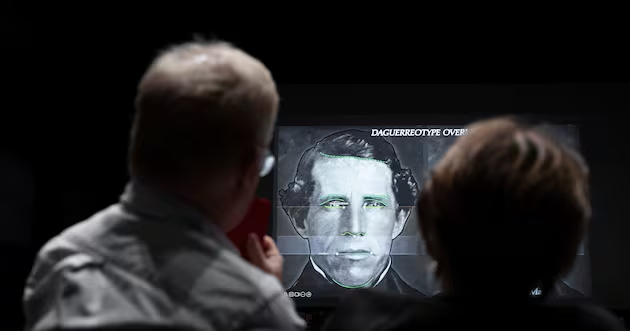
I spent the better part of Saturday in Orem, Utah, listening to two researchers and Latter-day Saints — Patrick Bishop and Joseph Brickey — make a case defending a daguerreotype some say depicts Joseph Smith.
Read more Utah’s wildfire season built for months before the flames arrived
Bishop and Joseph made their case with eight hours of slides and information. The findings and ideas they presented on the 182nd anniversary of Joseph’s martyrdom were solely theirs and are not endorsed by The Church of Jesus Christ of Latter-day Saints.
Bishop and Brickey dove directly into the decadeslong search, begun by early Latter-day Saints, for an accurate image of the founding prophet of The Church of Jesus Christ of Latter-day Saints. They then focused on the findings they have gleaned together from 25 years of ardent research into the prophet’s visual image.
“This research hasn’t been done sitting in a chair behind the screen for 25 years,” Bishop said. It “has been on site, testing our hypotheses, recreating things (and) meeting with the best scholars that are available.”
“As we have acknowledged since the discovery of the locket in 2020, we cannot draw a conclusion about who is pictured in the daguerreotype,” the church recently stated in a press release, shortly after acquiring the 1840s-era locket and daguerreotype.
Bishop and Brickey acknowledged the debate on whether the daguerreotype pictures Joseph Smith can go both ways and that more digging is needed.
Through their historical and forensic research, however, they claimed that the daguerreotype is a “forensic match” to Joseph Smith and expressed hope that their findings — along with their forthcoming book and documentary — will help millions “know ‘Brother Joseph’ again,” as written in a popular church hymn about the prophet.
Here are five key claims and takeaways from the two researchers’ presentation and research.
1. Joseph Smith’s iconic front-view oil portrait is not an entirely reliable source
Bishop and Brickey started by discussing the iconic 1842 front-view oil portrait of Joseph Smith, which is attributed to artist David Rogers.
They acknowledged some use Joseph’s appearance in the painting as evidence against the prophet being the man pictured in the 1840s-era locket and daguerreotype, but then pointed out the artist’s pattern of stylizing his subjects to have certain characteristics or fit certain contemporary ideals.
Comparing Rogers’ portrait of Emma Smith to a photo of her, for instance, Bishop and Brickey noted the artist sized up her eyes, lengthened her nose and shrunk her lips. They noted similar differences between another Rogers portrait and a photo of Sylvia Lyons.
The comparisons show “we have an artist who is interpreting,” said Brickey, who is also a classical and forensic artist. “I see a convention of how you lay out the proportions of the face that is dictated by an artistic standard, more than just copying precisely your subject.”
Bishop and Brickey thus concluded Rogers’ portrait of Joseph Smith features an artistic style that appears lifelike, but is “not true to life” and cannot be entirely relied on as an accurate depiction of Joseph Smith.
Overlaying the portrait with the prophet’s death mask also reveals significant discrepancies in nose, mouth and chin placements between the two pieces.
2. Sutcliffe Maudsley’s side-profile portraits appear to be more reliable
In contrast to Rogers’ Joseph Smith portraits, Sutcliffe Maudsley’s side-profile portraits of the prophet appear to be more precise and consistently true to life, Bishop and Brickey said in their presentation.
Maudsley’s artistic style is less lifelike, but his multiple portraits reveal a pattern of paying great attention to detail and faithfully portraying important Smith family artifacts, such as Joseph Smith’s Nauvoo Legion sword.
Read more What big outdoor concerts are in Utah this summer? Here’s the latest
Maudsley’s side-profile portraits also align well with Joseph’s death mask and serve as more reliable sources of Joseph Smith’s side profile, as they were drawn tracing his shadow on a wall, according to Bishop and Brickey.
3. Hyrum Smith is likely not the man on the daguerreotype
Bishop and Brickey also sought to debunk claims that the man on the daguerreotype is Hyrum Smith, Joseph’s brother.
In each Maudsley portrait of Hyrum Smith, they said, he is seen having a mole on his right cheek. The man depicted in the 1840s-era daguerreotype, discovered by Joseph Smith’s great-great-grandson, does not have a mole on his face.
Textual and artistic evidence also reveals Emma Smith owned a gold locket and a daguerreotype of Joseph Smith, Bishop and Brickey said. The two researchers are not sure if the gold locket and daguerreotype are the same or separate items.
4. Joseph Smith’s death mask does not paint a complete picture
The plaster cast of the prophet’s face, created in the days after his martyrdom, is a valuable source, but should not be solely relied on to grasp Joseph Smith’s visual image, Bishop and Brickey said.
Life masks of celebrities — such as Johnny Depp, Taylor Swift, Tom Cruise and Anne Hathaway — have been made using modern tools and materials; yet, they tend to look significantly different from their living models, the two researchers said.
It is thus reasonable to assume inconsistencies between Joseph Smith’s death mask and his actual visual image — especially considering his face likely sustained deformities both during and after his death and martyrdom, Bishop and Brickey said.
The masks of Joseph and Hyrum were created under grief and urgency, Bishop said. They are not perfect representations of their visual images, but they do preserve tangible, structural evidence.
The structural evidence left by Joseph’s death mask does align with the facial features of the man on the daguerreotype, according to Brickey.
“Everything is corresponding as you would expect a match to,” he said. That “doesn’t mean that it’s a perfect conclusive match, but in terms of really distinct anchor points, things are aligning.”
5. The man in the daguerreotype ‘is a forensic match’ to Joseph Smith
Within the context of their yearslong research comparing evidence found in portraits, alleged daguerreotypes, skulls and death masks of Joseph and Hyrum Smith, Bishop and Brickey boldly asserted “the man in the daguerreotype locket is a forensic match to the anatomy of Joseph Smith.”
They showed overlays of the man’s image with Maudsley’s profile portraits and their own reconstructions of Joseph’s and Hyrum’s skulls and death masks.
The man in the daguerreotype appeared to align well with each type of evidence.
Bishop and Brickey also unveiled a new sculpture and painting created by Brickey. Both combined features from the daguerreotype, Joseph Smith’s death mask and Maudsley’s side-profile portraits of the prophet, revealing what Bishop and Brickey believe to be the most accurate visual image of Joseph Smith.
“I know the true character of Christ, because of the prophet Joseph Smith,” Bishop said.
“And I hope for all of you that love the prophet Joseph Smith, love his teachings, love his mind, love his heart — today, will come to know brother Joseph again a little bit better.”
Read more Analysis: What you need to know about the birthright citizenship decision