
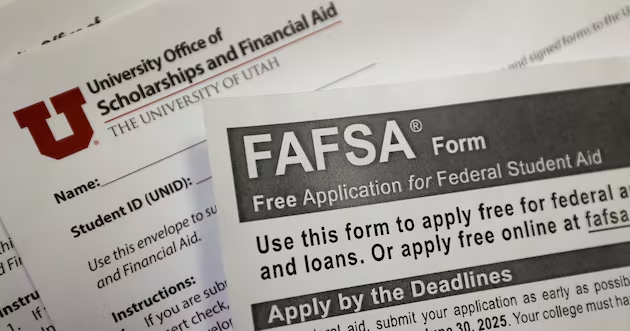
- Several major changes to the federal student loan programs are being implemented starting July 1.
- The Trump administration called the modifications “commonsense” steps to simplify repayments.
- Others worry the loan policy changes will increase financial burdens for college students and their families.
For millions of Americans with student loans — and for those applying for new student loans — July 1 is aptly being called tectonic.
Read more ‘Committed to getting better’: Taylor Frankie Paul voluntarily entered rehab
A major overhaul of the federal loan system goes into effect Wednesday that includes fewer repayment options and new borrowing limits for parents of college students and some graduate students.
Participants of the Biden-era SAVE repayment plan are also impacted.
The federal student loan changes mark the latest far-reaching disruption from the Department of Education — a federal agency that has been historically redefined during President Donald Trump’s second administration.
Wednesday’s federal student loan borrowing modifications are a major element of Trump’s “One Big Beautiful Bill” Act.
DOE officials say the updates are “commonsense” steps designed to simplify repayments and improve the federal lending system. But others worry that the changes will impede many would-be students’ access to higher education — and their abilities to pay off their loans after graduation.
One thing that’s not debatable: The colossal size of the nation’s student loan profile.
The outstanding federal student loan portfolio includes 42.6 million recipients with federal student loans totaling $1.7 trillion, representing a nearly 4% dollar increase from March 2025, according to the DOE’s Federal Student Aid office.
Not everyone will feel the changes being implemented Wednesday. Many current borrowers will be largely unaffected.
But new borrowers, parents, grad students and those borrowers previously enrolled in the SAVE program are expected to be immediately impacted.
The demise of Biden’s SAVE loan repayment plan
One of the defining changes in the Trump administration’s July 1 student loan revamp is the end of the Biden-era repayment program called Saving on Valuable Education, aka SAVE.
There are currently about 7 million borrowers enrolled in SAVE. Now they have 90 days to switch to a new plan to pay back their student debt, according to ABC News.
Current borrowers who are not enrolled in the SAVE plan and do not consolidate or take out new loans can continue to access existing repayment options such as Standard Repayment Plan.
However, new borrowers and those enrolled in the SAVE plan are being required to select new DOE repayment plans. And current federal student loan borrowers who take out a new loan or consolidate any existing loan will also have to repay loans through one of the DOE’s new payment plans, according to the National Consumer Law Center.
So what are the new loan repayment plans?
Starting Wednesday, as part of Trump’s Working Families Tax Cuts Act, federal student loan repayments are shifting to two plans: the repayment assistance plan, or RAP, and the tiered standard repayment plan.
Borrowers can access the new plans via their StudentAid.Gov account. The application reportedly takes about 10 minutes to complete.
RAP, according to the DOE, “will provide borrowers with a simple and affordable option to repay their federal student loans” based on the income.
Monthly payments are between 1% and 10% of a borrower’s income, depending on how much they earn. In addition, their payments will be reduced by $50 per month for each of their dependents.
Under RAP, remaining unpaid monthly interest will be waived when borrowers make on-time monthly payment. The plan also provides a matching principal payment benefit.
“If a borrower’s on-time payment does not reduce the principal by at least $50, the Department will provide a matching payment of up to $50 each month,” according to DOE.
“These two benefits — the interest waiver and matching principal payment — ensure borrowers always make progress toward paying off their loans.”
Here’s a DOE-offered example of how RAP would work: A borrower with no dependents, an initial income of $35,000, and a loan balance of $20,000 can expect to have about $400 in interest waived over the life of the loan and could receive an additional $2,000 in matching principal payments during their repayment term.
But student loan advocates, reported ABC News, warn monthly payments under the RAP plan will be higher for borrowers.
Read more Bipartisan group unveils new framework for gerrymandering reform
The Institute for College Access & Success found that the median U.S. household could see student loan defaults spike and premiums increase by hundreds of dollars a month.
DOE has created a “repayment calculator” on its website where students can calculate their monthly bills and compare plans.
Meanwhile, the new “Tiered Standard Repayment Plan” offers fixed loan repayment terms in tiers of 10, 15, 20 or 25 years, based on the amount borrowed.
“This plan will automatically provide borrowers who have higher student loan balances with more affordable monthly payments by allowing the borrower more time to repay their loans,” noted a DOE release.
The aim of the tiered plan is to extend the repayment period, making monthly loan payments more manageable and affordable.
Also, DOE announced earlier this month that federal student loan borrowers enrolled in auto pay will be eligible for a 1% interest reduction rate, beginning Wednesday.
Borrowers who enroll in auto pay by Sept. 30, or are already enrolled, will benefit from the interest rate reduction through June 30, 2028.
“This interest rate reduction will help borrowers as they consider new, affordable repayment plans and work to repay their loans on time,” said Under Secretary of Education Nicholas Kent.
“We expect this temporary incentive to drive up repayment rates and significantly improve the overall health of the federal student loan portfolio.”
Attention, moms and dads: Changes to the Parent PLUS loan plan
Another major change happening Wednesday are modifications to the Parent PLUS Loan Program designed for parents to take out a federal loan for their child’s undergraduate studies.
In the past, parents could borrow up to the full cost of their son or daughter attending school.
But starting July 1, the maximum amount for all new PLUS loans that moms and dads can take out for each academic year is $20,000 — and the maximum for all PLUS loans over the course of a child’s undergraduate study is $65,000, according to the Federal Student Aid page.
Loan limits for many grad students
Federal loan amounts for borrowers attending grad school are also changing Wednesday.
Previously, grad students could borrow up to the full cost of their tuition and fees. Now graduate students pursuing Master’s degrees will only be able to take out federal loans up to $20,500 per year — and $100,000 total.
A notable exception to DOE’s loan policy are grad student borrowers classified as “professional students,” which includes law, doctor of pharmacy and medical students. They can borrow up to $50,000 per year, or $200,000 total.
Clare McCann, the policy director at the Postsecondary Education & Economics Research Center, told ABC News that it’s conceivable that some graduate borrowers won’t achieve their desired degrees.
“This may end up being a bit of an overcorrection,” McCann said. “We could see implications for student access.”
But DOE officials counter that the caps will curb excessive borrowing and prompt institutions to evaluate their tuition costs.
The “professional students” classification system has also prompted controversy.
The Trump administration did not identify graduate degrees in nursing, physical therapy and other related fields as “professional” programs — drawing spirited pushback from those communities.
Last week a federal judge paused the DOE’s definition of a “professional degree,” reportedly putting the “professional” designation system in limbo pending further litigation.