
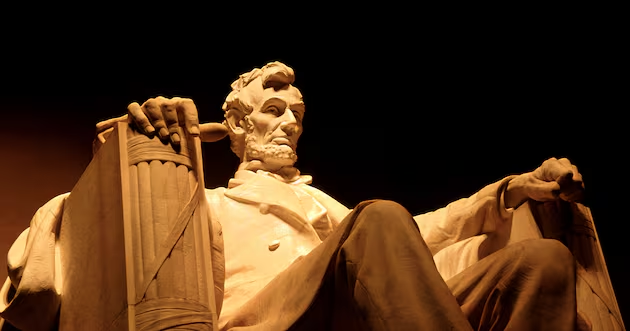
The setting was as symbolic as the moment was tense.
On February 22, 1861, a crowd gathered in Philadelphia’s Independence Square for a flag-raising ceremony in honor of George Washington’s birthday. The speaker — tall and gangly, with a craggy visage and a high-pitched voice — was Abraham Lincoln, president-elect of the United States.
Read more Opinion: 250 years of self-government
Over the previous nine weeks, seven Southern states had seceded from the Union. Many feared that more would follow. Before exiting the south entrance of Independence Hall for the ceremony, Lincoln spent a few reflective moments in the Assembly Room — the storied space where the Declaration of Independence had been signed and where the Constitution had been crafted.
Perhaps he thought of Thomas Jefferson, who had composed the declaration’s first draft, or of Washington, who had done more than any other to secure independence on the fields of battle and to establish the Constitution in the councils of state. Liberty and union — these were the high ideals that Lincoln had long championed.
These were the principles that secession imperiled.
Lincoln stood on a temporary wooden platform draped in bunting. As he looked out over the crowd, Independence Hall — the shrine of the founding — stood behind him. The future before him was profoundly uncertain; the prospect of national ruin was real. He spoke without notes.
The setting all but compelled Lincoln to speak about the Declaration of Independence. What surprised his audience was not the subject he chose, but the fervor with which he addressed it.
“I have never,” he intoned, “had a feeling politically that did not spring from the sentiments embodied in the Declaration of Independence.” Rather than surrender the declaration’s core principles, he continued, “I would rather be assassinated on this spot.”
These were not idle words at a time when the risk of assassination was clear, present and pervasive. Lincoln summarized the declaration’s principles as an overarching commitment to “liberty for all.” The stakes of secession’s threat to those principles were colossal — almost cosmic.
Accordingly, Lincoln affirmed and extolled “that sentiment in the Declaration of Independence which gave liberty, not alone to the people of this country, but I hope, to the world, for all future time. It was that which gave promise that in due time the weight would be lifted from the shoulders of all men.”
Lincoln was not exaggerating when he said that the whole of his political thought derived from the Declaration of Independence. For Lincoln, the declaration was more than revolutionary rhetoric or patriotic ornament. It was the moral heart of the American order — the bedrock of his political philosophy.
To Lincoln, the declaration was the “apple of gold”; the Constitution and Union were the “picture of silver” framed around it. Lincoln’s life and thought present an extended commentary, in word and deed, on the declaration’s key clauses. It is the richest and most consequential commentary in our history.
The principle of liberty “clears the path for all, gives hope to all, and, by consequence, enterprise and industry to all.”
— Abraham Lincoln
It is a commentary worth revisiting as we commemorate our national semiquincentennial — the declaration’s 250th birthday. For Lincoln not only expounded the declaration; he transfigured it. When we celebrate the declaration this year, it is Lincoln’s declaration that we honor.
Lincoln’s understanding of the declaration evolved over time, finding its fullest formulation in his most canonical statements — the Gettysburg Address and his second inaugural speech. Intriguingly, the textual arc of his understanding proceeded in reverse, emphasizing the declaration’s sonorous clauses in the opposite order from how they appear in the text.
We can trace that ascent by moving backward through the declaration itself — from “the consent of the governed” to “the pursuit of happiness” to “liberty” to “created equal.” This order will illuminate the path of Lincoln’s progression, highlighting how he thought, as he lived, in crescendo.
Democracy and slavery
Lincoln’s reading of the declaration — and hence the whole of his political creed — was rooted in his understanding of “the laws of nature and of nature’s God.” All legitimate authority, he believed, must yield to those laws.
Democracy requires moral right, not just majority rule. There can, Lincoln said, be “no just rule other than that of moral and abstract right,” which encompasses “the right of a people to ‘life, liberty, and the pursuit of happiness’” — their right, that is, to govern themselves.
“According to our ancient faith,” Lincoln said in 1854, in a speech that marked his return to politics, “the just powers of governments are derived from the consent of the governed.” This “ancient faith” applied to the plantation as surely as the polling place. Lincoln loathed slavery all his life, not least because it represented the quintessence of government without the consent of the governed.
When one man “governs himself,” Lincoln said, “that is self-government; but when he governs himself, and also another man,” without that man’s consent, “that is more than self-government; that is despotism.”
It was despotism, moreover, compounded by tyranny. In slavery, he explained, “the master not only governs the slave without his consent; but he governs him by a set of rules altogether different from those which he prescribes for himself.”
Lincoln had no patience for those who, channeling John C. Calhoun, insisted that slavery was “a positive good,” mutually beneficial to enslavers and enslaved. In response, Lincoln mocked the pro-slavery apologists with devastating irony.
“As a good thing,” he quipped, “slavery is strikingly peculiar in this: that it is the only good thing which no man ever seeks the good of for himself.” And again: “although volume upon volume is written to prove slavery a very good thing, we never hear of the man who wishes to take the good of it, by being a slave himself.”
Lincoln’s opposition to slavery was rooted in a democratic golden rule. “As I would not be a slave,” he observed, “so I would not be a master. This expresses my idea of democracy. Whatever differs from this, to the extent of the difference, is no democracy.”
Democracy, for Lincoln, meant refusing to impose on others what you would not willingly endure yourself. “This is a world of compensations,” he said, “and he who would be no slave, must consent to have no slave.” Lincoln here used the term consent advisedly.
It was utterly incompatible with “the consent of the governed” to do unto others what one would never consent to oneself.
The pursuit of happiness
Government by the consent of the governed should enable the governed to pursue their own ends. For Lincoln, the pursuit of happiness required a realm of equitable opportunity — “an open field and a fair chance” for all to seek and all to strive.
The American Union, as Lincoln saw it, existed “to elevate the condition of men; to lift artificial weights from all shoulders; to clear the paths of laudable pursuit for all; to afford all an unfettered start, and a fair chance, in the race of life.”
Lincoln himself was a consummate striver. The tales of his prodigious reading — the lad reading by firelight, walking miles to borrow a volume or pausing while hoeing to read one more page — are familiar, and they are true. Education and work were the dual engines of Lincoln’s ambition, and they served him surpassingly well. He had almost boundless faith that they would serve others, too.
In August 1864, Lincoln reviewed an Ohio regiment outside the executive mansion. In his brief remarks, the president succinctly set forth what later generations would call the “American dream.”
“I happen temporarily to occupy this big White House,” he said. “I am a living witness that any one of your children may look to come here as my father’s child has.”
Over time, the logic of equality progressively swallowed the limitations.
Lincoln was a child of profound poverty, the son of an illiterate father. He attributed his rise, and the possibility that others might similarly rise, to the combined forces of property, commerce, education and work.
Lincoln celebrated property as “the fruit of labor,” calling it “desirable” and “a positive good in the world.” Thanks to property and free enterprise, “the hired laborer of yesterday, labors on his own account to-day; and will hire others to labor for him to-morrow. Advancement — improvement in condition — is the order of things in a society of equals.” This being so, failure to advance was almost a moral failing.
“If any continue through life in the condition of the hired laborer,” Lincoln said, “it is not the fault of the system, but because of either a dependent nature which prefers it, or improvidence, folly, or singular misfortune.” Only that last clause prevented Lincoln from blaming the poor for remaining in poverty.
“Work, work, work,” Lincoln told an aspiring lawyer, “is the main thing.” And he practiced what he preached. A White House aide observed that “the president’s capacity for work was wonderful. … Each hour he was busy.”
In a superb book titled “The Pursuit of Happiness,” Jeffrey Rosen argues that, for America’s founding generation, the pursuit of happiness meant the cultivation of virtue — the quest to be good, not just feel good. Lincoln, who saw himself politically as the exponent and heir of “those noble fathers — Washington, Jefferson and Madison,” was also their successor in this.
He saw the pursuit of happiness as inseparable from the moral disciplines that make happiness possible: reason, prudence and charity; education, humility and work. Happiness, for Lincoln, meant self-command, not unbridled appetite.
It was to be the master of no one but oneself.
That pursuit was propelled by hope. “Free labor,” he said, “has the inspiration of hope,” whereas “pure slavery has no hope.” Hope, for Lincoln, was the emotional manifestation of freedom. Its negation was central to slavery’s crime.
Liberty and the Civil War
Freedom gave hope a path to fruition. “The principle of ‘Liberty to all,’” he said, was “the principle that clears the path for all, gives hope to all, and, by consequence, enterprise and industry to all.” Slavery, of course, was the antithesis of all these things.
Read more Even Thomas Jefferson needed an editor. America still thrives when different ideas collide
It negated any path forward, any hope for the future, and hence it eroded enterprise and sapped industry. Accordingly, Lincoln insisted, “there can be no moral right in connection with one man’s making a slave of another.”
This basic insight underscored the deep contradiction — the divided soul — at the heart of the American order. Lincoln saw the issue in stark moral terms. “Slavery,” he said, “is founded in the selfishness of man’s nature — opposition to it, in his love of justice. These principles are an eternal antagonism; and when brought into collision so fiercely, as slavery extension brings them, shocks, and throes, and convulsions must ceaselessly follow.”
Lincoln’s love of liberty was inseparable from his commitment to the rule of law. That commitment was tested during the Civil War. Lincoln felt keenly the tension of having to curb liberties to preserve liberty.
“Are all the laws but one to go unexecuted,” he famously asked, “and the government itself go to pieces, lest that one be violated?”
“Must a government,” he asked elsewhere, “of necessity be too strong for the liberties of its own people or too weak to maintain its own existence?”
For Lincoln, the pursuit of happiness required a realm of equitable opportunity — “an open field and a fair chance” for all to seek and all to strive.
On the whole, Lincoln struck a measured balance regarding wartime civil liberties. “What is surprising in the case of Lincoln’s presidency,” writes Allen C. Guelzo, a Lincoln historian, “is how few such dents were made in civil liberties, especially compared to what he might otherwise have done, and in the context of four years of bloody civil war.”
Lincoln employed the powers of the presidency aggressively, and although he sometimes strained at constitutional limits, he never claimed an open-ended power to transcend them.
Perhaps most significantly, Lincoln never moved a finger to impede the ordinary course of elections. As far as we can tell, he never even considered doing so. He allowed the presidential election of 1864 to proceed on schedule, even though it appeared, until some 11th-hour battlefield victories shifted the scales, that Lincoln was due for a drubbing.
Lincoln long believed he would lose that election. And there can be little doubt that, if he had lost, he would have honored the outcome and retired peacefully to private life. Lincoln’s commitment to the sanctity of elections and the sovereignty of the law was not theoretical. That commitment was tested when defeat seemed likely, and Lincoln passed the test resoundingly.
The same was not true of the slaveholding South. Ironically, the South rejected the outcome of the 1860 election for the sake of preserving slavery, and by so doing hastened slavery’s final demise. Lincoln, who would never violate the law to interfere with Southern slavery, ultimately destroyed slavery when a war waged to preserve the Union coalesced into a war to free the enslaved. Emancipation began as a means and became an end.
The Emancipation Proclamation was a war measure — an exercise of Lincoln’s constitutional authority as commander in chief. That authority did not, in Lincoln’s understanding, extend to the so-called border states — the slave states that remained in the Union and were thus not subject to Lincoln’s authority to suppress rebellion and restore the rule of law.
Freedom in those states would require a constitutional amendment. In the fullness of time, Lincoln helped see to that, too. He had the constitutional discipline to ensure that freedom was enshrined in the nation’s fundamental law, not merely proclaimed by emergency decree.
Lincoln, Douglass and equality for all
The declaration’s clause about equality was the one Lincoln approached most cautiously — and ultimately most consequentially. “To us,” Lincoln said in 1860, “it appears natural to think that slaves are human beings; men, not property; that some of the things, at least, stated about men in the Declaration of Independence apply to them as well as to us.”
Modern readers rejoice at the first half of this quotation but wince at the second. Why the hesitation? Why only “some of the things”? Why not all?
Lincoln’s record on race is mixed, though some of the statements that modern readers find most painful were couched in terms of popular opinion, and in some cases he later distanced himself from those remarks. Lincoln did not, at least initially, regard Black people as his social equals, and there were limits to his understanding of the declaration’s dictum that “all men are created equal.”
Responding to Stephen A. Douglas’ race-baiting in the first of their famous debates, Lincoln noted that “I agree with Judge Douglas that (the Black man) is not my equal in many respects — certainly not in color, perhaps not in moral or intellectual endowment. But in the right to eat the bread, without leave of anybody else, which his own hand earns, he is my equal and the equal of Judge Douglas and the equal of every living man.”
In the same speech, Lincoln insisted that “there is no reason in the world why the negro is not entitled to all the natural rights enumerated in the Declaration of Independence, the right to life, liberty, and the pursuit of happiness.”
Tellingly, equality was always, for Lincoln, a foundational principle, subject to limitations. Over time, the logic of the principle progressively swallowed the limitations.
One expression of this development was personal, as in Lincoln’s relationship with Frederick Douglass, the formerly enslaved abolitionist leader. Lincoln received Douglass in his White House office and insisted that Douglass be admitted to his second inauguration ball.
Douglass himself reported that Lincoln received him with significantly more than courtesy. In December 1863, Douglass told a Philadelphia audience that Lincoln had treated him in the same way “you have seen one gentleman receive another. … I tell you I felt big there.”
Lincoln, Douglass continued, was “the first great man that I talked with in the United States freely, who in no single instance reminded me of the difference between himself and myself, of the difference of color, and I thought that all the more remarkable because he came from a State where there were black laws.”
On another occasion, Douglass animatedly told a visitor that Lincoln had “treated me as a man; he did not let me feel for a moment that there was a difference in the color of our skins!”
Early in Lincoln’s presidency, Douglass had been quite critical in what he saw as the president’s reluctance and delay in matters of racial equality. Douglass’ criticism softened significantly after he met Lincoln and got to know him personally. Douglass moved from disappointment to qualified admiration as Lincoln moved from a cautious to a more capacious understanding of “created equal.”
Toward the end of his life, Lincoln, who began with a restricted concept of equality, found those restrictions increasingly difficult to maintain. Or perhaps Lincoln’s desire for equal civil rights had been there all along, but he was unwilling to air it publicly until he judged that the nation was ready to hear it.
Lincoln not only expounded the declaration; he transfigured it.
In any event, Lincoln’s final speeches implied support for equal education and citizenship. Lincoln called in his last public address for “giving the benefit of public schools equally to black and white.” “Free labor,” he said, “insists on universal education,” which would hasten “the profitable and agreeable combination of labor with cultivated thought.” He also expressed support for giving suffrage to educated Black people, as well as to Black veterans of the Union Army.
In his audience, an angry young actor fumed at the prospect, and vowed to prevent it. On the evening of Good Friday, April 14, 1865, an armed John Wilkes Booth entered Ford’s Theatre, casually made his way to the balcony and president’s box, opened the door and shot Lincoln fatally in the back of the head.
All honor to Lincoln
When Lincoln spoke at the dedication of the battlefield at Gettysburg on November 19, 1863, he fused liberty and equality. The “new nation” set forth by virtue of the Declaration of Independence had been “conceived in liberty and dedicated to the proposition that all men are created equal.”
The Civil War was a test of that proposition — a test that transcended America’s borders — a test “whether … any nation so conceived and so dedicated can long endure.” Its endurance, Lincoln continued, would require “a new birth of freedom,” as well as a firm resolve “that government of the people, by the people, for the people, shall not perish from the earth.”
As we celebrate the declaration’s 250th anniversary, it is this, too, that we are celebrating — a prairie lawyer’s resolve to make its core principles a reality for all people. In this anniversary month and year, we are honoring Lincoln’s declaration, at least as much as Jefferson’s.
Lincoln had reservations about Jefferson’s personal moral character, even as he lauded Jefferson’s public achievements.
“All honor to Jefferson,” Lincoln wrote in 1859 — “to the man who, in the concrete pressure of a struggle for national independence by a single people, had the coolness, forecast, and capacity to introduce into a merely revolutionary document, an abstract truth, applicable to all men and all times, and so to embalm it there, that to-day, and in all coming days, it shall be a rebuke and a stumbling-block to the very harbingers of re-appearing tyranny and oppression.”
I say, all honor to Lincoln — who in an even sterner crisis helped move our troubled nation toward making that “abstract truth” a lived reality. May we move it further still.
In an 1858 speech, Lincoln urged his hearers to “come back to the truths” of the Declaration of Independence. Those truths, he said, formed an “electric cord” linking “the hearts of patriotic and liberty-loving men” across time and space. With Lincoln’s summons ringing in our ears, let his own words provide the benediction to this year’s commemorations:
“With malice toward none, with charity for all, with firmness in the right as God gives us to see the right, let us strive on to finish the work we are in, to bind up the nation’s wounds, … (and) to do all which may achieve and cherish a just and lasting peace among ourselves and with all nations.”
This story appears in the July/August 2026 issue of Deseret Magazine under the headline “Lincoln’s declaration.” Learn more about how to subscribe.
Read more Opinion: America celebrates liberty. But can it still practice mercy?