
I’ve lived most of my life in vibrant, multicultural Miami, a metropolis heralded as the embodiment of the American promise to immigrants that if we work hard, pledge allegiance to the flag and play by the rule of law, this country will embrace us as one of its own.
Read more Religious freedom undergirds the very existence of America
For my generation of Cuban Americans, exiled from Fidel Castro’s brand of communism in the 1960s, this foundational principle held true, and we not only survived heartbreaking journeys to the land of the free, but thrived despite the hardships that starting anew entailed.
We became model American citizens, quickly amassing economic, cultural and political power we wielded at the ballot box and in the halls of state houses and Congress, so solidifying an immigrant-friendly landscape in South Florida that opened doors for others.
When flags unfurled or economies sank in the Caribbean and Latin America, we became a haven for a kaleidoscope of immigrants, expanding our workforce and language abilities — Haitian Creole is the third language on our legal forms, including the ballot. As a result, an even richer Greater Miami came into being.
“The Gateway to the Americas,” we proudly call our Miami, a title earned through our commitment to a cosmopolitan future and diversity as an engine for progress.
Our quintessential American story isn’t unique in the United States.
Similarly successful immigrant communities have risen in cities and towns across this land, east to west, north to south, in regions where the entrepreneurial spirit of immigrants and their high levels of educational achievement — coupled with the support of community allies — has brought renewed economic and cultural vitality for everyone.
Immigrants and their children have, in fact, driven business innovation and growth in this country for centuries.
These days, from the technological revolution to food industry expansion, from the construction of new homes to meeting the healthcare needs of all Americans, our daily lives benefit from immigrant labor and economic and intellectual contributions.
In Utah, for example, immigrants from Mexico, Peru, Venezuela (the fastest growing group), India, China and other countries contribute more than $3 billion a year in federal, state and local taxes.
Demographic shifts, however, often spring growing pains.
Paradise lost?
There were always sectors of Americans who shunned our exile and migration from Cuba, most notably natives who left after the massive 1980 Mariel boatlift thoroughly re-Cubanized suburban cities like Hialeah. “White Flight,” sociologists and journalists dubbed the demographic change. Cocaine cowboys running rampant and riots incited by racial injustice coincided with the refugee influx, and Time magazine proclaimed that we were “Paradise Lost.”
But, civic leaders from our diverse communities came together to address underlying issues and chart a comeback. In creating coalitions and becoming involved in each other’s communities, we found the formula to raise awareness, divide the public pie more equitably and shape a more conscientious city, even if not a perfect one.
Most of the country was, and still is, enthralled with Miami’s uniqueness, a place where minorities are the majority and hold most of the political power.
In Washington, D.C., the Cuban Americans’ bipartisan lobby of the 1990s on behalf of a democratic Cuba — and our fleeing brothers and sisters, risking their lives at sea — enjoyed exceptional influence, precisely because we courted both sides of the aisle.
“City of the Future,” author T.D. Allman dubbed us, echoing the feeling that we were ahead of demographic changes coming to all of the United States.
He wasn’t wrong, but attitudes toward immigrants have changed.
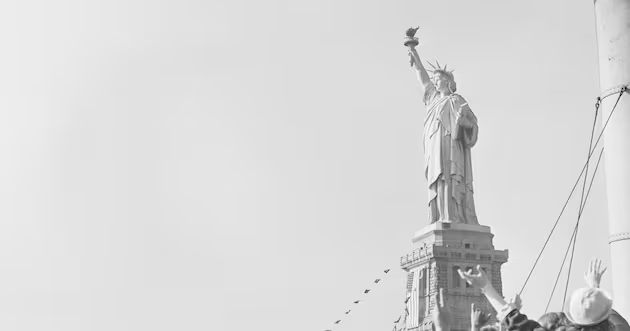
Even South Florida, which, exodus after exodus, played the role of safe harbor for the “huddled masses yearning to be free” that Emma Lazarus elegantly uplifted in her iconic poem at the base of the Statue of Liberty, is an official sanctuary no more.
Was there ever a world in which we would witness a 17-month-old baby ripped from the arms of her abruptly deported, breastfeeding Cuban mother?
Where an American citizen is dragged from a car owned by her undocumented boyfriend in our lovely, peaceful Keys and erroneously pegged as undocumented by federal agents?
Where immigrants — without criminal records — dutifully come to immigration court in New York for a status hearing and find agents lined up against the walls, ready to handcuff them in front of their terrified children and spouses when they exit?
Read more The world’s biggest America fans are … Europeans?
And, who could have imagined that our fragile Florida Everglades ecosystem would be home to “Alligator Alcatraz,” a state-operated immigration detention center, accused of inhumane treatment, and so named to inspire immigrant fear of the alligators surrounding it? Cruelty is its foundational purpose.
It’s the stuff of dystopian fiction.
I hardly recognize this rabidly anti-
immigrant America, although it has always existed to some degree. Racism is the United States’ original sin, a point of disunity during the ugliest parts of history.
It’s no coincidence that this is happening when our democracy itself is being tested and political anger separates Americans between the fearful who conveniently use immigrants as scapegoats for local and national failures and the compassionate who defend immigrant neighbors, even at the cost of their lives.
Instead of joyful, it feels like heartbreak to celebrate American independence this year.
Carrying the flame
And yet, I also see promising signs of hope.
In true American fashion, as happened in Miami decades ago, civic leaders and ordinary Americans from all backgrounds are coming together to protect immigrant communities. Empathetic Americans have risen to the task of defending their immigrant neighbors’ human rights by staging massive demonstrations all over the country to protest arbitrary, ruthless ICE arrests, and federal invasion of their neighborhoods.
Two heroic Minnesotans paid with their lives in Minneapolis.
They had no trouble seeing that immigrants are an integral part of the constitutional “We, the people” we hold so dear.
It is imperative on this historic Fourth of July when we celebrate our nation’s 250th anniversary that we pay tribute and elevate our immigrant history.
Instead of doling out fear of “The Other” and demonizing an entire class of people, we should encourage our elected leaders to pass immigration reform that includes a path to legalization, citizenship and appropriate institutional support.
Treating immigrants with basic human decency — examining their cases and giving them a shot at the American dream — doesn’t mean support for open borders. As in other countries around the world, the times call, perhaps more than ever, for security and vetting.
But immigrants bring with them mettle, drive, motivation, resilience. It takes a great deal of courage to leave loved ones and all you own behind to flee dictatorship, unspeakable violence, religious and ethnic persecution, environmental perils.
No, immigrants aren’t born in the USA. They become Americans by choice — and that’s a beautiful patriotic legacy.
Let’s replace fear-mongering with reflection.
Let’s all of us remember our own immigrant roots and champion compassion for the persecuted who deserve safe haven. By ensuring that the American dream remains accessible to everyone, regardless of where their journey began, we create stronger communities and affirm our bonding foundational values.
Tough times call for unity, gratitude and a celebration of the enduring strength of our diverse nation.
Americans must never forget that being a nation of immigrants has been a treasured source of identity and pride. This earned us respect. We’ve been a beacon of hope to the world, and that’s no old-aged cliché.
The Statue of Liberty still stands as a beacon, and the words inscribed at its base, a promise to the huddled masses that this land is for them too, still ring true.
The torch still burns. The question is whether we still hold it.
This story appears in the July/August 2026 issue of Deseret Magazine. Learn more about how to subscribe.
Read more Opinion: The Declaration of Independence set the stage for religious freedom