
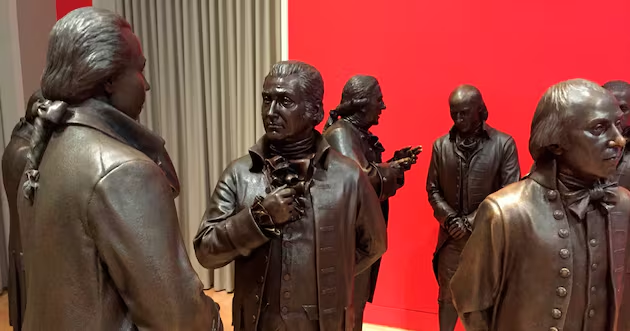
When we picture July 4, 1776, we see our Founding Fathers signing the Declaration of Independence, culminating in the dramatic birth of our country. We think of courage, statesmanship and liberty.
Read more The sincere, unapologetic joy of Utah’s Freedom Festival parade
May I offer another perspective on our Founding Fathers? It’s a title not found in history books, but one I believe they earned: auditor.
“Auditor” isn’t as romantic as “Revolutionary,” but they were our first auditors. As Utah’s State Auditor, let me share how our founders were insightful, detailed and courageous auditors.
More guest opinion pieces relating to America 250
- Opinion: On America’s 250th anniversary, don’t take our courts for granted
- Opinion: The Declaration of Independence is more than America’s birth certificate
- Opinion: American energy is the backbone of national progress and prosperity
- Opinion: The Declaration of Independence set the stage for religious freedom
- Opinion: The founders bet their future on the American experiment
Auditors look at a system, ask questions about accountability, demand transparency, look where control is being abused and require evidence to make a claim. They are fiercely independent. Reading the Declaration of Independence closely, it’s more than just a political breakup letter; it’s also history’s greatest audit.
5 ways the founding fathers acted as the nation’s first auditors
Looking at our nation’s birth through an auditor’s lens, we see five profound lessons from our Founding Fathers.
1. ‘Tone at the top’
Auditors know any entity is only as ethical as its leadership. If leaders lack a moral compass, no rules will save them. The founders understood this perfectly, they established the moral baseline. They wrote the greatest “tone at the top” statement in the Declaration of Independence:
“We hold these truths to be self-evident, that all men are created equal, that they are endowed by their Creator with certain unalienable Rights, that among these are Life, Liberty and the pursuit of Happiness. That to secure these rights, Governments are instituted among Men, deriving their just powers from the consent of the governed.”
They established that in these United States, we, the people, have inherent, God-given rights that must be protected.
2. The findings
In audits, you can’t just say, “something’s wrong.” You need objective proof. Thomas Jefferson, the chief author/auditor wrote, “To prove this, let Facts be submitted to a candid world.”
The declaration is an incredibly well-documented list of injustices — a ledger with 27 specific, documented failures of the British Crown. Our Founding Fathers performed like uncompromising auditors, detailing how King George III failed to uphold their rights:
Read more Letter to the Editor: As we celebrate America 250 choose hope over division
- Taxation without representation
- Destruction of personal property
- Denial of trial by jury
- Suspending colonial legislatures
- Making judges dependent on his will
They weren’t just complaining; they were documenting evidence for why the system fundamentally failed.
3. Checks and Balances
Dangerous things happen when one person has too much power and overrides all “checks and balances.” Auditors call it “management override.”
Our founders saw a leader in King George who had overridden the controls. He unilaterally altered local governments and repeatedly acted as if he were above the law. The founders knew that absolute power destroys accountability. By declaring independence, they laid the groundwork for our system of checks and balances — ensuring power would be divided and no single person would go unchecked.
4. ‘Consent of the Governed’
Auditors know systems only works if people believe in them. The declaration powerfully states that governments derive their “just powers from the consent of the governed.”
The American experiment is built on the radical idea that the system belongs to us, “We the People.” Our government is only legitimate because we give our consent.
5. Recommendations
Most important in an audit report are the recommendations.
Two hundred and fifty years ago, our nation’s first auditors reviewed the British Empire. They found material weaknesses and a catastrophic failure of leadership. They crafted a bold recommendation: the only way to mitigate risks to life, liberty, and the pursuit of happiness was to build a new framework.
“That these United Colonies are, and of Right ought to be Free and Independent States; that they are Absolved from all Allegiance to the British Crown, and that all political connection between them and the State of Great Britain, is and ought to be totally dissolved,” reads the declaration.
As we celebrate today, let’s remember what those signatures mean. They demanded accountability. This recommendation is now ours to uphold and defend. It is up to us to join our Founding Fathers in their closing pledge:
“And for the support of this Declaration, with a firm reliance on the protection of divine Providence, we mutually pledge to each other our Lives, our Fortunes and our sacred Honor.”
Read more Red, white and view: Checking out celebrations in the nation’s front yard
May God bless our home, The United States of America!