
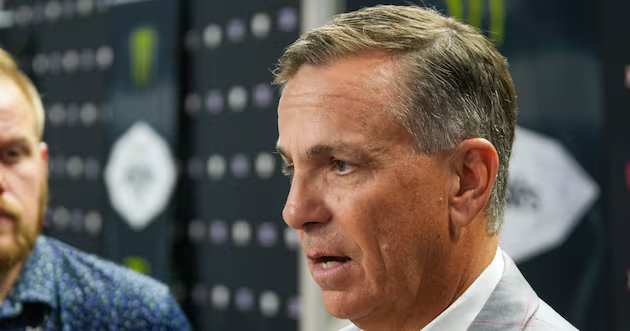
On July 1, the University of Utah athletic department entered a new era.
Crimson Brand Partners — Utah’s new for-profit company with private equity company Otro Capital — began operations, marking a major shift for the university.
Read more NBA decides Keyonte George coaching role goes against the rules
Under the new partnership, which is the first of its kind in college sports, Utah Athletics is spinning its revenue side off into the new for-profit company, including events at stadiums and arenas, branding, licensing and sponsorships, ticketing and digital media.
As part of the deal, Otro will infuse capital into Utah Athletics in exchange for a portion of the new company’s revenue.
The original report about the deal by Yahoo Sports’ Ross Dellenger last December put the total capital commitment at $500 million, which also included capital commitments from donors.
Harlan said Wednesday at Big 12 media days that Utah is “still looking into” the donor piece of the deal and has “not proceeded with that yet.”
Harlan will chair the new company’s board, and the university will retain the majority of seats on the board. There’s also an exit strategy for Utah within five to seven years, per Dellenger, and the university holds the right to purchase Otro’s stake.
Since things have just gotten going in the last week, Crimson Brand Partners is not quite fully in gear yet.
“They’re building their team, but they’re already hunting and I’m really excited by their progress,” Harlan said, noting that he had a Zoom meeting scheduled with them soon after meeting with the media.
“Really impressed with the people they’re bringing in, really impressed with what they’re already doing.”
Crimson Brand Partners scouted out Rice-Eccles Stadium during last week’s Monster Jam World Finals, and already has ideas for how to improve the experience.
“They were a part of the big events at the stadium the last week. They saw a lot of things that we need to work on. That’s part of that,” Harlan said.
“We have the (Post Malone) concert coming up, and then of course I like to say the big one, the big opener for this (football) season. I’m thrilled with the team that (CEO) Matt Webb is putting together and continue to be very excited.”
Webb comes to Utah with two decades of experience in professional sports. He was previously the vice president of corporate sponsorships for the New Orleans Saints and New Orleans Pelicans.
His experience will be invaluable as the new company starts to explore major sponsorships with corporations.
“Crimson Brand Partners, one of the big pieces of it, and I know I’ve talked about it publicly, but I have to always reinforce it, is it’s no longer just athletic assets. It’s University of Utah assets in a very meticulous, professional way,” Harlan said.
“And so now the pitches are different. Now you’re pitching to the big companies, the ones that have real money and want to create a really deep relationship, now get to look around the campus and yes, they get all the athletic assets if they want them, and so that process is underway. We’ve already seen some really interesting conversations of interest because we’ve never been able to offer it that way before, if that makes sense. So this day and age, big deals really comes down to partnerships.”
As collegiate sports gets more and more professionalized, Harlan is taking inspiration from Utah Jazz and Utah Mammoth owner Ryan Smith in terms of the “deep relationships” they’ve been able to create with corporate partners.
“I’ve been really impressed how they co-brand around the community. It’s not just monetary value, it’s co-branding together. That’s kind of the professional way and I think you’re going to see more of that,” Harlan said.
“If you look at the team when it’s all assembled, they’re all coming from professional backgrounds at big places. I think you’ll see more and more of that going forward.”
Crimson Brand Partners is looking at every avenue to increase revenue, which could include the construction of field-level suites in the north end zone at Rice-Eccles Stadium.
“I think we’re going to do some suites on the field or some kind of box seating. We saw that around the conference the last few years, so we’re going to look at that,” Harlan said.
The new company is also looking at overhauling the gameday experience and will hire a new “game experience coordinator.”
The university recently installed new LED lights that can provide a “light show” during night games, and while they are looking at improving the fan experience with the new company, there are some aspects of Rice-Eccles Stadium that can’t be changed right away.
“I mean, we’re still challenged in the stadium,” Harlan said. “They’re not going to come in here overnight and make the concourses bigger, but we can be smarter on some things. We can provide more opportunities.”
Will the terms of the deal with Otro ever become public? The exact stake Otro holds and the total dollar figure is still not publicly known.
“The board, as it comes together, we’ll definitely talk about it. I think that what we probably need to do is where we can, we will. It is a private company and so we have to honor the terms of the deal,” Harlan said, “but I think that one thing that we really can be transparent about is what are they doing that’s going to affect the fans? What changes are coming that they’re going to be doing?
“But when it gets into all the dollars and cents, I don’t know if we’ll completely get there to the satisfaction of all, but what is really important is that the governance, as we said from the very beginning, is absolutely on the side of the University of Utah. I’ll chair that board and we’ll make some really good decisions, but we’re continuing to figure out what’s reasonable to share.”
Here are other topics Harlan covered in a meeting with the media Wednesday.
A ‘Monster’ brand deal
Monster Energy will reportedly pay the Big 12 Conference $20 million annually in exchange for the rights to a co-branded Big 12 and Monster patch on football, men’s basketball and women’s basketball jerseys and a co-branded Big 12 and Monster logo on the playing surfaces of those sports.
Read more 9 books everyone’s talking about this summer
The deal, per Sports Business Journal’s Ben Portnoy, is expected to make each Big 12 school $1 million per year.
“Well, you have to think of this a little bit different than a typical jersey patch in that it is part of the Big 12’s patch. It’s really their turf and the NCAA said they could do it,” Harlan said.
The University of Utah currently has a deal with Pepsi as the official beverage partner of Utah Athletics. How will the Monster deal impact that?
“We certainly have talked to Pepsi. They’re aware of it and that’s a great partner and we’ll figure it all out,” Harlan said.
At $20 million for the entire conference, it’s a bargain for Monster, but ultimately, it’s extra money for Utah and the rest of the Big 12 schools.
The deal means that for the first time in history, there will be at least one advertisement on Utah’s jerseys, with a potential second patch to be added later if the athletic department strikes its own deal with a company.
University of Utah Health has had branding on the Rice-Eccles Stadium field and Huntsman Center court since last year.
“I think it’s a really innovative thing that (Big 12 commissioner Brett Yormark has) done and someone was being critical about the deal and I said on radio … I just said it’s about a million bucks more than Utah had yesterday, and that’s really important,” Harlan said.
“The traditionalist in me is like, ‘Ugh,’ but the reality that the operation that we have to run is revenue is important and I think this one’s pretty harmless and pretty cool.”
Utah’s apparel partnership with Adidas
After nearly two decades with Under Armour, Utah will sport the three stripes starting in July 2027 after signing a seven-year apparel deal with Adidas.
“I love the way they were authentically passionate about being our partner,” Harlan said of Adidas. “Their president came down, the president of North America, who was dealing with this thing called the World Cup, but he still took time and he walked through the bookstore and he saw all these things we can do. I thought the deal was really good for the Utes.”
Harlan particularly liked Adidas’ NIL program, which will be available to all Utah athletes.
“I particularly like the innovative approach to NIL and you can see that on paper and you can hear it from them, but then I went and called other Adidas schools and they were just effusive in their praise about how it’s helping all the athletes,” Harlan said.
The partnership with Adidas, Harlan believes, will also be especially beneficial with basketball.
“I also like (that) they’re really, really popular in the basketball space, and I think that that’s something that was really important to me, too,” Harlan said.
“I really feel like what Adidas is doing for college basketball, they’ve reinvented a lot of things. I think it’s going to really help us in a lot of different ways.”
Huntsman Center renovation
Last week, Utah announced that it had begun a process to explore the possibility of a major renovation of the Jon M. Huntsman Center.
The university has chosen Populous and VCBO Architecture, which will conduct a “comprehensive feasibility study” exploring a range of options to modernize the 57-year-old arena.
In a February board of trustees meeting, Harlan presented options for the Huntsman Center, including a “renovation-plus” plan, which could reduce the arena’s capacity to around 9,000 seats from the current 15,000, according to a slide deck from the meeting.
The renovated Huntsman Center could include more premium seating, which could increase revenue brought in from each event. The slide deck also listed non-Utah Athletics events that could be held at the venue, such as concerts, comedy shows, expos, conventions and more.
Back in 2025, the university was exploring options for an entirely new basketball arena. Why renovate instead of relocating and building new?
Harlan likes the “bones” of the building and its central place in the university’s “College Town Magic” concept — a plan to transform Utah’s current status as a commuter school into a university wherein a significant chunk of students live on campus.
The university has greatly increased the amount of housing available to students in recent years, including constructing residential buildings for students directly east of the Huntsman Center.
“VCBO is a local Salt Lake architect who’s done a lot of design work for us — baseball stadium, South end zone — combined with Populace, who’s also been great,” Harlan said.
Engineers from the companies are currently going through the building and looking at the structure.
“So far it looks like — it’s really not surprising — incredibly sturdy and it’s unbelievable how that thing is just there,” Harlan said. “How they built stuff a long time ago, I mean, it is absolutely stronger than we already thought. That’s a good thing, which even reinforces more the opportunity to try to have some fun on the inside of it, so we’re going through that process now. It’s fun. The meetings, I think I got a five-hour one tomorrow to figure out what we’re going to do, and I’m excited about it.
“It’s a big priority of (university president Taylor Randall) and the board (of trustees). As you guys know, College Town Magic is going to happen and it’s going to be unbelievable, and we just felt like having it there as the starting point and having some retail in it and all the fun we could have, there will be a lot of challenges ahead, but it will be a fun project.”
Read more Opinion: The competing worldviews of Zohran Mamdani and Donald Trump