
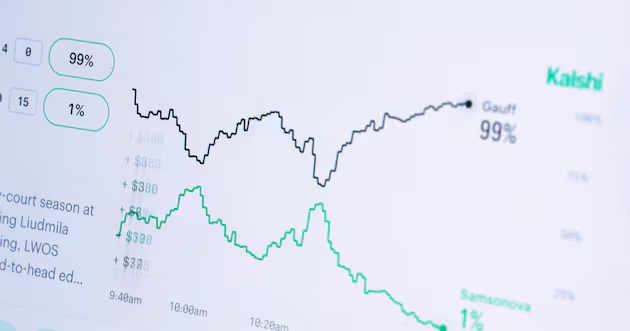
Tired of sitting idly by while drought ravages the West and wildfires spew smoke into the air? Why not make money off of other people’s misfortune by placing bets on how bad things are going to get?
Read more Smelling chocolate may help when exercising on an empty stomach
Prediction markets are taking money on both droughts and fires, as well as other natural disasters. One such company, Polymarket, lures customers to its website with this: “Explore 100 live Wildfire prediction markets as of July 6, 2026. Track real-time odds and trade on The World’s Largest Prediction Market.”
If that doesn’t sound appealing, maybe you’d like a website that specializes in the devastation of wildfires in California. A site called wyldfyre is in the works, with the catchy slogan, “You can’t predict fire. But you can trade on it.”
And get rich (or more likely poor) off it.
If you’re not feeling a little queasy by this, or even a bit outraged, try imagining yourself as someone who lost a house in the Eaton Fire that destroyed much of Altadena, California, last year, and who later learned people earned a windfall by taking a gamble that the fire would do what it did.
High Country News asked fire victim Sylvie Andrews, who lost the new house she had built with her partner, how she felt about these bets.
“My first take is that it’s morally reprehensible,” she said.
Of course it is.
Prediction markets, as these ventures are called, have begun to flourish ever since one trading company, Kalshi, won a lawsuit in 2024 against the Commodity Futures Trading Commission. Utahns have a unique stake in this. Because the commission is the sole governing body for this form of gambling, Utah’s laws against gambling have no effect on the companies. Prediction markets have effectively usurped the state’s representative form of government.
The companies involved would take issue with me calling them gambling or betting concerns. They prefer to be classified as exchange traded markets or crowdsourcing. Traditional casinos and sports books profit off of bettors’ losses. Prediction markets charge flat fees for the privilege of trading.
But Les Bernal, the national director of the advocacy group Stop Predatory Gambling, calls them “a con.”
He doesn’t stop there. Bernal, who spoke to me via telephone this week, said prediction markets, which allow contracts on everything from the spread of disease to if and when a killer will be caught to the date when the United States will attack a foe, are “an example of how commercialized gambling has metastasized into almost every element of American society.”
“There’s no public benefit to people wagering on forest fires.”
Prediction markets argue their crowdsourcing brings clarity to current events, such as election predictions. Critics argue that many predictions can be manipulated. Earlier this year, U.S. Army Special Forces Master Sgt. Ganon Ken Van Dyke was arrested after making more than $400,000 on Polymarket by allegedly using insider information to accurately predict when the U.S. would invade Venezuela and force President Nicolás Maduro from office.
Likewise, someone trying to predict the ignition of a wildfire, or its path, might be tempted to use arson to increase his or her chances.
A Kalshi spokeswoman told me the company strictly bans insider trading. However, it’s hard to see how uninformed guesses on military strikes or wildfire paths could benefit from the opinions of the masses.
Bernal said too many Americans rail against the spread of so-called Hollywood values, when in fact the nation has adopted Las Vegas values instead.
“Commercialized gambling has become so normalized today that we have stopped to question it the way we need to,” he said. “There’s no grassroots movement in America for people wanting to wager on these forest fires. It’s driven by greed, and they’ve lost their moral compass.”
What could put an end to this madness? Lawsuits challenging prediction markets are underway. Bills are slowly wending through Congress.
Meanwhile, it ought to be easy to see the difference between laying down money on a game of pure chance and laying down money in hopes of profiting from another person’s tragedy.
Both are foolish. Both can be addictive and destructive. But one is clearly on a different level of moral depravity.
Don’t take my word for it. Listen to Andrews, who was left to rebuild a life destroyed by that fire in California. A total of $1.2 million was spent betting on questions surrounding that fire, according to Aeon Magazine.
Read more Watch: How President Porter learned she is never alone through Jesus Christ
“The fact that someone would feel OK doing that flabbergasts me,” she said.