
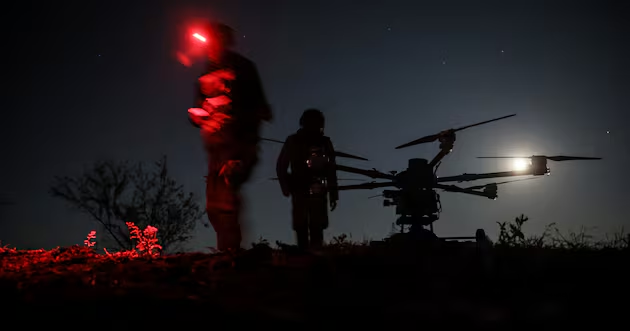
- “Small Drones, Big Problems” offers a collective approach to drone threats.
- The free guidebook is designed to assist law enforcement and other public agencies in their efforts to foil drone attacks.
- AI is an evolving component of drone tech — but it does not replace human judgement and decision-making.
There was a frightening period during World War II when German U-boat operations proved catastrophic for the Allies, sinking hundreds of ships.
Read more Daycare-related fraud conviction in Minnesota ends in guilty plea
Ironically dubbed “The Happy Time,” the U-boats’ lethal capabilities forced British and American ships to adapt by implementing convoy systems to protect shipping lines — while simultaneously developing new technologies such as sonar, radar and depth charges.
And while the German U-boats would remain a threat to Allied maritime shipping and operations throughout the war, they ultimately didn’t lead to Germany’s victory.
The Allies survived — winning the war after developing and executing principles to effectively respond to a weapon that had triggered fear in every sailor.
Now in a recently published counter-drone handbook, the Pentagon contends unmanned aircraft systems — aka drones — have, in U-boat-like fashion, enjoyed their “Happy Time.”
“They are versatile, agile and adaptable tools,” states the handbook. “Like German U-boats, however, drones don’t win wars.”
Still, the guidebook asserts, Americans from many sectors — from local law enforcement to industry and academia — must take deliberate steps to protect citizens, property and critical infrastructure from drones.
Don’t look for a drone ‘silver bullet’
Released by the Defense Department’s Joint Interagency Task Force 401, was publicly released to offer a collective approach to drone threats.
The guide’s not technical. It’s written for non-experts and is fairly short. It can be read in one sitting. But it is deliberately current — drawing upon drone combat examples and lessons learned from ongoing conflicts in the Middle East and Ukraine.
The principles outlined in the guide “are important to prevent a drone attack before it occurs — or defend against one that is underway,” wrote U.S. Army Brig. Gen. Matthew Ross in the guide’s foreword.
“They are also not unique to the U.S. military. Drone protection principles apply equally to federal agencies and departments, as well as state and local law enforcement across our nation.”
And while there’s no silver bullet to protect against drones, threats can be mitigated by being proactive and cooperative. “It is imperative to give our warfighters the tools, technologies, and training they need as rapidly as possible to defend the homeland,” wrote Ross.
“We have faced novel challenges before, and we should not be intimidated by this one. On the contrary, we should lean in and take every possible step to remain ahead of our adversaries.”
Army Maj. Joe Amoroso, deputy chief of strategic initiatives for JIATF 401, said the handbook offers “vital first principles” to help in “countering the defining threat of our time.”
“It is crucial to build a common foundation for counter-drone efforts as we work with the entire government and interagency partners to respond to this growing threat,” Amoroso told Military Times.
The guidebook functions as a “how-to” resource for drone protection for both military and civilian communities.
“The fundamentals of drone employment and drone protection can be learned,” the guidebook noted. “Once you know the fundamentals, you can start adapting and innovating to counter the threat of drones.”
And while jamming or downing enemy drones with bullets or lasers seems prevalent in Hollywood or military combat footage, the truth about drone protection is less glamorous.
In most cases, according to the guidebook, “you can effectively protect yourself against drones by evaluating the threat methodically and approaching it pragmatically.
Read more Lawsuit alleges Forest Service overhaul is cover for massive workforce downsizing
“Often, the best defense is a good offense. Targeting drone operators, as well as the component parts of drones, can remove the threat before it materializes.”
A long-established aerial combat weapon
Drones are part of everyday life — used for everything from aerial wedding day photos to medical supply deliveries.
And drones in the hands of both state and non-state actors are also being launched to intimidate, harm and kill. Iran’s Shahed-136 drone, for example, has targeted U.S. forces and interests across the Middle East following the start of Operation Epic Fury last February.
Shahed-136 drone strikes have reportedly accounted for 66% of Iran’s counterattack operations during the initial phase of the Iran war.
But while today’s drone technology is advancing in real time, combat-purposed unmanned aircraft systems have existed for nearly two centuries.
In 1849, Austria tried to bomb Venice, Italy, using pilotless balloons filled with explosives. And Britain’s radio-controlled “Queen Bee” in World War II is believed to have inspired the word drone.
Combat-purposed drones continued to evolve during the Cold War, the Vietnam War and the global war on terror.
But drone technology has rapidly accelerated following Russia’s invasion of Ukraine in 2022.
By some accounts, Ukrainian drones have accounted for the significant majority of Russian casualties and Russian military systems, according to the DOD.
No surprise, Iran has witnessed the success of military drones and adopted the technology to enhance its own strength.
Drone guidebook: Don’t overstate AI
“Small Drones, Big Problems” identifies “The Five Ds of Protecting Against Drone Threats” — Discipline, Detect, Deny, Disrupt and Defeat.
“Good protection against drones isn’t a well-aimed shot in the heat of an attack,” noted the guidebook. “It consists of smart actions taken by defenders before a drone launches, during its flight, and after an attempt has been made.”
The guidebook also examines the emerging role of artificial intelligence in drone tech in both offensive and defensive platforms.
There’s temptation, the guide notes, to classify drone AI as either a “savior” or a “threat,” but neither description is useful.
AI is far more neutral than either of these extreme perspectives suggest.
“Put simply, AI is a set of tools designed to help computers recognize patterns, learn from data, make predictions, and assist humans in making decisions, especially when the volume of information exceeds what any one person or team can reasonably manage,” according to the guidebook.
“It does not replace judgment and disciplined decision-making. It does not understand intent or consequences. It does not decide what matters.”
Plan on drones evolving in the coming months and years.
“Yet the foundation of (drone) protection — principles applied with discipline, shaped by terrain, strengthened by training, and accelerated by intelligent systems — will remain constant,” concluded the guide.
Read more An old rival is lending an 11th-century tapestry to England