
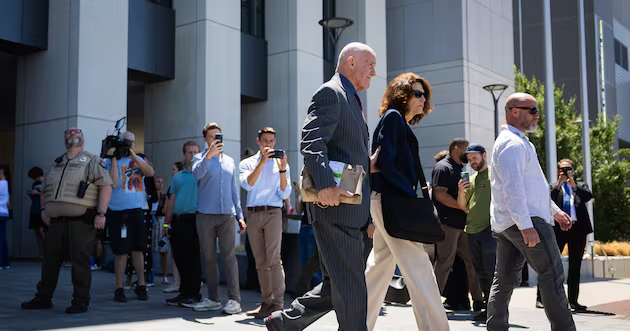
Charlie Kirk’s widow sat in a Provo, Utah, courtroom on Friday, as the weeklong preliminary hearing of her husband’s alleged killer concluded.
Read more Men’s State Am: Defending champ Bowen Mauss will meet Cameron Crawford in championship match
From the courtroom gallery’s front row, Erika Kirk listened stoically as prosecutors laid out evidence against 23-year-old Tyler Robinson. He sat just a handful of yards in front of her through the week, keeping his gaze forward.
The proceedings were visibly painful for both Kirk’s and Robinson’s families. At times, Erika and Robert and Kathryn Kirk, Charlie Kirks’ parents, left the room when evidence became too graphic.
But their time in the courtroom far exceeded their short absences, and for nearly 30 hours, Erika sat between her mother and her mother-in-law, as prosecutors introduced new forensic, video and written evidence.
She was joined by about two dozen of Kirk’s friends, family members and political allies through the week, including Donald Trump Jr., political commentator Jack Posobiec and Utah Sen. Mike Lee.
After court concluded Friday, Kirk’s family released a statement, saying the hearing had brought them “comfort” and “marks an important step forward in the pursuit of justice for Charlie.”
The case’s high-profile nature naturally drew in members of the public and the press.
When Utah County residents realized the court allowed only 14 members of the public into the gallery, they began camping outside the 4th District Court early in the night. Some told the Deseret News they were drawn to the hearing after witnessing the conservative activist and Turning Point USA co-founder’s assassination at Utah Valley University 10 months earlier.
Others told the Deseret News they were skeptical Robinson had killed Kirk, and they wanted to hear the evidence for themselves.
Robinson faces six felony charges, including aggravated murder, witness tampering and obstruction of justice. He also faces the Class A misdemeanor of a violent offense in the presence of a child.
During the Monday-through-Friday preliminary hearing, prosecutors were tasked with establishing probable cause that a crime was committed and that Robinson committed it. Meanwhile, the defense used their witnesses and cross examinations to try to convince Judge Tony Graf that there is insufficient evidence against the defendant.
It was initially expected that the preliminary hearing would conclude with oral arguments, but Graf granted the defense’s request to file written briefs instead.
The state’s opening brief must be submitted to Graf by July 28, and the defense is ordered to respond by Aug. 11. The state will then reply to the defense’s brief by Aug. 18.
When the court reconvenes on Sept. 1 at 10 a.m., each party will take two hours to argue their cases.
Following those oral arguments, Graf will not rule on guilt or innocence; his only question is whether there is enough evidence for the case to proceed to trial.
If Robinson is convicted following a criminal trial, the state plans to pursue the death penalty.
During the hours of back and forth between the prosecution and defense — in a hearing that was televised live and reported on by major news outlets across the country — the court accepted a vast amount of new DNA evidence, security footage and witness statements.
Agents: Robinson appeared on UVU campus 4 times on Sept. 10
From hundreds of hours of security surveillance footage, state prosecutors determined that Robinson appeared on UVU campus four times the day Kirk was killed, according to expert witnesses.
He was seen twice before the shooting, at the time of the shooting, then later in the evening into the early hours of Sept. 11, according to testimony.
Investigators showed video of a gray Dodge Charger entering a parking garage on campus on Sept. 10. David Hull, a lead investigator in the case, said he believed the man who exited the car was Robinson. Footage then showed Robinson visiting the outdoor amphitheater and returning to his vehicle at about 9:25 a.m.
The next video purportedly showed Robinson returning to campus from a nearby neighborhood at 10 a.m.
“He went to Chick-fil-A in the Sorensen (Student Center) and purchased some food and sat and ate the food,” Hull said. Then Robinson left to a wooded area at 11 a.m. Here, Hull said Robinson changed clothes but kept on the same shoes.
Footage released to the public shows an individual Hull believes to be Robinson walking by the Losee Center, near the staircase leading to the roof just after noon. Then footage showed a man on the roof of the building, crouching down and crawling to the corner. After the shooting, the individual stood up, then moved across the building to the north. He appeared to be carrying an object.
From there, he jumped off the roof and entered the wooded area near campus.
Later that evening, Robinson was pulled over in Orem. The police officer took down his license plate, which gave one of the first indications Robinson had been on campus that day.
Lance Twiggs’ recorded interview shown in court
One of the most significant developments came when prosecutors publicly revealed the full scope of Robinson’s alleged confessions to his former roommate and romantic partner, Lance Twiggs.
The video began with state prosecutor Ryan McBride asking Twiggs about his relationship with Robinson.
“When I first met him, I didn’t know him super well. He was just a new roommate. So I knew he knew my friend group, and I knew he liked playing games,” Twiggs said of their initial meeting in 2023.
Twiggs said their relationship turned romantic two or three months after Robinson moved in.
The prerecorded interview was slightly edited at Graf’s orders, but what was shown conveyed additional text messages and Discord chats in which Robinson allegedly explained his motive, discussed retrieving the rifle because he feared police would find his DNA on it, and advised Twiggs not to speak to the media and to ask for a lawyer if questioned.
Twiggs said he saw Robinson the day he turned himself over to authorities. Twiggs said he asked if what Robinson had messaged him was true, and the defendant said it was. Twiggs said Robinson told him he wished he hadn’t done it and said he planned to tell his parents or turn himself in.
He also testified that while he could not identify Robinson with complete certainty in every surveillance image, the final photos, he said, “definitely do look like Tyler Robinson.”
At another point during the hearing, the prosecution accidentally showed a photo of Robinson’s handwritten note he’d left Twiggs.
The note said, “Luna, If you are reading this per my text, then I am so sorry. I left the house this morning on a mission and set an auto text. I am likely dead or facing a lengthy prison sentence. I had the opportunity to take out Charlie Kirk, and I took it. I don’t know if I will/have succeeded, but I had hoped to make it home to you. I wish we could have lived in …”
After three seconds of the note being visible to the media, Graf asked that it be taken down. Its publication “violated the court’s orders,” he said.
The courtroom was heavy and tense
Throughout the week, Erika Kirk sat between her mother and her husband’s parents in the courtroom gallery.
On Monday, they left the room several times, as Graf admitted graphic evidence to the court. That day, he allowed three videos of Kirk’s assassination to be played on the attorneys’ and his monitors.
As the gunshot rang through the gallery, a friend of Kirk’s rested his head on the bench in front of him; the woman to his left cried.
Kirk’s and Robinson’s families returned to the courtroom on time each day, as the evidence became more specific.
Read more Opinion: How I failed as a 4-year-old Viking with my Norwegian grandfather
On the final day of the proceedings, Graf allowed an enhanced compilation of security footage to be played to the gallery but not to the media. The footage showed a man lying on the roof of the Losee Center, then getting up to run in the opposite direction, where he jumped off the roof and fled the scene.
As Erika watched the footage, she began to cry.
Someone in the courtroom gave her a box of tissues, and by the end of the video, she averted her eyes from the screen.
Testimony: DNA on evidence belonged to Robinson and his roommate
According to testimony, investigators took cheek swabs of Robinson and Twiggs, and found that the DNA profiles of a screwdriver and towel recovered from the crime scene were “30 quintillion times more likely” if the contributors were Twiggs and Robinson, and Twiggs and an unrelated person.
Amanda Bakker, a forensic examiner for the FBI in Quantico, Virginia, testified that the DNA left on the evidence was not evenly split between Twiggs and Robinson.
On the towel, 5% belonged to Twiggs, and 95% belonged to Robinson. On the screwdriver, 11% was Twiggs’ and 89% was Robinson’s.
Twiggs has complied with the prosecution and was granted immunity from both state and federal officials for information he provided in at least one interview. However, he is not immune from being prosecuted for information that authorities may discover outside those conversations.
During a separate witness testimony, prosecutors presented new forensic evidence tying Robinson to the alleged murder weapon and the ammunition used with it.
Jennifer Faumuina, a sergeant with the State Bureau of Investigation, testified that DNA evidence recovered from various parts of the rifle near UVU matched Robinson’s DNA. She said reports she received from ATF laboratory analysts determined that the likelihood of the DNA belonging to Robinson was at least one trillion times greater than that of it belonging to any other person.
A separate ATF report also concluded that a Dremel engraving tool recovered from Robinson’s home created the markings on the cartridge cases found both at his home and inside the recovered rifle.
While investigators said a fired cartridge case was consistent with having been fired from the rifle, they could not conclusively determine whether the bullet jacket fragment recovered from Kirk’s body came from that firearm.
Caitlin Oliver, a DNA section chief for the Bureau of Alcohol, Tobacco, Firearms and Explosives, also testified about the DNA testing she conducted on evidence in the case.
Oliver said Robinson’s DNA was discovered on the gun’s stock and grips, butt plate, trigger and trigger guard, bolt, fore-end, barrel, optical accessory, protected underside of the receiver, one .30-06 cartridge case and several .30-06 cartridges.
Oliver also addressed DNA found on the rotary engraving tool, which was allegedly used to engrave bullets. The tool belonged to Twiggs, and his DNA was found on the tool’s buttons, Oliver said.
Details of the night Robinson surrendered
Davis testified that he’d met Robinson the night of Sept. 11, after the then-22-year-old had turned himself in to the Washington County Sheriff’s office in southern Utah.
Previous reports said Robinson’s parents had recognized their son in the screenshots released by the FBI. When Robinson came home on Sept. 11, he told them he would rather kill himself than turn himself in. His parents convinced him to speak to a family friend, Mike Mitchell.
Mitchell spoke with Robinson, then the four of them traveled to the sheriff’s office together, according to reports.
When Davis arrived, Robinson and his parents were already in a room together. Security footage from the sheriff’s office, which was released to the public, showed Robinson wearing a dark baseball hat, burgundy T-shirt, blue jeans and tennis shoes.
Mitchell took an hour to write a witness statement, which Davis reviewed personally. The court did not allow the statement to be released to the public.
That night, Robinson was arrested, then transported to the Utah County Jail at around 7 a.m. on Sept. 12. There, he was formally booked by Davis at 8 a.m.
Search warrants were then issued for Robinson’s home, which he shared with Twiggs, and for his parents’ home.
Bullet found on the roof of the computer science building
During the sweep of campus, which turned up the screwdriver, a body imprint on the Losee Center’s roof and the gun wrapped in a towel, investigators discovered a bullet on the roof of UVU’s computer science building.
Agent Brian Davis of the Utah State Bureau of Investigation testified that the building was southeast of the Losee Center, and he did not believe the building was in the line of sight of Kirk’s white tent.
The bullet, Davis said, was a live .223-caliber round, meaning it was still intact.
The defense sought to poke holes in the prosecution’s case
Through the week, Robinson’s defense sought to expose instances they characterized as loose ends.
On Monday, during defense attorney Kathryn Nester’s cross-examination of Christopher Bagley, a former Utah Valley University officer, she questioned whether agents were thorough in ruling out other possible shooters.
Bagley said he’d found an empty pistol holster in the courtyard after Kirk was shot, but said he didn’t know what happened to the holster or whether it was ever fingerprinted.
Nester also referenced a concealed carry, which was discovered on Sept. 10 in a backpack on campus, as evidence that the shot could have come from elsewhere. UVU students 21 and older are legally allowed to carry loaded concealed handguns without a concealed firearm permit.
The defense also referenced accusations that Bagley’s body camera did not record portions of his investigation on Sept. 10. Bagley testified that his body camera’s battery had died while he was investigating the Losee Center’s roof, where Robinson allegedly fired his shot at Kirk.
On Tuesday, as expert witnesses described the DNA discovered on various pieces of evidence, the defense argued that the reports were not 100% definitive.
Court concludes: The aftermath
Following the conclusion of court on Friday, the Kirk family released a statement saying the preliminary hearing brought the family “comfort” and “marks an important step forward in the pursuit of justice for Charlie.”
“As difficult as these last few days have been, it brings our family comfort to know that the world has witnessed the overwhelming evidence of what occurred to Charlie that day,” the family wrote.
“Nothing will ever undo the loss of our beloved Charlie. As this case moves into its next phase, we pray that truth will continue to be heard through a process that is fair, transparent, and grounded in the facts.”
Statement from Kirk Family following preliminary hearing:
“The conclusion of the preliminary hearing marks an important step forward in the pursuit of justice for Charlie. Our family is grateful for the prayers, support, and kindness that has been extended to us, especially…
— Lynden Blake (@LyndenBlake) July 10, 2026
The family’s legal counsel did not speak to the public or press following court proceedings on Friday. And counsel did not appear to address the media.
Speaking to the press has already been a contentious issue in the case after Graf found a state prosecutor in civil contempt of court last month for comments he made to media outlets back in March.
Robinson was transported back to the Utah County Jail in Spanish Fork under heavy armed escort, where he will remain without bail as the case continues.
Read more ‘God had a plan’: Jonathan Roumie on the difficult road to ‘The Chosen’