
On the day President Donald Trump took office in January 2025 he signed an executive order that placed a 90-day freeze on all U.S. foreign aid.
Read more Opinion: How to reach the pursuit of happiness
In the following months, the Trump administration began laying off thousands of U.S. Agency for International Development (USAID) employees or placing them on administrative leave.
On March 10, 2025, the administration canceled 83% of USAID-related programs. By July, the government had effectively dismantled USAID as it was absorbed into the U.S. State Department.
Last month, people in online conversations, sparked by Elon Musk’s avidly used X feed, debated the effects of reducing the agency.
Some said the defunding has led to the death of millions of people while others say the agency spent money on destabilizing governments and on projects counter to U.S. interests.
What did USAID do?
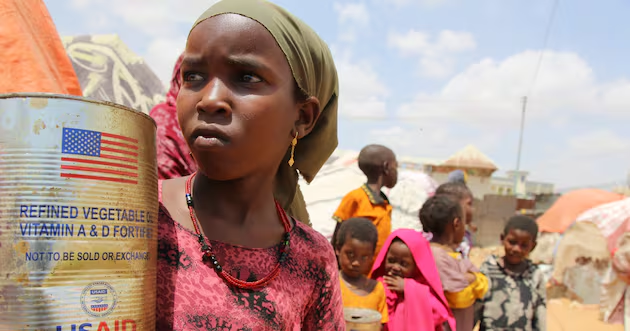
For more than six decades, USAID served as the government’s primary agency for humanitarian assistance. The agency’s mission was to “partner to end extreme poverty and promote resilient, democratic societies while advancing our security and prosperity.”
According to Dr. Craig Zelizer, professor at Georgetown University, USAID helped provide health care to 95 million people, grow local businesses by $4.8 billion, and help 23 million children gain an education.
In a study published by The Lancet, 92 million lives were saved by USAID between 2001 and 2021.
Through USAID, the U.S. worked to combat the HIV/AIDS outbreak, the Ebola crisis, and the COVID-19 pandemic. For each of these, the agency aided in providing medical supplies, food, safe water, and vaccines.
The agency also helped to relieve suffering during natural disasters and global conflicts.
Although USAID was effectively dismantled last July, many of the agency’s humanitarian programs continue to operate through the U.S. State Department. The State Department, for example, administered the disaster relief services in Venezuela following the massive earthquakes last month.
What has happened since the defunding?
In 2024, according to Community Partners International, USAID accounted for 40% of all humanitarian aid.
Karen Feldscher, writing for the Harvard T.H. Chan School of Public Health, wrote in November that “the Trump administration’s decision to shut down the U.S. Agency for International Development (USAID) has resulted in hundreds of thousands of deaths from infectious diseases and malnutrition.”
In an interview with PBS, former USAID Administrator Samantha Power argued, “Cuts were done, not on a glide path … but it was a cliff. And by cutting off resources on a cliff, you do the most human harm possible.”
Read more Interior proposes to rewrite grazing rules on 155M acres of BLM land
Powers said that the cuts will not only result in lives lost but also harm the U.S.’s global influence. “When you commit soft power suicide,” she said, “who is going to be the biggest beneficiary? Of course, your largest geopolitical competitor and that is China.”
Proponents of cuts say USAID was a ‘wolf in sheep’s clothing’
Secretary of State Marco Rubio told the House Foreign Affairs Committee in May that “no one has died because of USAID cuts … No children are dying on my watch.”
“Beyond creating a globe-spanning NGO industrial complex at taxpayer expense,” said Rubio in a statement for the U.S. Mission to the Organization for Security and Cooperation in Europe, “USAID has little to show since the end of the Cold War. Development objectives have rarely been met, instability has often worsened, and anti-American sentiment has only grown.”
Many people applauded the cuts to U.S. foreign aid and the dismantling of USAID saying that its programs were not in the interest of the U.S. or developing countries.
Arikana Chihombori-Quao, former African Union ambassador to the U.S., told Al Jazeera in an interview that USAID had significant negative effects on political stability and economic growth within Africa.
“When you look at it on paper,” Chihombori-Quao said, “it all looks really good, but they’re actually wolves in sheep’s clothing. They’re using that open access … to constantly destabilize governments.”
“I can tell you right now that the majority of African leaders and not just African leaders, but leaders in the developing world, are celebrating the exit of USAID.”
“The American taxpayer needs to know that [of the] billions of dollars that have been given to USAID, a fraction is making it to the people,” she continued.
Chihombori-Quao said that the solution for African prosperity was for Africa to take control of its natural resources and prevent developed countries from exploiting them. She also said that the average African government can afford to provide health care and education for their populations and should not rely on foreign handouts.
What’s the future of U.S. foreign aid?
Although the cost of dismantling USAID was roughly $6 billion, Reuters reported that the U.S. decreased foreign aid spending by $25 billion.
Recently countries such as France, Germany, and the United Kingdom have also reduced their humanitarian spending. Proponents of an increase in humanitarian funding, like Ara Friedman at Georgetown’s School of Foreign Service, say reducing foreign aid worldwide increases the likelihood of starvation and disease.
Meanwhile, Rubio argues the State Department will continue the most effective and necessary foreign aid programs.
“Moving forward,” Rubio said in his OSCE statement, “our assistance will be targeted and time-limited. We will favor those nations that have demonstrated both the ability and willingness to help themselves and will target our resources to areas where they can have a multiplier effect and catalyze durable private sector, including American companies, and global investment.”
Read more Opinion: You should go to your high school reunion