
- Utah’s Stratos Project has become the latest clash between industrial expansion and conservation efforts in a state balancing economic growth with limited natural resources.
- Supporters say the data center will strengthen Utah’s economy, energy capacity and national security, while opponents warn it could strain water supplies and damage the environment.
- The fight over the project has expanded beyond the data center itself, becoming a broader debate over who decides how Utah’s land, water and resources are used.
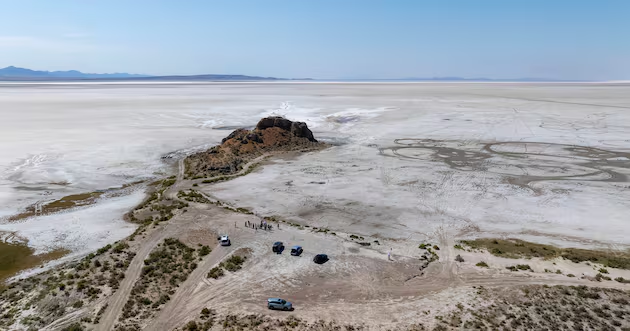
The land in Utah’s Hansel Valley is vast and empty. It rises gently into low, rounded peaks to the east and west; to the north and south, the land fades into the horizon.
Read more With Graham’s death, is the age of the Republican hawk fading?
About six square miles of this area, just northeast of the Great Salt Lake, have become the new battleground between industrialists and conservationists.
Developers, including “Shark Tank” investor Kevin O’Leary, hope to build a 9 gigawatt data center on the land. They say the project — the Stratos Project — will bring 2,000 permanent jobs to the area, generate a large tax base for the state and strengthen U.S. national security as the Pentagon attempts to integrate AI into its arsenal.
The project fits into Utah Gov. Spencer Cox’s goal of increasing the state’s energy capacity to 20 gigawatts by 2034. Outside the Stratos Project, the goal has attracted a host of energy developers, including Valar Atomics, the first American startup to ever produce nuclear power.
However, others believe the project will be an environmental “train wreck” for northern Utah.
On Monday, two Utah-based groups, Grow the Flow and Mineral Resources International (MRI), presented members of the press with their case that the Stratos Project should be slimmed down further or stopped entirely.
They took reporters from several Utah-based news organizations on a bus tour around the land slated for Box Elder County’s infamous data center.
The project’s landmass has shrunk to about half its original size since county commissioners unanimously approved the project in May. Developers now have access to about 20,000 acres, a portion of which includes a major natural gas pipeline. Developers have maintained that buildings will not cover all 20,000 acres.
As reporters trickled into MRI’s headquarters to begin the tour, the company’s president, Bruce Anderson, linked the data center with the state’s declining Great Salt Lake.
The theme wove itself into the tour. Grow the Flow Executive Director Ben Abbott joined MRI board members on the tour and described how the project could influence the land’s ecology. In terms of water, Utah has no more room to give, regardless of what industry it is, Abbott said.
The water issue
Rhonda Lauritzen and her brother Mike Anderson stood in front of a dried up cove off the old shore of the Great Salt Lake. They held a photo taken in the 1990s of their father near Lone Rock. In the sun-bleached photo, Gaye Anderson stood in the same spot, knee deep in water.
Their family business uses water and minerals from the Great Salt Lake to make health products. However, about a decade ago, water stopped reaching their land.
Holding the picture frame, Lauritzen said she was concerned that if the data center uses water, there won’t be any left for those with more recent water rights.
Her family’s business, like other water users in the area, already uses less water than they’re entitled to. This June, MRI and other water consumers entered into an agreement limiting its use to 30% of its water right.
Anderson then said the Stratos Project’s alleged thermal load would make the area’s water situation worse.
“You talk about doubling the electricity of the entire state of Utah — I’m not aware of any energy production of that magnitude that doesn’t put off heat,“ he said.
While an official study has yet to emerge, physics professor at Utah State University Robert Davies conducted a preliminary analysis on the project’s thermal load, or “waste heat,” when the project was approved.
Read more Charging bison throws man 8 feet in the air as he shields grandson from attack
He estimated that if all energy was generated through natural gas, the valley would experience temperature increases by 2℉–5℉ in the day and 8℉–12℉ at night.
In a conversation with the Deseret News, he said he wished to emphasize, “this is a relatively simple estimation, not intended to be rigorous.” Davies did not have a formal uncertainty analysis for his study, and he was unwilling to share his prompt data, results and assumptions.
A slew of conflicting messages
State leaders have delivered a different answer regarding the project’s water footprint. When announcing a state of emergency in late May, Utah Gov. Spencer Cox told press that the project would “use less water than the current water use (in the area).”
He promised the data center would “actually return water to the lake.”
Stratos Project developers similarly say any water used will come from deep underground wells drilled on the property. Currently, there are no bodies of water in the area, and no water goes to the Great Salt Lake.
Developers say they have secured about 3,000 acre-feet of water rights from existing agricultural sources on the land. However, Lauritzen said her company is fighting the water rights change application from going through.
Mineral Resources International has filed formal water quality and quantity protests against the project in hopes that the state will revoke them. The chief concerns listed in their legal protest include concerns that clean water will not return to the local watershed and that the water’s industrial use will pose ecological damages on the land.
The data center was a political wrecking ball
Utah Senate President Stuart Adams faced a backlash for his part in the data center project during the state’s primary elections in June. After serving in the state Senate since 2009, Adams was ousted at least in part over his involvement in the Stratos Project.
“I did not think I would ever see the day in Utah where incumbents are held accountable for their decisions. This is really something,” Lauritzen said while standing on the project’s proposed land.
Adams was not alone. Both of the commissioners in Box Elder County whose seats were up lost their elections.
“What has happened over the last three months proves that the people still have the power,” Abbott said in response to Lauritzen. He described the public’s overwhelmingly negative response to the data center as proof that the democratic process still works.
“What is the most important thing you can do as an individual? Don’t act as an individual. Get organized. Build power,” Abbott said.
What’s the crux of the debate?
When asked what she believes is the main concern with the data center, Lauritzen told the Deseret News, “It feels like it’s a mix of things.”
“People are worried about the project wrecking the environment just so that artificial intelligence can take everybody’s jobs,” she said. “Like, that’s affecting your kids. It’s making a place where our kids can’t afford to live, it’s hurting their quality of life, and now they’re not going to have jobs.”
The ideal outcome for the project, Abbott later told the press, is for it to go away.
“The project, as it was originally conceived, has been dealt a mortal wound,” he said. “Like, there is no scenario from here, with the government and the people unified on this issue, where we’re going to see Stratos 1.0. Now we’re going to see Stratos Version 7.0 or Version Zero, where it’s not there at all. But we really need to improve or stop the project.”
Read more The decision that kickstarted the Utah Mammoth’s rebuild 5 years ago