
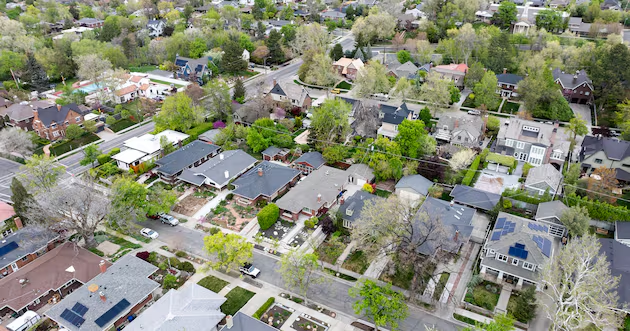
When I was 15, a new family moved into my Millcreek neighborhood and Church of Jesus Christ of Latter-day Saints congregation. Working-class, seven kids. They could barely afford their home, and only because prices were lower in 2005.
Read more Money-making driveways? Here’s how some locals are profiting from the World Cup
One of the sons was my age. He didn’t like to dwell on the future. No one in his family had gone to college. How could someone like him make it?
But, over time, our neighborhood changed what he believed was possible. Our bishop took him under his wing. The neighborhood kids made sure he had a friend to turn to for homework help. Maybe most importantly, he looked at the other guys our age and thought, “If these clowns can succeed, then I can too.”
He was right. A few months ago, he told me that moving into that neighborhood was the best thing to happen to him.
That story’s repeated thousands of times in our state. A family moves in. Maybe they’re starting out, or coming from a house that’s too small or a city with few opportunities. Maybe they’re fleeing a dangerous homeland. They arrive, lonely, perhaps a little scared. After all, they don’t know anyone.
And then Utah springs into action.
Utah has the highest social capital of any state (a fancy way of saying we’re good neighbors), with among the highest rates of, family orientation and voluntarism. When someone moves here, they don’t just get a house. They get a community.
Our congregations and neighborhoods can’t lift up those who can’t afford to live in them.
Utah’s profound neighborliness changes lives. We have the nation’s highest economic mobility, and our children have among the best odds of earning more than their parents. As a result, Utah has some of the nation’s lowest rates of poverty, homelessness and inequality.
Put another way, Utah’s families still live the American dream.
Unfortunately, fewer and fewer families can afford to live here. Housing prices have risen 60% since 2020. Rents have also gotten 17% more expensive, even after declining 10% since their peak in 2022. As a result, families are finding it harder than ever to stay here, and they’re having fewer children.
Read more A Hollywood megamerger could reshape the industry. These states are trying to stop it
All this threatens Utah’s powerful recipe for lifting up our neighbors. Historically, the children of Utah’s working-class families had a real shot because they grew up in economically diverse neighborhoods. Maybe a fellow Boy Scout prepped for the ACT with them. Maybe the doctor next door gave them a passion for medicine. Whatever the specifics, Utah helps those among us who need it most.
But this only works if they’re actually among us. Our congregations and neighborhoods can’t lift up those who can’t afford to live in them. To stay a land of promise, Utah needs ample, affordable housing in its highest-opportunity areas.
Why did Utah’s housing get so expensive? Well (see above), Utah’s a great place. Unsurprisingly, thousands of people have moved here, particularly since the pandemic-era rise of remote work.
But housing’s like a game of musical chairs. When there are more people than homes, everybody has to compete for what’s available. Prices go up, and families get priced out. Only the rich or the lucky can play.
Making sure there are enough homes for every family means building all kinds of housing: starter homes, ADUs, duplexes, condos and apartments. We can do this in Salt Lake City by changing zoning rules to expand housing options. Statewide, we can embrace new detached ADU legislation as a starting point to allow more homes in every municipality.
Building housing isn’t enough on its own. We can do more and ensure rents are affordable. But none of those programs work if there aren’t units to buy or rent. Having enough homes for everyone is the foundation for affordability.
Finally, more than anything, we need to ask ourselves, “Who is our neighbor?” Twenty years ago, a boy moved into the neighborhood, and it changed his life. Today, a family like his can’t afford to live there.
But it’s not too late. Utah can still be the state that changes lives. We can still love our young, working-class and refugee neighbors. All we have to do is once more make our neighborhoods affordable for the families who need to live here most.
Read more Monsoon season has arrived in Utah, bringing much-needed rain and new threats