
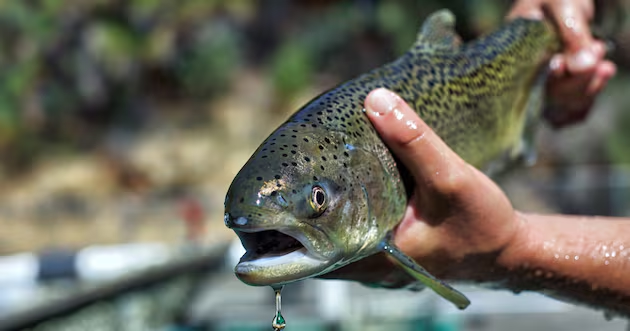
- The Trump administration removed protections for the habitats of endangered species.
- The rule changes the definition of the word “harm” in the Endangered Species Act.
- Several wildlife advocacy organizations filed lawsuits in response to the change.
Last week, the Trump administration finalized a rule that removed federal protections for the habitats of endangered species. Now the “modification or degradation” of an at-risk species’ habitat is no longer illegal, which allows a greater number of uses on formerly protected land.
Read more Republicans unveil new $95 billion spending framework. This is what’s inside
In order to do so, the new rule, which the Department of the Interior and the Department of Commerce finalized on July 10, changes the definition of the word “harm.”
For the majority of the law’s 52-year existence, that word’s scope extended to the habitats of at-risk species. In the case of some larger species with massive ranges, that necessitated the protection of large, potentially economically productive tracts of land.
It is that “misguided” definition, as federal officials called it, that was rescinded.
“For years, federal agencies abused the ESA to obstruct lawful land use and burden American families and businesses,” Interior Secretary Doug Burgum said in a press release.
“That approach turned routine activity into a regulatory trap, drove up costs that impacted people’s lives, and expanded federal authority beyond what Congress intended.”
In response to the new rule, the Western Environmental Law Center and Earthjustice filed lawsuits against the federal government Tuesday. Wildlife advocates and conservation groups argue that protecting a species habitat is integral to its protection.
“This is war on the forests and rivers of the West,” Pete Frost, attorney at the Western Environmental Law Center in Eugene, Oregon, said in a statement.
“No longer protecting where grizzlies, salmon and owls live will make them go extinct. We’re hopeful the court will clarify what the Endangered Species Act has always meant.”
What were the changes?
That single word “harm” represented a foundational principle at the heart of the Endangered Species Act, which extended protections beyond the body of the 1,662 at-risk flora or fauna currently listed to their broader habitats.
In that effort, the law is credited with saving 99% of protected species from extinction — all but four — and preventing that end for at least 291 others.
The far reach of that interpretation of harm, however, was also the cause of much ire for opponents of the law. In 1995, those frustrated with the breadth of its reach took their arguments all the way to the Supreme Court.
In Babbitt v. Sweet Home Chapter of Communities for a Great Oregon, however, the court ruled 6-3 in favor of a definition of “harm” that included habitat.
In a dissenting opinion, however, Justice Antonin Scalia wrote that the law should be interpreted more literally. And, rather than hinge on the scope of “harm,” it should be based on the definition of “take.”
Read more Opinion: 16 ‘almost feral’ children in Ohio show why we need Child Protective Services
“The term ‘take’ means to harass, harm, pursue, hunt, shoot, wound, kill, trap, capture, or collect, or to attempt to engage in any such conduct,” reads the law, signed by Republican President Richard Nixon in 1973.
Rather than haggling over harm, Scalia wrote that the definition of “take” was about whether or not an animal was killed. That interpretation is the basis for the new definition applied by the Trump administration.
In the press release, the Interior wrote that the law’s “core protections remain firmly in place.”
“Actions that directly injure or kill listed wildlife will continue to be prohibited … What ends today is a system that repeatedly punished people for indirect or speculative impacts never contemplated by Congress.”
“We’re returning the ESA to its foundational purpose to ensure legitimate conservation goals are met without sacrificing economic growth and American prosperity,” Commerce Secretary Howard Lutnick said in a statement.
What was the response to this logic?
Conservation and wildlife advocacy groups say they see the change as another instance of the Trump administration reducing the potency of the country’s environmental regulations. As recently as March, the administration carved out an exemption from the endangered species law for offshore oil and gas operators in the Gulf of Mexico.
But in terms of the rule’s rhetoric, opponents say that the new interpretation of the law obfuscates the science that explains why harm extends to habitats.
“The Endangered Species Act has been one of our nation’s most successful conservation laws because it relies on science to determine what threatened and endangered species need to survive and recover,” said Bradley Williams, a deputy legislative director for the Sierra Club.
“These new rules move us in the wrong direction by making it harder to provide protections for imperiled wildlife and by giving greater weight to corporate interests than to the biological needs of species facing extinction.”
Do Americans support the change?
Last year, some 400,000 people submitted public comments opposing rolling back endangered species protections. In national polls, the law is often supported by more than 75% of respondents. In one case, 69% supported extending protection to habitats.
“Destroying or damaging habitats is just as lethal to endangered species as directly hurting them,” Bart Melton, senior wildlife program director for the National Parks Conservation Association, said in a statement.
“This change in how the law is carried out defies common sense, science, and paves the way for mining, oil and gas drilling, logging, and development in areas that are crucial to the survival of some of our most vulnerable species. This rule ignores decades of conservation science and could undermine recovery efforts for more than 600 species, from salmon in Olympic to grizzlies in Yellowstone.”
Read more Social contagion and a ‘solid self’