
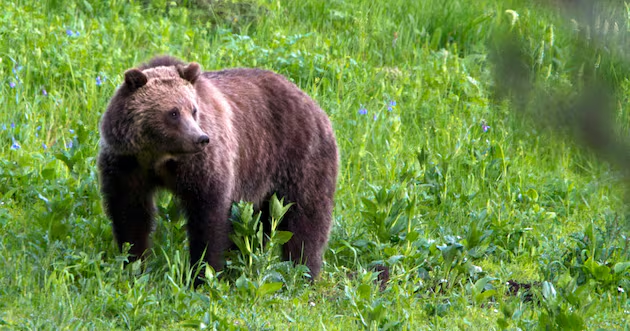
- The Interior proposed allowing Western states to manage their grizzly populations.
- The proposed rule does not remove the bears from the endangered species list.
- Grizzlies have surpasses certain population benchmarks but remain below historic averages.
The Department of the Interior announced a revision to a pending 2025 grizzly management proposal allowing individual states to manage bear populations rather than federal agencies.
Read more O’Leary’s China conspiracy claims spark federal defamation case in Utah
“The science is more than clear: grizzly bears have recovered and far exceeded every federal recovery benchmark,” Interior Secretary Doug Burgum said in a statement.
“Today, Interior is returning conservation leadership to the Western states instead of Washington bureaucrats.”
The change would not necessarily remove the grizzly’s status as “threatened” on the endangered species list, but it would create what the U.S. Fish and Wildlife Service — the agency responsible for enforcing the Endangered Species Act — is calling “flexibility” so that Idaho, Montana and Wyoming can manage them according to their own needs.
Burgum, Wyoming Gov. Mark Gordon, Idaho Gov. Brad Little and Montana Gov. Greg Gianforte made the announcement during a livestream on a very windy Tuesday in Big Sky, Montana.
“Thanks to the work of Montana Fish, Wildlife, and Parks, the U.S. Fish and Wildlife Service, and many Montanans over decades, the grizzly bear recovery story is one of America’s great conservation successes,” said Gianforte at the press conference.
“With this success has come a challenge — bears have expanded into new areas and conflicts have increased with farmers, ranchers, recreationists and residents. Returning management to the states is a welcome change.”
What does the new rule say?
The full text of the revised rule has not yet been published in the Federal Register and will not, the website states, until July 17. However, a 62-page “unpublished” version was uploaded, which might be subject to change.
That document details how, through a “memorandum of understanding,” the U.S. Fish and Wildlife Service will grant states, tribes and other authorized parties specific management responsibilities. Those entities will still be accountable to the federal agencies, but they’ll determine their own management and conservation plans.
A number of prohibitions regarding the “take” — killing — of grizzly bears in the lower 48 remains in place, though the proposal offers states latitude to create broad exemptions they can then implement at their discretion.
With the introduction of the new rule, the Interior opened another 30-day public comment period for this specific change to its 2025 grizzly management proposal.
Reactions to the proposal
Reviews on the proposal are mixed.
Some wildlife advocates and conservation groups applauded the result, while others were unhappy with the news. Those that did not like it suggested the action is just a stop on the way to the bear’s full delisting.
“This is a decision being made for political reasons, it is not based on science, in the best interest of the survival of the species, or in compliance with the requirements of the Endangered Species Act,” Greg LeDonne, Idaho director of Western Watersheds Project, said in a statement.
“It’s clearly too soon to remove federal protections in light of the continued lack of connectivity, ongoing habitat destruction and modification due to climate change, and record numbers of grizzly bear mortalities in 2025 even under existing protections.”
LeDonne added that the state’s various management plans are already well known and that they’ll lead to more grizzlies being killed.
“These states consistently ignore science and ethics, promote misinformation, and enact laws and regulations to permit the killing of carnivores by any means they deem necessary,” he said. “Once delisted and placed under state management, grizzly bears will be subjected to the same persecution and eliminationist goals that these states imposed on wolves after delisting. Not only will recovery and connectivity between populations be impeded, but the survival of grizzly bears in the lower 48 States may be jeopardized.”
Read more Senate grills Trump’s national intelligence nominee ahead of confirmation vote
Those pleased with the news see it as a recognition of a massive effort to help the grizzly bear return to the landscape.
“For 50 years, states and landowners invested in grizzly recovery without any regulatory recognition of what they’d built,” Jonathan Wood, vice president of law and policy at the Property and Environment Research Center, said in a statement. “This proposal changes that and gives them reason to keep going.”
The conservation and hunting club founded by Theodore Roosevelt sees the proposal as good news.
“The Boone and Crockett Club celebrates today’s proposed rule for grizzly bear conservation by the U.S. Fish and Wildlife Service,” the club wrote in its press release.
Citing how low the bear population was in 1975 — a mere 136 — compared to the nearly 2,000 alive today, it called the proposal an “innovative fix.”
Is grizzly bear recovery a success story?
The effort to delist the grizzly has been ongoing for decades with various flare-ups at the legislative or legal level popping up from time to time.
The last big one was in 2017 when the Fish and Wildlife Service attempted to remove the bear from the threatened list. A federal judge in Montana a year later.
Citing both a lack of scientific evidence and an “arbitrary and capricious” application of the threat analysis necessitated by the Endangered Species Act, he told the agency to go back to the drawing board.
Then just a year ago this month, the Wyoming congressional delegation introduced legislation in the House seeking to delist the bear.
At that time, Rep. Harriet Hageman, R-Wyo., told Deseret News that “the grizzly bear was first listed as threatened in 1975, and the recovery goal has been about 500 bears … We exceeded that in 1997. We have exceeded recovery goals for almost three decades.”
In 2019, Christopher Ketcham published “This Land,” where he summarized the longer timeline.
“Put it this way: Grizzlies in 1800 ranged on 740,000 square miles across 16 states west of the 100th meridian,” he wrote. “A century-and-a-half later they had a range of about 37,000 square miles in three states.”
Today, according to the Fish and Wildlife Service, there are at least 1,900 grizzlies in the lower 48 states. About 700 are in the Greater Yellowstone Ecosystem, more than 1,000 in the Northern Continental Divide area of Montana and the rest in Washington and Idaho.
To Fish and Wildlife Service director Brian Nesvik, the population rebounding from such historic lows and existing with humans is a success story.
“Grizzly bear conservation has steadily advanced over the decades in many portions of the species’ range,”Nesvik said. “This proposal recognizes these successes and right-sizes management where the greatest conservation success has taken place. This action would support the administration’s priority of easing regulatory burdens through common sense flexibilities in management.”
Read more Opinion: The blind spot in the talk about Trump Accounts