
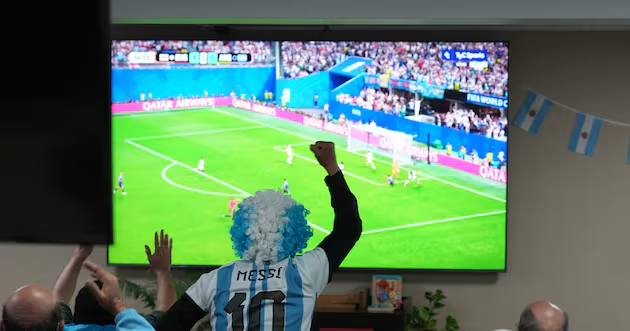
The FIFA World Cup featured its two biggest games of the tournament so far on Tuesday and Wednesday, leaving some fans wondering why games — especially this week’s heartstopping semifinals — were played in the middle of the day instead of primetime slots.
Read more Real Salt Lake founder Dave Checketts returned to Utah with a surprising pitch for fans
“They wanna grow the World Cup and have their semifinals at 2 p.m. on a Wednesday? Makes a lot of sense,” one person posted on X.
They wanna grow the World Cup and have their semifinals at 2 pm on a Wednesday? Makes a lot of sense.
— JM 🐍 🏴☠️ (@TheLoneStarStar) July 15, 2026
It is not completely new for the World Cup to play semifinal games midweek as it seeks to maximize its viewership. The previous two World Cups in Qatar and Russia featured semifinal matinees for fans on the American continents; however, in 1994, semifinal games were in the late afternoon and evening in the middle of the week for East Coast viewers, a much more convenient time for the U.S.
- England knocked Erling Haaland out of the World Cup, but not from the spotlight
- While March Madness expansion draws murmurs, the World Cup may have got it right
- Looking back: Soccer’s rise in U.S. since World Cup’s last visit
- World Cup soccer fans learning realities of U.S. ticketing
Perhaps some felt the host countries would enjoy a friendlier kickoff time again in the World Cup’s first return to the continent in 32 years. Clearly, FIFA had different priorities. One user on X pointed out a key fact — the world does not all live in one time zone.
The entire world doesn’t live in your timezone… j/s
— ContractorKeith (@contractorkeith) July 15, 2026
Still, it is frustrating to some North American fans who fell in love with the sport that the largest global sporting event in the world took place on their home soil and they couldn’t watch two of the biggest games because it was scheduled during a time they had to work.
What FIFA said
Responding to backlash, Manolo Zubiria, the World Cup’s chief tournament officer for the United States, said it was all about finding the middle ground.
Everything was taken into account, from “the weather on site and the time back home in participating teams’ countries, to the recovery and potential travel facing players and fans. We’ve tried to basically strike the right balance,” he said.
“The more people you can bring to this game around the world, the better.”
What did the World Cup semifinal ratings show?
France and Spain averaged 11.462 million U.S. viewers during Tuesday’s match, according to Variety. England and Argentina’s Wednesday match averaged more than 15 million U.S. viewers on Fox, a new record for semifinals English-language telecasts in U.S. history.
The England broadcast on BBC One also recorded an average viewership of 15 million, per Deadline. An average of 20 million in France watched as their country lost to Spain. Among other European nations viewing the matches, the World Cup performed quite well and FIFA should be careful to maintain those viewers.
But given it was a record-breaking semifinal for U.S. viewership during working hours across the country populated with 349 million, there may be an even greater untapped market.
Read more Anne Hathaway calls pregnancy with third child ‘a blessing’
Viewership for the NBA Finals Game 5 easily outperformed England and Argentina’s, climbing to 33 million viewers in the closing moments. And since the World Cup takes place during the slowest part of the U.S. sports calendar, an opportunity for increased viewership seems so obvious.
It begs the question: Is there more FIFA could capitalize on?
An easy fix?
As mentioned, the semifinal start times were not friendly to U.S. viewers, who, in the middle of the day, are working — though many offices elected to televise the games where possible. It appears as a missed opportunity to grow the sport in a market with the ability to pay dividends going forward. However, the market isn’t quite there yet, and FIFA should cater to its much larger European market.
But does the international organization need to choose?
The 3 p.m. EDT kickoff time makes it an 8 p.m. kickoff in England, which is five hours ahead of the East Coast. FIFA could shift games to allow the semifinals matchups to take place on a Saturday and a Sunday and then place the third-place and finals games the following weekend.
Very strange to me that the world cup is scheduling it’s semifinal matches for weekdays.
There were no games last Sunday, now the last two games to decide the championship match are in the middle of the week?
Everything in quarterfinals and after should have been Sat/Sun imo
— Kriss Berg, etc. (@KrissBergTweets) July 15, 2026
I know they’re doing it for global time zones, but having such a big World Cup game on a Wednesday afternoon feels so weird and blah. At least do it on a weekend afternoon and move the Final to the next weekend if you have to
— Mmarsala (@mMarsala46) July 15, 2026
Of course, logistics are a monster when you bring the world together, because it is impossible to appease everyone at once.
But by putting semifinal games on the weekend, kickoff times can be much more flexible, potentially including even more time zones.
This X post catches many Americans’ sentiments toward the current semifinals timing.
With four years of planning time, and a global stage during most quiet time of the North American sports calendar, FIFA decided to play their semifinal matches during the middle of the day on a Tuesday and Wednesday. pic.twitter.com/2kLEAtP7ew
— Scott my cup of tea (@scottinthe503) July 15, 2026
Third-place and finals games
Americans likely will not complain too much about game times this weekend for the third-place and finals matchups, since they take place on a weekend. France and England will face off with each other Saturday at 3 p.m. MDT, while Spain’s attempt to prevent Argentina’s Lionel Messi from securing a consecutive World Cup begins Sunday at 1 p.m. MDT.
Read more What’s happening to mortgage rates as the Iran war escalates