
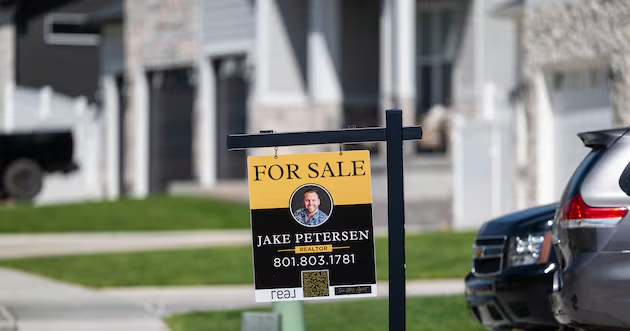
The cost of borrowing money to buy a home is continuing to climb as fighting intensifies in the war launched earlier this year by the U.S. and Israel in Iran.
The weekly average rate for a 30-year fixed-rate mortgage in the U.S. hit 6.55% as of Thursday, according to the Federal Home Loan Mortgage Corporation, better known as Freddie Mac. That’s an increase of 0.06 percentage points from the week ending July 9.
Rates, which had dropped below 6% just before the war began in late February, had been on a downward trend after a preliminary ceasefire deal was signed last month. But this week, strikes by both countries resumed, driving up oil prices and pressuring the U.S. economy.
Mortgage rates, largely based on the interest the U.S. government pays on long-term bonds, shot back up to the wartime high of 6.75% on Monday before falling slightly, according to the daily index posted by Mortgage News Daily.
Prior to the war, the last time mortgage rates reached 6.75% was nearly a year ago. Thursday’s daily index rate on the Mortgage News Daily website was at 6.68%, up 0.04 percentage points from the previous day.
A ‘sense of unease’ among homebuyers
As of Wednesday, the number of mortgage applications nationwide was down 2.7% from a week earlier, according to data from a survey of applications conducted by the Mortgage Bankers Association.
Citing higher mortgage rates, the association’s vice president and deputy chief economist, Joel Kan, said the applications also “dipped below last year’s pace in the week following the July 4th holiday.”
Summer homebuyers are going to have “to recalculate their purchase budgets,” Erika Giovanetti, the consumer lending analyst for U.S. News, said in a Thursday “expert insights” post that cited the “sense of unease” many are feeling.
Read more What’s Defense Secretary Pete Hegseth doing to deep-six low testosterone levels in the ranks?
“With mortgage rates now at their highest levels in about a year, and geopolitical uncertainty bleeding into the economy, prospective buyers may not feel motivated to jump into the market,” Giovanetti said.
“Today’s high mortgage rates are a result of the resurgence of the U.S. war in Iran. The Middle East conflict has led to higher oil prices, fueling inflation throughout the economy,” she said, noting mortgage rates are especially sensitive to price changes.
Are high mortgage rates here to stay?
The result? “The bottom line: mortgage rates will stay high due to the inflationary pressures of the war,” Giovanetti said.
In Utah, the senior vice president of Zions Bank Mortgage, Jeremy Holmgren, told the Deseret News that the latest developments in the Middle East are adding upward pressure to mortgage rates as concerns increase over oil prices and inflation.
“While the long-term direction of rates will still depend on inflation and economic data, borrowers should expect increased day-to-day volatility until the situation becomes clearer,” he said.
Holmgren said for borrowers under contract to buy a home, “this is a good reminder that markets can change quickly, making a rate lock worth discussing.” Homeowners looking to refinance their loans, however, may be more likely at this point to put their plans on hold.
Read more Opinion: What I hope to see in Christopher Nolan’s adaptation of ‘The Odyssey’