
Utah Sen. Mike Lee says mail-in voting should be restricted in future elections despite hailing from a state that was an early adopter of the practice.
Read more Opinion: Utah parents need help protecting kids from predators
In a social media post on Thursday night, Lee wrote that mail-in voting, with exceptions for deployed military personnel or those with physical disabilities, “should not survive much longer.” The post came after President Donald Trump delivered a national address Thursday claiming significant vulnerabilities in past elections, warning those weaknesses could threaten future races.
Mail-in voting—other than for deployed military personnel and others physically cannot vote in person—should not survive much longer.
— Mike Lee (@BasedMikeLee) July 17, 2026
The primetime speech featured a number of allegations that foreign countries such as China and Russia sought to interfere with the 2020 presidential election when Trump lost reelection to Democratic nominee Joe Biden. Trump used the speech to promote passage of the SAVE America Act, the proof-of-citizenship and voter ID bill led by Lee in the Senate.
“President Trump told Americans of two grave dangers to our system of representative government: the machinations of China and other foreign adversaries to compromise American elections, and a conspiracy of silence among our intelligence agencies to keep this information from the President and the public,” Lee told the Deseret News in a statement. “With hundreds of thousands of non-citizens on our voting rolls, it is more vital than ever that Congress pass the SAVE America Act to secure our elections, and that President Trump continue to uproot the unelected deep state.”
Trump has long made the SAVE America Act a fixation in his second term, pressing congressional Republicans for months to make it their top priority. Lee is the original author of the SAVE Act, which has since taken on several forms but primarily focuses on removing noncitizens from voter rolls across the country.
The president has sought to expand that legislation to also ban mail-in voting, with some exceptions, and impose restrictions for transgender individuals. But neither of those provisions have been added to the current version of the SAVE America Act awaiting a vote in the Senate — especially as some Republicans reject any effort to curtail mail-in ballots.
Utah’s junior Sen. John Curtis, for example, has previously expressed hesitation with supporting a version of the SAVE America Act that includes those restrictions.
“I always try to get to a yes, but I’m really struggling because it does fly directly in the face of the way Utah does things,” Curtis told the Deseret News in March. “I think at some point there is a place for some national involvement. But this gets pretty close to telling states what they can and can’t do.”
While the most recent iteration of SAVE does not outright ban mail-in ballots, it does include provisions to no longer permit election officials to automatically send ballots to individuals on the voter rolls and instead require them to opt in. Those voters must then also prove their citizenship through some form of documentation.
Read more Andy Burnham to become prime minister of United Kingdom
Utah approved a similar law to require voters to opt in for mail-in ballots every eight years and verify their citizenship status, although that won’t take effect until 2029.
Utah mail-in voting system experiences changes as Trump calls for its elimination
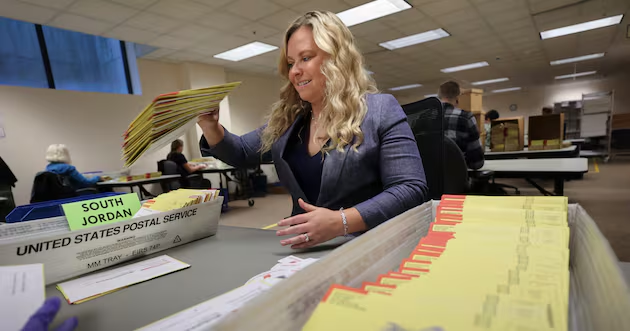
Although Utah was an early adopter of the vote-by-mail system, the Beehive State has implemented some changes of its own to make the process more secure.
Many of those reforms were prompted by the 2024 GOP primary in the 2nd Congressional District, which ended in a recount that may have been decided by ballots that were not counted because of a late postmark or incorrect signature.
For example, legislators decided ballots will only be counted if they are in a dropbox or the clerk’s office by 8 p.m. on election night. Previously, ballots could be counted up to two weeks later, if they were postmarked by Election Day.
Another change the Legislature approved in response to the 2nd District debacle is an additional method of voter identification to reduce reliance on county clerks comparing signature affidavits to those on record, which is subject to human error.
Starting this year, ballots include an option to enter four digits of a Social Security number or driver’s license. A majority of voters already complete both measures even though it is not required until 2029, according to local election officials.
Even with those changes, Trump has targeted Utah for its mail-in ballot practices — questioning why a heavily red state would subject themselves to what he believes is a faulty system.
“We should stop Utah from doing this. All Mail In Ballots, dishonestly handled, are a big advantage for Dumocrats, whose only Road to Victory, because their Policies are so insane, is CHEATING,” Trump said in a June Truth Social post, containing a political nickname the president has assigned to the Democratic Party.
Lt. Gov. Deidre Henderson responded to those allegations with a statement shortly after defending Utah’s unique status as a Republican supermajority state with mail-in voting, which she said is the preferred method for most Utah voters.
Read more Stephen King calls out Utah: ‘What’s wrong with these people?’