
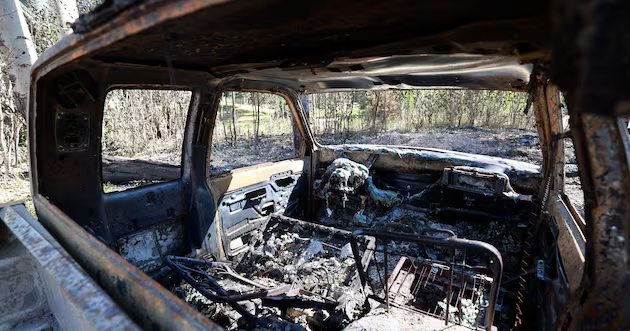
- Flooding devastated Beaver County in west-central Utah after heavy monsoon rains fell on land recently burned by the 97,000-acre Cottonwood Fire, damaging homes, water systems and roads.
- Forest Service Chief Tom Schultz said decades of forest overgrowth and declining health have fueled larger, hotter and more expensive wildfires across the West.
- Lengthy environmental reviews and litigation have slowed forest management efforts, preventing the agency from reducing wildfire risks more quickly.
Following a smoky June and early July, the second stage of the West’s wildfire season has begun, with monsoon season bringing catastrophic floods.
Read more How Arizona’s swing-state chaos will shape Congress
On Sunday afternoon, rain started falling in Beaver County in southwest-central Utah, where the Cottonwood Fire recently charred more than 97,000 acres — around 150 square miles.
Anticipating flooding, Beaver Mayor Matt Robinson checked on the live video feed taken from cameras in the Tushar Mountains. “It was unbelievable,” he told the Deseret News. “I tuned in to the camera that was furthest up the canyon and watched a 15- or 20-foot concrete structure get overtaken and wiped out.”
The floods came down through Beaver City, washed out a portion of one neighborhood’s culinary water system, impacted more than 200 homes and overtook a section of I-15.
Between 0.5 to 1.5 inches of rain fell on the mountains in about 45 minutes, then a wave of water rushed down toward the city.
Beaver City officials issued a notice on Sunday evening to not drink tap water over concerns it had been contaminated. “We’ve been encouraging our community for three-plus weeks now to get a supply of drinking water, and I think most everybody did,” Robinson said.
Meanwhile, the Cottonwood Fire is still not entirely contained. Robinson estimated that about 300 firefighters are still stationed in the area to put out the remaining 10%.
“Wildfire will come to much of the West, and by us not doing anything, there will be an impact.”
— Forest Service Chief Tom Schultz
And Beaver is not alone in its wildfire experience this summer.
Across the West, national forests are facing the same problem: litigation and regulatory processes have caused a buildup of decay, which is causing bigger, hotter and more expensive burns.
In a conversation with the Deseret News on Friday, U.S. Forest Service Chief Tom Schultz said the problem has cascading effects.
Burns cause floods, and floods cause mass destruction.
“What’s going to happen when it rains? That water is going to erode those soils, which will create flooding that will impact the watershed. It will impact fish, wildlife and water systems,” he said. “Wildfire will come to much of the West, and by us not doing anything, there will be an impact.”
American forests have been declining for decades
Schultz explained a series of hurdles his agency runs up against in managing the nation’s 193 million acres of Forest Service land.
While every year has been a little bit different over the past three decades, “the general trend is that we are having more expensive fires, hotter fires and more acres burned,” Schultz said.
As of Monday, about 40,700 fires have burned 3.9 million acres across the U.S., more than 6,000 square miles.
“We knew back in January or February based on snowpack levels that things were going to be outside the normal range of what we expect in fire seasons,” Schultz said.
To prepare the states for the impending fires this summer, Schultz spoke to Congress on several occasions about what to expect and how to gear up.
The issue has worsened persistently since the 1990s.
In many areas across the nation, forests’ vegetation density is double what it’s been historically, and in some areas like California’s Sierra Nevadas, densities are five to six times higher.
“We’ve got substantially more vegetation today than we had in many areas a hundred years ago,” Schultz said.
Without management, insect and disease activity increases, and soil conditions get worse.
“A healthy forest will grow at somewhere between 5% to 7% a year,” Schultz said. But, he said, many national forests in the West have higher mortality rates than growth rates.
What is causing the forests to deteriorate?
In the past ten years, the Forest Service has relied on mechanical thinning, prescribed burns and timber sales to reduce the amount of vegetation and protect both people and forests.
Read more Trump signs order to tighten defense supply chains
However, to implement any of these treatments, local residents and land managers must go through environmental review processes dictated by the National Environmental Policy Act.
“There are folks that, I would argue, in some cases have used the processes to thwart projects.”
— Forest Service Chief Tom Schultz
NEPA requires the Forest Service to assign someone — typically a district ranger, forest supervisor or regional forester — to approve the project.
Then a specialized team is put together. Depending on what’s proposed, the team could include biologists, hydrologists, foresters, and archaeologists. Then an interdisciplinary team identifies the project, objectives and alternatives. People are assigned to do on-the-ground analysis, while others could be assigned to do computer modeling or look at watershed and wildlife impacts.
Once everyone has done their research, the team comes back together and creates alternative plans, while they take public comment. After all of this, the decision maker will approve or deny the project before it moves forward.
The process is required whether the proposal covers 50 acres or 1 million acres; it is not uncommon for environmental review processes to take three to four years.
“There are folks that, I would argue, in some cases have used the processes to thwart projects,” Schultz said.
However, the current presidential administration is trying to speed the process up. USDA Secretary Brooke Rollins asked the agency to make sure environmental assessments are completed within 12 months if the project is simple, and within two years if it’s more complex.
Rollins has also approved the decision to move Forest Service headquarters to Salt Lake City, Utah. The decision, she said, will put “operation leaders closer to the landscapes we manage and the people who depend on them.”
Upon the announcement, Schultz said the move will make his agency more “nimble, efficient (and) effective.”
Litigation makes the process even harder
About 1 billion board-feet of timber are currently under some form of litigation in the U.S., Schultz told the Deseret News.
That’s a third of the work the Forest Service does in a year.
It’s enough lumber to build about 66,600 single-family homes. If the amount of litigated timber were milled into 1-foot-wide planks, each 1 inch thick, it would be enough to wrap around the Earth’s equator more than 7.5 times.
Environmental groups regularly sue the Forest Service for how it manages federal land. The three most frequently litigated project types are timber sales, fuel management (thinning and prescribed burns) and general vegetation management.
Those who oppose forest management have expressed concerns that large-scale mechanical thinning emits carbon and “contribut(es) to global emissions that then feedback on more climate-change related insect outbreaks and wildfires, wrote Dominick DellaSala, the chief scientist at the environmental nonprofit Wild Heritage.
Litigation against the Forest Service is overwhelmingly concentrated in the West, specifically in Montana, northern Idaho and North Dakota.
Lawsuits pose a wide variety of costs to the agency.
One study published to the Montana Business Quarterly in 2021 concluded that “even when a project is not directly enjoined by a lawsuit, the work associated with responding to litigation is significant and takes personnel away from their planned program of work, representing additional opportunity costs to the agency.”
To cushion the expected litigation, the Forest Service “does a lot more environmental review than is probably necessary,” Schultz said.
“If we could do anything to streamline and limit some of the litigation, that would be helpful,” he added.
Schultz then referenced Utah Sen. John Curtis’ Fix Our Forests Act, which passed the House of Representatives 279-141 and now waits for a vote in the Senate. He said he believed the bill would help address the issue of litigation.
Read more Sen. Curtis says ‘it’s time for Congress to act’ after 2 servicemembers killed in Iran