
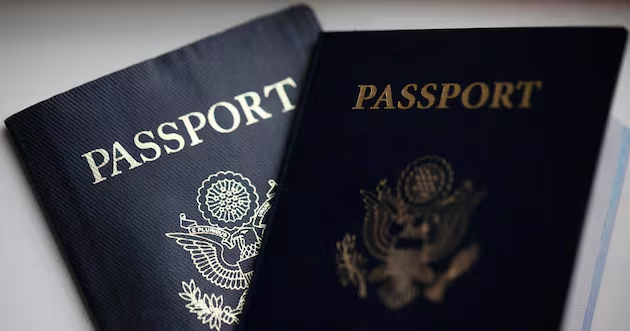
- The U.S. passport, once ranked first in the world for visa-free travel, is now ranked behind 37 countries.
- Singapore passports received the best rankings, with visa-free travel allowed to 192 countries.
- Mobility is increasing worldwide, but varying rates of growth are causing disparity between nations.
- Global mobility power is shifting from “traditional transatlantic leaders” to Eastern nations.
- Experts say passport power could be representative of peacefulness and prosperity.
Twenty years ago, the U.S. passport was a golden ticket to world travel, offering its owner visa-free access to more countries than any other passport in the world.
Read more Utah selected as potential site for nuclear fuel recycling campus
Today, the U.S. passport is no longer at the top of that list, according to the Henley Passport Index, a ranking that measures the travel freedom of passports across the globe by counting how many destinations a passport holder can access without applying for a visa.
The report shows the U.S. is falling behind in global travel, and the effects could appear far beyond just travel documents.
A look at where the U.S. passport stands
According to the July report, the U.S. is in 10th place when ranking the countries with the most visa-free travel, but because several countries can occupy one ranking at the same time, the 10th place ranking actually sits the U.S. behind 37 other countries.
As of July 2026, the U.S. passport allows a holder to visit 180 destinations without the hassle of a visa, which is a dozen fewer than the 192 countries allowed by a Singapore passport, which sits at the top of the list.
The number of countries a U.S. passport allows visa-free access to has increased since 2016, when it allowed visa-free travel to 174 countries, but the U.S. is falling behind other countries expanding their travel access at a greater pace.
Mobility is increasing worldwide
The Henley Passport Index shows that overall, global mobility is increasing. Henley & Partners reports that every country except for Bolivia reported a net gain in the number of countries with visa-free access.
In 2006, 26 countries were listed as part of the top 10 because of ties. In 2026, these slots are home to 38 countries, meaning more countries are gaining more access.
But even as a majority of countries expand their access, growth is far from evenly spread between countries, which widens the gap between the most and least mobile citizens.
“This reflects a broader trend: passport power has expanded globally, but relative advantage has become harder to maintain,” Henley & Partners said in a press release.
This is particularly apparent when looking at the U.S. and the U.K. These nations, once “the world’s mobility elite,” have both fallen from top-tiered slots, marking “a longer-term shift in mobility power away from the traditional transatlantic leaders.”
Asia, on the other hand, is becoming “far more prominent at the top of the index.”
The United Arab Emirates passport has taken the greatest leap of any country, climbing three places since January to join Japan and South Korea in a tie for second place, each providing smooth travel to 188 countries.
Read more Historic ‘fire clouds’ escalate wildfire epidemic in Spain and France
Henley & Partners notes that the UAE has added 153 visa-free destinations in the last two decades, marking the “greatest improvement of any passport in the index’s history.”
The United States has added 50 new destinations in the same period of time.
Passport power could be linked to peacefulness and prosperity, experts say
Henley & Partners reports that a comparison of their index and the , developed by the Institute for Economics and Peace, an Australian-based think tank, shows “a strong positive relationship between peacefulness and passport power.”
Many countries, including Singapore, Japan, Switzerland, Ireland, Finland, Denmark, New Zealand and Canada, are highly ranked on both indexes.
The comparison proves true on the other end as well, with Afghanistan, Syria and Yemen among the nations with both the weakest passports and the lowest peace ratings.
Despite this strong correlation, the report acknowledges several countries proving an exception to this rule, the U.S. and Israel among them.
The U.S. is in the bottom fifth of the GPI rankings and Israel is ranked in the bottom five, but both have powerful passports. Other countries outside this pattern include Ukraine, France, South Korea, the UAE, Brazil, Mexico and Russia.
These exceptions prove that “while peace provides the foundation for international mobility, diplomacy, geopolitical influence, economic strength, and regional integration can all have an even greater impact,” Henley & Partners said in a release.
Christian H. Kaelin, chairman of Henley & Partners and creator of the Henley Passport Index, said passport power is also linked to economic prosperity.
“The world’s strongest passports belong to nations that other countries want as partners — for trade, investment, security, or cooperation,” Kaelin said in a press release. “Mobility is ultimately a measure of the value other countries place on their relationship with you.”
An increase in mobility reflects growing ‘freedom to choose’
In addition to reflecting on global peace and prosperity, the findings give insight on a global shift in how nations and families view mobility, Kaelin said.
“In an increasingly uncertain world, the greatest privilege is no longer simply the freedom to travel,” he said. “It is the freedom to choose, to have access rights.”
Read more SpaceX stock plunges. Is Elon Musk still the richest person in the world?
The Henley Passport Index top 3 rankings:
- Singapore (192 countries)
- Japan, South Korea, United Arab Emirates (188 countries)
- Sweden (187 countries)
The Henley Passport Index bottom 3 rankings:
- Afghanistan (22 countries)
- Syria (25 countries)
- Iraq (28 countries)