
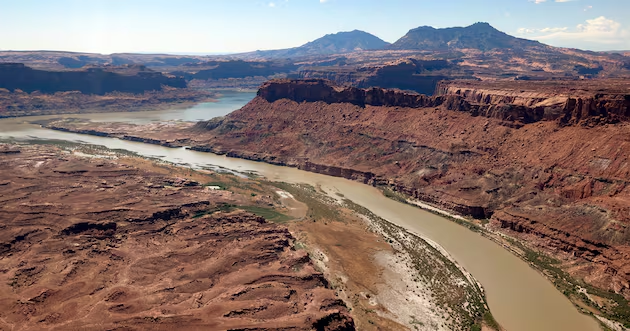
- The Interior Department released a preferred Colorado River management framework that would impose new guidelines for who foregoes water in dry years.
- The plan would require the Lower Basin states to potentially cut up to 3 million acre-feet of water while allowing the Upper Basin to contribute up to 200,000 acre-feet through voluntary conservation.
- Utah officials praised the framework’s focus on hydrology over demand.
The federal government is stepping in to try to resolve a two-year stalemate over how to make cuts to the amount of water used from the Colorado river.
Read more Sister Jolene Clayson Pace, widow of Elder Glenn L. Pace, dies at age 83
The Interior Department released a report on Friday, describing a preferred management plan for the Colorado River.
Current low-water guidelines expire Oct. 1, and Colorado River basin states have been unable to come to an agreement about how much they’ll cut during bad water years.
The Upper Basin states include Utah, Colorado, New Mexico and Wyoming, and the Lower Basin states are Arizona, California and Nevada.
In the likely case that basin states are still locked in a stalemate when the deadline comes, the Interior Department will impose guidelines.
Speaking to the press about the proposed plan on Friday afternoon, Utah River Commissioner Gene Shawcroft said the framework is a “bridge not a destination.”
However, he praised the Interior’s plan for being driven by hydrology instead of demand. The 2007 guidelines were driven by demand, and Shawcroft said they consequently “allowed Lake Powell, Lake Mead, Flaming Gorge and potentially others to be drained.”
Between 2020 and 2024, Colorado River basin states consumed 13.1 million acre-feet of water.
The amount was not split evenly between the Upper Basin and the Lower Basin. On average, the Lower Basin used 3.8 million acre-feet (29% of total use), and the Lower Basin used 6.5 million acre-feet (49%). Mexico and evaporation took up the remaining 2.8 million acre-feet (22%).
What is the Interior’s proposed Colorado River framework?
In accordance with how much water the West receives, the Interior will re-issue specific guidelines every two years until the basin states can reach an agreement.
Amy Haas, the executive director of Utah’s Colorado River Authority, told press on Friday that she hadn’t yet received a two-year operations plan from the Interior, but she expected to get it in the next couple of days.
From the general 10-year plan, Lower Basin states — California, Nevada and Arizona — could be required to cut up to 3 million acre-feet of water (978 billion gallons).
When asked whether Utah and its fellow Upper Basin states would be required to take cuts, Shawcroft said, “We get cuts from Mother Nature every year.”
Read more 6 months, a $1.2 million reward and still no Nancy Guthrie
“I believe the department has recognized that the only water that could be cut is pre-compact water, which there isn’t the ability to cut pre-compact,” he continued. “So cuts exist, but they exist because the water just simply isn’t there for the Upper Basin.”
However, the Interior’s plan added that the Upper Basin could give 200,000 acre-feet of water conservation voluntarily.
“What we’ve tried to do is demonstrate that we are anxious to be part of the solution,” Shawcroft said in reference to the Upper Basin’s voluntary conservation. “The expectation is to have an amount of 200,000 over three to five years.”
The Interior also lowered Lake Powell’s minimum dry-year release by 1 million acre-feet. With the proposed plan, Lake Powell may be required to release between 5 million acre-feet and 12 million acre-feet annually.
The plan also allows 8 million acre-feet of conserved water to be stored in Lake Powell and 3 million acre-feet of water to be stored in Lake Mead.
First in time, first in right
Water law follows seniority. California’s big farming districts hold some of the oldest and most senior water rights on the entire river.
Nobody, not even the federal government, can force California to accept cuts it doesn’t legally owe.
Arizona, meanwhile, absorbs the brunt of water cuts, since most of its settlers came to the area later.
In previous guidelines, Arizona has been responsible for 80% of reductions, Mexico for 16.67%, Nevada for 3.33% and California for 0%.
If the Interior’s proposed framework is implemented, Arizona may see its biggest water cut in the state’s history.
Brenda Burman, the general manager Arizona’s 336-mile diversion canal, said the state is “not in an ideal space” with the looming water reductions.
Read more High school football: 4A champion Ridgeline is favorite to repeat as Region 11 champ