
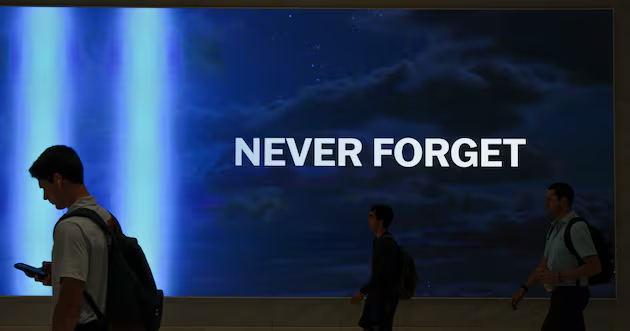
- American Muslims can move beyond viewing 9/11 solely through the lens of post-attack surveillance or prejudice, acknowledging the attack as a defining piece of national grief and sacred memory.
- Just as Latter-day Saints and American Jews navigated suspicion to prove their loyalty and integrate into the national story, Muslims can take steps to make their faith and civic commitments legible to their neighbors.
- American Muslim institutions can better prioritize their local civic covenant in the U.S. rather than centering foreign territorial disputes as the core defining feature of their identity.
- As part of this, mosques and community members should consistently attend annual local 9/11 commemorations and honor fallen Muslim first responders and service members as an essential part of our own shared American history.
This month the nation marked the 25th anniversary of the Sept. 11 attacks in the same year the United States celebrates 250 years of independence.
Read more Why Gov. Cox is pushing voluntary service for America’s young people
As a Muslim, I believe the two anniversaries belong together. Few events since the Civil War have shaped how Americans understand sacrifice, service and belonging as deeply as that Tuesday morning in 2001. And few American communities have misunderstood that fact as consistently as my own.
Every nation keeps sacred days. Gettysburg became hallowed ground because Lincoln taught Americans to see its dead as the price of a “new birth of freedom.” Sept. 11 has become something similar and in one respect larger. Steel from the fallen towers was sent to communities across the country and around the world. It stands today in firehouses, police stations, military bases, schools and town squares.
Universals that transcend specific harms
In Slidell, Louisiana, where I preach, steel from the World Trade Center anchors a local memorial. Each year firefighters and police officers gather at these relics to read names, ring bells and renew a promise. For a country transformed by immigration since 1965 and divided by politics, this is one of the few rituals still shared across party, region and faith. Sociologists call it American civil religion.
Many American Muslims I know have not grasped this. Much of our community’s leadership, and much of the academic work on Muslims in America, treats 9/11 almost entirely as the beginning of surveillance, profiling and racialization.
Those harms were real. But in that telling, the attack itself nearly disappears, and nearly 3,000 murdered Americans become a prelude to our own grievance. When our neighbors see that, they conclude, not unreasonably, that we do not mourn what they mourn.
A nation that keeps improving
That frame also misses something worth crediting. After Pearl Harbor, the United States forced roughly 120,000 people of Japanese ancestry, most of them citizens, into camps. After 9/11, despite genuine abuses, nothing on that scale happened.
Instead, a president visited a mosque within days and insisted that Islam was not the enemy. That is evidence of a nation that learned from its past, and Muslims should say so.
Seeing who we really are
Honesty requires more. The hijackers lived in the United States and moved through our communities as if they were ordinary Muslims. In the years since, self-described Muslims have attacked American soldiers and Jewish congregations.
Americans of other backgrounds commit terrible violence too. Yet a minority community carries a heavier burden to make itself understood. That is not fair, but it is true, and wishing otherwise will not change surveys in which Muslims rank near the bottom of American religious groups in public warmth and favorable perceptions, especially among Republicans and religious conservatives.
The old question, “Why don’t Muslims condemn terrorism?” was always partly misplaced; many did, loudly. The deeper question was how American Muslims differ from the men who flew the planes, and whether our values are legible to neighbors formed by a different religious civilization.
Overly defined by overseas concerns
Too often our institutions answered this question by pointing abroad. Many of the national organizations built in the 1970s, ’80s and ’90s were shaped by activists from the Arab world who made the Israeli-Palestinian conflict the defining cause of American Muslim identity.
Read more The Senate just passed a massive overhaul of college sports. Here’s what happens next
Concern for Palestinians is legitimate. But placing a foreign territorial dispute at the center of an American religious identity has little precedent in Islamic tradition, and it has left many fellow citizens wondering where our loyalties lie.
A common challenge among minority faiths
Readers of these pages know this story from the other side. Latter-day Saints were once driven from Missouri under an order of extermination and were regarded for generations as a people whose loyalty to the republic was in doubt. Over time they made their faith legible to their neighbors without surrendering it.
American Jews did something similar, helping to build the idea of a Judeo-Christian heritage that placed them inside the American story rather than outside it.
It is fitting that in 2015, amid calls to bar Muslims from entering the country, The Church of Jesus Christ of Latter-day Saints recalled Joseph Smith’s 1841 Nauvoo ordinance, which extended religious liberty to “Mohammedans” alongside Catholics, Methodists, Quakers and others.
Helping fellow Americans see our hearts
So what should American Muslims do? First, remember our own. Muslims died in the towers, and Muslims ran toward them. Mohammad Salman Hamdani, a 23-year-old paramedic trainee and NYPD cadet, rushed to the World Trade Center that morning and died there.
Army Cpl. Kareem Rashad Sultan Khan, killed in Iraq in 2007, rests in Arlington National Cemetery beneath a headstone bearing a crescent. Muslims have served this country in uniform since the Revolutionary War.
These are not talking points. They are our family history, and they belong in American memory.
Second, show up. Mosques should be present at local 9/11 ceremonies every year, not to explain themselves but to stand beside firefighters and families as fellow mourners.
Third, draw a clear line between the American Muslim community and the politics of the wider Islamic world. We are not a diaspora awaiting instructions from abroad. We are Americans whose faith commands us to honor our covenants, including the broader civic covenant we share with the neighbors among whom we live.
Twenty-five years on, the question is not whether 9/11 will shape American identity. It already has. The question is whether American Muslims will stand inside that memory or outside it. As the country has turned 250 and continues to argue over who counts as fully American, we should choose to stand inside it, beside the steel.
Read more He used to perform, but life got in the way. Then his wife signed him up for ‘The Voice’