
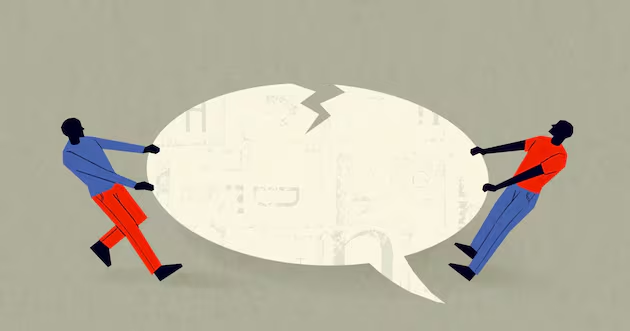
Gloria Steinem didn’t filter her opinions. The famed feminist who said “a woman needs a man like a fish needs a bicycle” was, at the very least, honest. Which is why it’s odd she chose to appear on the Netflix series “Famous Last Words,” which records interviews with celebrities that get released after their deaths.
Read more A year after the Grand Blanc church shooting, survivors cling to faith as memory haunts them
In her interview, Steinem said things like she wants to “perpetuate what we hope is a global democracy” and that “the most important thing we can do for each other (is) to know each other through stories.” Finally, she advised people to “do what you love — (and) to be, also, the unique person you are.”
Did she really have to wait until she was dead to convey those banal sentiments? Probably not. But there are definitely other folks out there who are keeping their cards close to their vests, not telling anyone what they really think. I’d like to nominate some of them for “Famous Last Words.”
It’s true that, in keeping quiet about certain subjects, some people are just being polite. No, you don’t have to tell us what you really think of your mother-in-law. Even after you’re dead, we probably don’t care. And there are some who are concerned about losing their jobs. No need to insult your boss.
The people I’d really like to hear from, though, are those with considerable amounts of job security and power who nevertheless keep their mouths shut about what they really think. Last year, for instance, I received a call from the leader of a large foundation. We chatted about why conversations about child welfare seemed so unproductive. “You know,” she said, “between you and me, maybe we overemphasized the importance of ‘lived experience.’”
“Really?” I replied, somewhat dumbfounded.
Having sat through innumerable meetings where one participant’s main qualification was that he or she had spent time in foster care — and who took any mention of data or research that didn’t exactly mirror his or her own experience as a personal attack — I couldn’t have agreed more. But if you try to discount “lived experience” publicly, or suggest that one person’s story should not be weighed in the same way as population-level data, then you’ll be attacked as insensitive, or more likely, a racist.
Of course, it was at least conceivable that this philanthropic leader could be fired for speaking her mind. The same is not true for all the tenured university faculty who refuse to say what they really think.
One argument for tenure has always been that it allows professors to pursue the truth in research and teaching and to go against the grain of public opinion without fear that they will lose their jobs. But universities have become hubs of groupthink. It turns out that even if they can say what they want without getting fired, most faculty still don’t want to become social pariahs.
Just look at the recent spate of reports that have come from Cornell, Yale and Harvard. These reports acknowledge that there has been a decline in the public’s trust of higher education, that maybe there is not enough free speech on campus, and that it’s not helpful for the university administration to issue political statements. If you had asked Ivy League faculty about these issues in 2020, the answer would have been much different. The fevered pitch of DEI ideology would have ensured the silence of any dissenters.
In a recent column in The New York Times, Carlos Lozada asks people who have acknowledged that “Woke 1 was crazy” exactly how they arrived at Woke 2.
“Before that time goes farther down the memory hole, discarded as just one of so many vibe shifts,” he asks the “formerly woke”: “If you can dismiss it so casually now — all the defunding and abolishing, the BIPOCing and Latinxing, the canceling and decentering and my truthing — how much of it did you truly believe at the time? How much was conviction, how much was a pose, how much was groupthink, how much was fear?”
Almost none of it was conviction, of course. Everything was virtue signaling and fear of being on the outs with their cohort. And the elites, the people with the most power and money and security, were among the worst offenders. They could have stopped the ride or at least stuck their foot out to slow it down anytime they wanted. But they chose not to. If you want to know what these folks really think, you have to wait until the fever breaks. Or until they’re dead.
Read more Opinion: American Muslims belong inside the nation’s shared 9/11 grief