
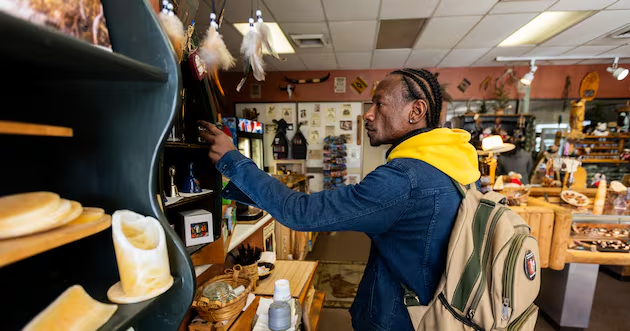
“It seems like there is a souvenir shop on every corner and a gift shop at the end of every museum,” Gary Corino complained to me as we left the Folk Museum in Oslo, Norway. “Why is there so much kitsch at every tourist spot?”
Read more Pope Leo weighed in on the death penalty. Not everyone liked what he had to say
“I guess it’s like the old saying — one person’s treasure is another person’s trash,” I replied. “If people didn’t buy certain souvenirs, then vendors wouldn’t carry so many of them.”
Testing this theory, I decided to ask shop owners and street vendors at popular tourist sites that I visited how they decided what customers wanted to buy and what type of souvenirs were the most popular.
“At the end of the day, people don’t buy because of some deep philosophical reason,” one vendor named Mohammed told me. “They just want proof they’ve been to a distant place and use it to recall memories about it.”
While on that cruise, I casually asked dozens of passengers what type of souvenirs they bought to see if I could validate Mohammed’s perspective. As it turned out, he was mostly right.
“Since retiring, I’ve started a new hobby finding unusual rocks wherever we travel and then using them to make jewelry,” Scott Hess told me. “Mostly, we keep it for ourselves as reminders of places we’ve been and things we’ve seen.”
A piece of rock or physical fragments like shells are inexpensive and sometimes personal reminders of a certain place. For centuries, tourists took chunks of Stonehenge home with them as souvenirs. In the 19th century, visitors were even handed chisels to help them extract a piece of the ancient monument.
Other popular types of souvenirs are branded spoons, stickers or T-shirts, as well as other types of mass-produced “markers” such as miniature Eiffel Towers or New York snow globes with tiny replicas of the Statue of Liberty encased inside.
These souvenirs are “symbolic shorthand,” Beverly Gates notes in her seminal study of souvenir-buying behavior. They silently proclaim that “We’ve been there, done that.”
“We like to get refrigerator magnets from each place we visit,” Tom and Nancy Benham told me. “Not only are they easy reminders of where we’ve been, but also when friends come to our house, they are easy to notice and become the start of conversations about what we’ve liked about a particular place.”
Read more High school girls soccer: 5A state tournament first-round previews
Stickers and spoons are also popular among many cruise passengers I’ve spoken with. “I like to put stickers from places that I’ve visited on my luggage,” Betty Smith told me. “It not only becomes a way to have a conversation at airports and cruise terminals but also makes it easier to find my bags.”
While kitsch to some people, spoons are practically universal at most tourist sites. However, their entrance into the souvenir market is relatively recent. They were first mass-produced for the World’s Columbian Exposition in 1893, which was attended by nearly 28 million visitors to Chicago.
Tens of thousands of commemorative spoons were sold there after the “spoon craze” was vigorously promoted by American jewelry and silversmith companies through subscription options in magazines like the Ladies’ Home Journal and newspapers from coast to coast. This fad continues at gift shops around the world today.
While types and uses of souvenirs can vary widely, Greg and Elain Witt, owners of the Provo-based Alpenwild travel and tour company, encourage clients to select souvenirs that are either consumable or practical: something you can eat or something you can use. Travel experiences include “tasting” places you are visiting, as well as using purchases in everyday life.
We tried to follow that advice on a recent Scandinavian trip by eating cardamom buns at every city or town we visited so we could make our own taste comparisons. (For what it’s worth, hagabullen buns in Gothenburg, Sweden, were by far the biggest and maybe the best; but there are so many good ones everywhere, it’s hard to pick just one.)
We also thought we’d buy Danish dough hooks or whisks while in Denmark for our children since it would be both practical and memorable. But after scouring kitchen appliance stores in both Copenhagen and Skagen, not only could we not find one, but neither could we find a store clerk who had ever heard of it.
While these dough hooks or whisks were traditionally made in Denmark to mix bread or meat pies, they are no longer produced and rarely sold there. Now, they are made either in China or Poland and best found on Amazon.
So much for that Danish tradition.
Souvenirs can serve as physical reminders for our travel experiences, translating intangible moments of discovery into tangible reminders of a place or an event. They are evidence that we have stepped outside our day-to-day lives and experienced something new and different.
However, this impulse can turn genuine experiences into mere consumption, reducing vibrant experiences into commercial foraging. The more we as travelers balance the urge to possess a place with letting the journey change who we are, the more traveling will enable us to have truly lasting memories.
Read more Opinion: Watching an execution can bring long-lasting consequences